



Ireland
Is the glass half full or half empty? That is the question facing those who debate, and will sup from, the future of the Irish fishing industry. Pieter Tesch reports. – According to Irish Fisheries’ Minister “Pat the Cope” Gallagher, the glass is full to the brim. But some industry leaders fear that the minister’s own, new, sea-fisheries legislation will undo what has been achieved over recent decades when it is added to the decisions of all EU ministers at their December 2005 fisheries’ Council meeting.
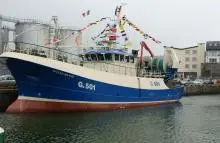
No one familiar with the state of the Irish fishing industry since the country joined the then EEC in the 1970s can deny the great strides the sector has made since. Progress was even more pronounced in the 1990s. With government support, the Irish fishing industry has become the envy of its neighbours, especially Scotland and the southwest of England.
Padraig Gordon, fleet development executive of Bord Iascaigh Mhara (BIM — Irish Sea Fisheries Board) declined to be drawn into the arguments between the minister and the industry. He only pointed out that, up to the early nineties, the Irish fleet was based on 19-metre, wooden-hulled vessels which could only make day trips. Today the majority of the fleet is modern and can put to sea for up to seven days in the whitefish sector and up to 15 days or longer in the pelagic sector.
Gordon says three new whitefish boats are under construction (without any grants) and BIM knows of plans for at least three other vessels.
While industry leaders do not deny the improvements, they would also argue that it was the industry, rather than the government, which was responsible for progress. Lorcan O’Cinneide, chief executive of the Irish Fisheries Producers Organisation (IFPO), is among those who argue that the minister’s new sea-fisheries’legislation threatens to turn the country’s fishermen into “criminal classes”, with him saying that small misdemeanours in the fisheries sector will face heavier penalties than those imposed on drug trafficking.
He says he fears that the proposed legislation, if passed, would undermine what has been achieved regarding the management of stocks. The industry and its supporters in the Irish Parliament are mounting a vigorous campaign against the bill.
Mr O’Cinneide was also disappointed with the apparent lack of influence which the newly formed North Western Waters Regional Advisory Council (NWWRAC – it covers the Atlantic seaboard from Scotland to the English Channel) had on the decisions of the December EU Council meeting.
However, he and others welcomed the Council decision to ban deepwater gillnets off the Irish west cost in waters of more than 200 metres in order to conserve whitefish stocks. The Irish are still bitter about the loss of their tuna, driftnet fishing due to the influence of the Spanish fishing industry.
Whitefish & shellfish
The €45 million whitefish and shellfish (mainly scallop) decommissioning scheme was the last phase of the overhaul and modernisation of the Irish whitefish fleet, according to Mr Gordon.
It followed the two successful €116m whitefish renewal schemes which started in 1998 and run to the end of this
year. Under those, 62 new vessels were delivered, in addition to the introduction of 17 modern, secondhand boats, 77 boats are undergoing significant modernisation and almost 650 boats have had major safety upgrades.
That means some 800 whitefish vessels, 65 per cent of the fleet, have benefited from the programmes. Thirty one per cent of fleet tonnage has been built since
1996 and the average age of the gross tonnage (GT) of the fleet is only 21 years, a substantial improvement on the
pre-1996 period.
The aim of the decommissioning scheme was to reduce the capacity of the whitefish fleet by 25 per cent (10,937 GT) to bring it into line with the sustainable management of stocks. Overall, the fleet had become more efficient, said Mr Gordon. He said that an additional aim was to increase the fleet’s viability by improving onboard catch handling to secure higher prices.
While there would be no more grants for newbuilds, there would be grants to improve onboard processing and packing, Mr Gordon said. The scallop fleet would be reduced to a level of 4,800kW.
“Last summer BIM worked with a few skippers to add value to their catch by improving handling and boxing onboard. Hake especially (boxed to go direct to Spanish supermarkets in boxes of one or two kg) made in excess of €11 per kg. Traditionally boxed hake made €6.50 per kg,” Mr Gordon said. Similar improvements in the prawn sector, including the delivery by plane of live prawns to Spain, were equally promising, he added.
It was hoped that such measures would increase the income for crews and so persuade Irish crewmembers to return to the industry. Many had left to work on building sites and had been replaced onboard by Polish and other Baltic crews.
Already 19 of the 22 vessels approved in the first batch in the decommissioning reform scheme have taken up their grants and have surrendered their licenses. Those 19 vessels account for 2,841GT and include five scallopers.
The second batch of approvals is expected to be announced in mid-February and the third batch is due in June 2006. To date, vessels have been scrapped in yards in Denmark, the UK and Ireland.
Pelagic sector
The development in recent decades of Killybegs, on the southwest coast of County Donegal, northwest Ireland, into one of Europe’s premier, pelagic ports is a testament to the enterprising spirit of its fishermen. They are organised in the Killybegs Fishermen’s Organisation (KFO). The Irish pelagic fleet numbers 23 vessels with a total capacity of some 36,000GT and 48,000kW and an average capacity of 1,000GT and 1,500kW.
Of these 23 vessels, 22 are refrigerated sea-water (RSW) ‘tank boats’, with an average length of 48 metres and 1000GT/1500kW. The remaining ship is the Atlantic Dawn, a 134m-freezer.
Because the average age of the pelagic fleet is now below seven years, BIM feels that the Irish pelagic sector should be able to compete in the European and world market. The pelagic sector, like the whitefish sector, has undergone significant upgrading in the past three years. But, unlike the whitefish fleet, this upgrade has been funded entirely by private investment.
The latest additions are skipper Denis’and Paul Carbery’s 23-metre Atlantic Quest and Skipper Kevin Boyle’s 22-metre Eternal Dawn. They can team up as midwater pair trawlers, targeting sprat, herring, mackerel and tuna. They can also work as demersal singe or twin riggers, targeting prawn and whitefish species, fishing a few miles off the Donegal coast or travelling as far as the Bay of Biscay.
Killybegs itself recently benefited from a €50 million upgrade. Another €50m is being invested in a new fishmeal plant there in a joint venture between the KFO and Welcon, Norway’s largest fishmeal processor. Through EU membership, Irish fishermen have gained access to blue whiting grounds in the Norwegian sector.
KFO chief executive Sean O’Donoghue said the new plant means larger quantities of blue whiting can now be landed at Killybegs and time at sea will be reduced, with fuel savings, for the pelagic fleet.
The fleet also targets mackerel, horse mackerel and herring. Because of lower quotas for mackerel and herring, the fleet is now looking at alternative fisheries to maintain financial viability. This is why blue whiting and Atlanto-Scandian herring have become of increasing importance. The fleet is pursuing opportunities in third country waters for species such as capelin (Iceland) and pilchard (Mauritania).
In catch terms, the outcome of EU Council was mixed for Ireland — a 15 per cent reduction of herring in the Celtic Sea, increases of 12 per cent for herring off the northwest coast and five per cent up for mackerel.
IFPO’s Lorcan O’Cinneide says the ultimate test for the industry is price. “The current prices must [at least be] maintained otherwise the [industry feels it] cannot survive on the quantities it has been allocated,” he said.
Brown Crab
The brown crab (cancer pagurus) fishery in Ireland has grown into the third most economically important species for the country, but fishermen fear that the new ‘days-at-sea’ regime will adversely affect their already small profit margins.
Just over 13,000 tonnes of brown were landed in Ireland in 2004 with an approximate value of €23 million. Landings had increased by approximately 500 tonnes per year between 1990-2004, with a higher average increase between 1997-2004.
A significant number of vessels depend on crab fishing, particularly in the North West where 55 vessels target this species. Around the coast, hundreds of smaller boats rely to some degree on brown crab in the mixed lobster and crab fisheries.
The fishery originally developed off Malin Head in Donegal and then along the Donegal coast. The stock targeted extends to the continental shelf. The latter area has the largest stock fished by Irish vessels. Today about 40 per cent of national landings originate from stocks off the west, southwest and southeast coasts. After the demise of the North West coast whitefish fishery, the crab fishery is now one of its main fisheries supporting a modern fleet of ‘vivier’ vessels and processing plants A large proportion of the catch is currently exported live to France. BIM says it is an increasingly intensive and highly capitalised industry. This is exactly why the December Council decisions on kilowatt days at sea could undermine the profit margins of crab fishing. This could become a “major battle ground” in the fight for the survival of the Irish fishing industry, Lorcan O’Cinneide said.