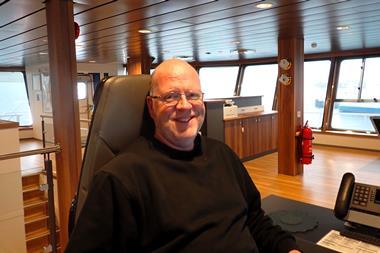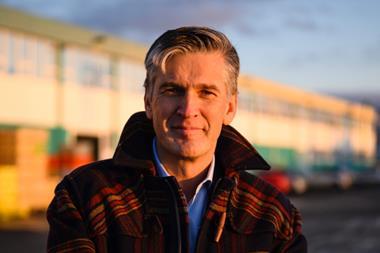




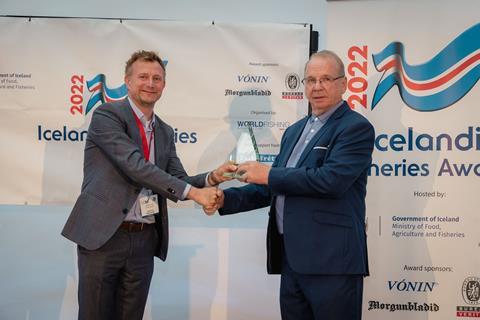
Guðmundur Gunnarsson accepted the Icelandic Fisheries Exhibition’s Outstanding Achievement award for his contributions to the development of fishing gear – and a few days later he was decorated by President of Iceland Guðni Th. Jóhannesson with the Order of the Falcon, the highest honour the Icelandic state can confer on an individual
Gunnarsson is someone who rarely needs an introduction among trawler skippers and his name is firmly linked to the development of the Gloria trawl in the late 1980s, which revolutionised pelagic trawling for the Icelandic fleet.
Originally developed with the skippers of Sjóli and Haraldur Kristjánsson to fish for redfish deep off the southwest of Iceland, getting the Gloria trawl to function wasn’t a painless process to begin with. But once the bugs had been ironed out, this design, which at the time was a radical departure from some of the conventions of gear design, became a great success for the company.
Aside from the success of the Gloria design, which has since then been refined and developed over the years for many other fisheries around the world, during a 50-year career at Hampiðjan, he has seen some huge changes take place, not least the work done in the 1980s with the Marine Research Institute and Netagerð Vestfjarða that made it possible to refine demersal trawls. This made these trawl gears significantly more effective, while also reducing the rate of gear damage to a fraction of what it had been.
In 1983, he took over managing Hampiðjan’s sales, while at the same time being closely involved in working on fishing gear research, and in 2001 he stepped aside from sales to concentrate fully on his role as the company’s development manager.
Gear selectivity
Gunnarsson has been instrumental in increasing the selectivity of trawl gears with his involvement in the development of QuickLines and adopting the use of netting in T90 configuration, as well as introducing Helix self-spreading technology and taking advantage of the opportunities offered by Dyneema, which today has widespread uses, not least in DynIce trawl warps and DynIce Data netsounder cables.
“When I joined Hampiðjan, we exported practically no netting. That began to change around 1974-75, when we started exporting netting to Denmark and the Faroes, and later to Canada. There was a significant advance in 1976 when we were able to heat-set netting. Up to then poor knot stability had been a problem, but heat-setting made Hampiðjan’s netting the best on the market and there was a big increase in sales when this came in,” he recalled.
The pivotal points of the last few decades include the arrival of stern trawlers after 1970 and the implementation of the quota system that began in 1983, he said.
“Then there were the fisheries for offshore shrimp in the 1980s and offshore redfish from 1989 onwards, and the new generation of fishing vessels that began around 2000.”
Evolving business
Hampiðjan has also been through some great changes – going from a set of buildings dating back to the 1930s and around 200 staff when he joined the company, to its present incarnation with its headquarters and purpose-built net loft on the Skarfabakki quayside in Reykjavík, while today the group as a whole has more than a thousand staff across 28 locations in 15 countries.
“Having the opportunity to work at Hampiðjan and to gain a knowledge of the technology and expertise behind fishing gears has been invaluable,” he said.
“Being able to travel abroad as a young man to become familiar with the fishing gear business around the world was highly memorable. At Hampiðjan, I had the opportunity to research, develop and design gears for demersal and pelagic fishing. I’ve also had the chance to spend time at sea to put these gears to work and to contribute to these being the outstanding fishing gears that Hampiðjan produces today.
He added, “Being able to take part in exhibitions and visits to flume tanks has also been a part of this process as whole, alongside the chance to get to know customers and colleagues, many of whom are my closest friends.”