




Larger, fewer pens pay off for Scottish Sea Farms
The first Scottish Sea Farms site to switch to 160-metre pens has reported record tonnage at an average harvest weight of 6.8kg, along with improved fish welfare and reduced seal predation.
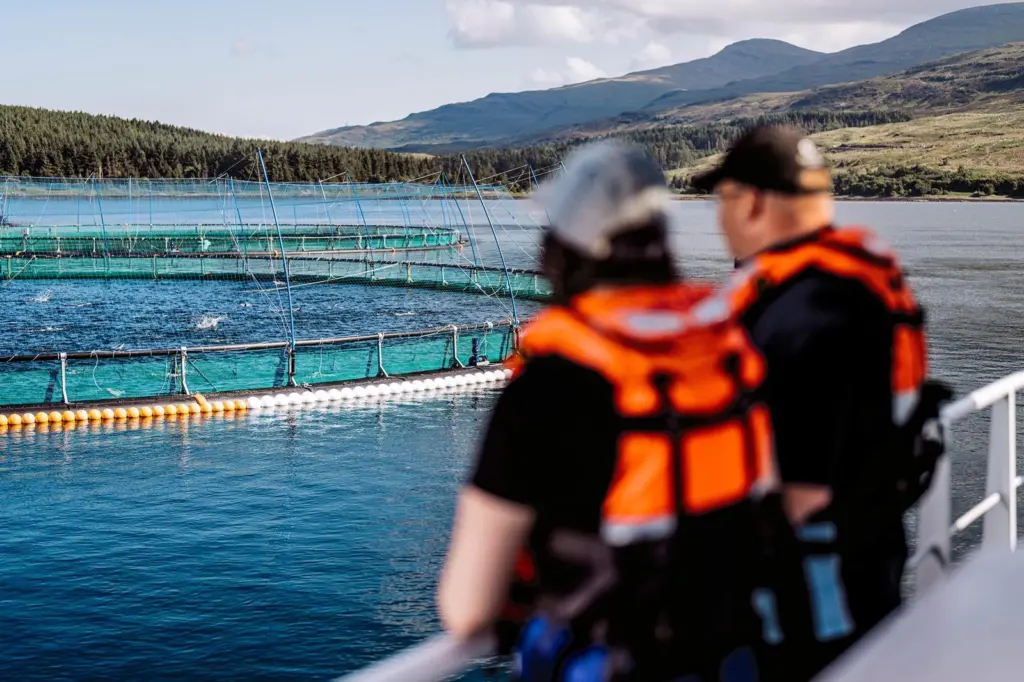
Fishnish A off Mull saw ten 100-metre pens replaced with four 160-metre pens. As well as the bigger pens and heavier moorings, Fishnish also introduced Midgard HDPE knotted nets and a new winch system, and trialled a smart feeding regime, in an investment of around GBP 3 million.
“It was night and day compared to the previous set-up: so simple, less labour intensive, with less manual handling. The new winch system is another world and once we got the hang of it there was no going back,” Farm Manager Alastair Fraser said.
Ten winches are fitted to each walkway and operated remotely from a dedicated workboat, providing better net control and improving staff safety.
“Dealing with three instead of 10 pens (we kept one spare for handling or freshwater treating) allowed us to stay focused on the task in hand and carry out any treatments much faster.”
The combined tonnage for Fishnish A and B, where half the crop was moved after six months, was just over 4,000 tonnes, Fraser said, adding that this was quite an achievement given challenges which included the micro jellyfish that affected most of the sector between 2022 and 2023.
He attributed the results to good husbandry as well as to the bigger pens, which provide lower stocking density and better water flow and oxygen.
Additionally, the new feeding system, involving motorised smart spreaders, produced “fantastic results”, ensuring the whole population was fed at the same time, with feeding finished by 9.30am so the fish could go down to the depths of the pen.
With the fish harvested over summer, the team is now preparing for the next cycle and hoping to roll out similar infrastructure at neighbouring Fishnish B.
And while they will do some things differently, such as increasing the ratio of wrasse in the pens to better handle sea lice off Mull, they are convinced the new infrastructure has paid off.
“The team realised they’d had a hard crop but saw the benefits of this new way of farming and morale was definitely better,” Fraser said.
Meanwhile, the sinking of Scottish Sea Farms boat Julie Anne in the Sound of Mull this summer has prompted the inspection of the company’s entire fleet and the introduction of additional precautions to minimise future risk.
Fifteen-metre Julie Anne sank at its mooring at Fiunary on the morning of 4 July, prompting a swift response from the marine team, specialist partners and the Maritime and Coastguard Agency, who, together, helped limit any environmental impact and ensured the safety of the salmon stock.
The boat was towed to Spelve on Mull, where the chief cause of the incident was confirmed as a hole in the hull. It is now undergoing a refit.
Since the incident, some 60 Scottish Sea Farms vessels have been inspected, with none found to be at risk. But going forward, the company’s engineers have launched a new inspection regime, and the safety team will be carrying out additional checks during monthly inspections.
An ongoing review of watertight doors will be completed by the end of the year.
A further safety measure will see HDPE matting, a feature on new boats, rolled out to existing craft, replacing tyre fendering at the waterline on the working side of the boat, at a cost of around GBP 4,000 per vessel.
Related Articles
 AQUACULTURE
 AQUACULTURE
 AQUACULTURE