



GM salmon evaluated
By turning off a special gene with the CRISPR method, researchers at the Institute of Marine Research in Norway created the world’s first salmon without reproductive cells with the overriding purpose to develop a farmed fish that cannot mate with wild salmon if it escapes.
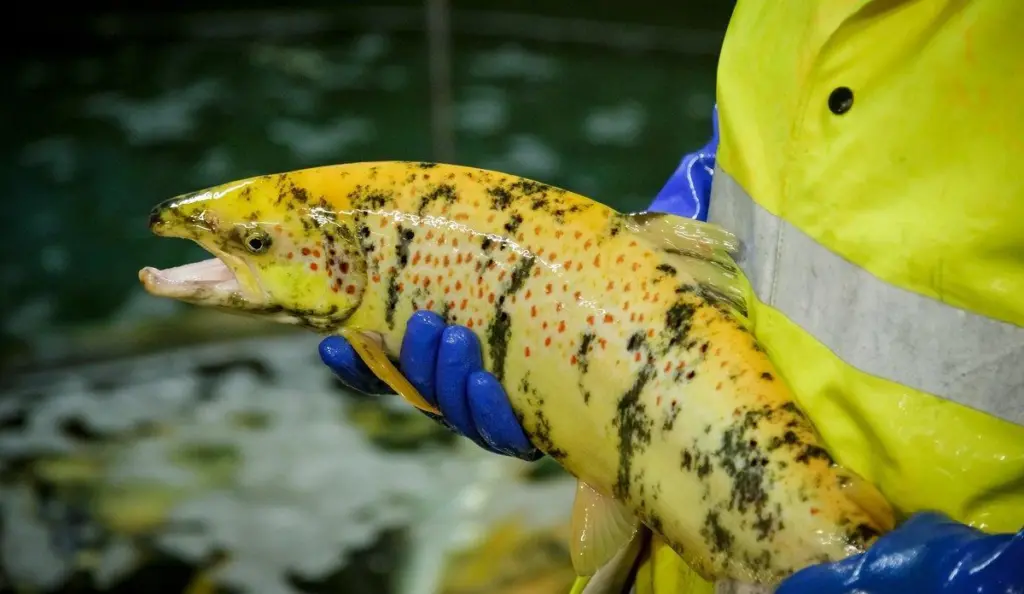
The same team have now followed the new salmon throughout the entire production cycle to compare growth, signs of welfare and omega-3 content with normal farmed salmon, finding no measurable differences in growth and welfare.
“We found no differences in body size, smoltification, stress markers, heart size or the occurrence of skeletal malformations,” researcher Lene Kleppe said.
The sterile salmon also had the same amount of healthy omega-3 fatty acids as normal farmed salmon.
What the researchers saw, however, was that normal salmon began to grow faster than the sterile salmon towards the end of the experiment. They also grew larger livers.
“These are early signs of sexual maturation. You generally want to avoid that in farming, not only because sexually mature fish on the run can mate with wild fish,” Kleppe explained.
Fish that reach sexual maturity become more susceptible to disease and can thus experience poorer welfare. They also deliver poorer meat quality because they use energy on sexual maturation.
In farming, sexual maturation means that the salmon must be slaughtered, even if it is ahead of schedule.
Particularly in closed breeding facilities on land, early sexual maturation is a problem. Although breeders can to some extent use light and temperature to prevent this from happening.
“The easiest thing would be to exclude sexual maturation completely in farmed salmon,” Kleppe said. “We have now shown that gamete-free salmon is largely similar to normal salmon but have the clear advantage that it never reaches sexual maturity.”
So far, the gene-edited salmon has only been produced for research in the laboratory. In Norway, this is defined as genetically modified, and strictly regulated by the Genetic Engineering Act.
Related Articles
 AQUACULTURE
 AQUACULTURE
 AQUACULTURE