



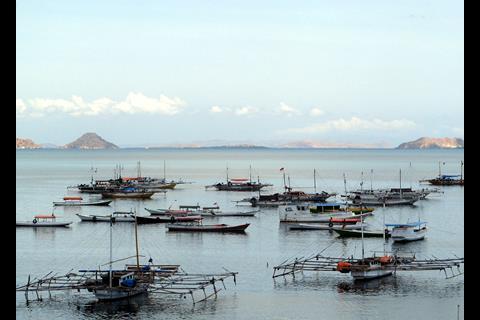
Indonesia is aiming to raise annual domestic consumption of sustainable fishery products by more than 350,000 metric tons (mt) within the next few years as part of government plans to raise per capita consumption of protein and improve the national diet, reports David Hayes.
A large share of Indonesia’s increased fisheries production already is being supplied to the domestic market, with the exception of farmed shrimp and longline caught tuna which currently are produced mainly for export.
Total yearly consumption of fish products has grown by around 700,000mt over the past five years to reach about 7 million mt annually as efforts to promote sustainable fishing begin to take effect.
The recent appointment of Syarif Cicip Sutargo as Indonesia’s new fisheries minister is expected to further strengthen government support of fisheries development and protection. Fisheries is a major source of income and employment in coastal communities across the sprawling Indonesian archipelago in addition to being an important source of food.
Technology and efficiency
The new minister has issued a new policy directive calling for both up and downstream fisheries to be developed on a modern industrial footing with improved technology to be more widely used in aquaculture while wild capture marine fisheries is due to benefit from improved efficiency in future.
More value added fishery processing should be introduced in Indonesia, Mr Sutargo believes, and less fish exported to support increased domestic consumption.
“Export processing is growing in Jakarta, West Java, and in East Java; also, salmon is being smoked in Bali to substitute for imports,” noted director of foreign market development, Saut Hutagalung, at the Directorate General of Fisheries Product Processing and Marketing under the Ministry of Marine Affairs and Fisheries.
“The Minister’s idea is that small, medium and big fishing operations can grow together.”
Indonesia’s 240 million population currently consumes around 30kg per capita of fishery products a year, with consumption having risen more than 10% since 2006.
“We are targeting 31.5kg of fish consumption per capita. The figure is going up; five years ago it was 27kg per capita,” Mr Hutagalung said. “It’s part of national policy to increase fisheries consumption and that affects our seafood exports. Around 85% of our total production is for local consumption and 15% for export which was worth US$2.9 billion in 2010.
“We try to protect domestic fishery producers. There is no prohibition of fishery imports. We import 9% of the export value of our fisheries. There is a very good balance of trade with a US$2.63 billion fisheries export surplus.”
Fish prices lower
Fish consumption has risen partly in response to increased retail prices for chicken meat and beef. In supermarkets, the average price of fish currently is 20% lower than chicken meat and 43% cheaper than beef.
In many households, fish is eaten with every meal. Fresh fish rather than frozen fish is preferred either fried, boiled or in soup, and eaten with rice.
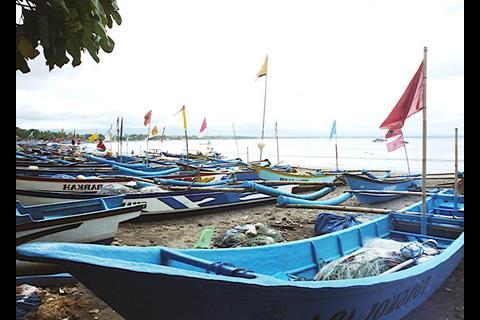
Most fishermen in Indonesia are small scale operators with 95% of the nation’s fishing fleet consisting of fishing vessels less than less than 30 tonnes. Fishing occurs in all of Indonesia’s 32 provinces with East, Central and West Java being among the major fishing centres along with South Sulawesi, North Sumatra and the Moluccas.
Following revisions to the Marine Fishery Laws in 2009, Indonesia’s waters were divided into 11 fishery management areas, each being a distinct marine ecological area, replacing the previous marine fishery zoning system consisting of nine fishing areas.
Under Indonesia’s fishing boat licensing system, the Ministry of Marine Affairs and Fisheries licenses fishing vessels over 30 tonnes while vessels from 10 to 30 tonnes are licensed by provincial governments. Fishing boats under 10 tonnes, which constitute the vast majority of Indonesia’s fishing fleet, are registered by local district governments rather than issued with fishing licenses.
“We have 590,000 fishing vessels of all sizes, among which there are only about 6,000 boats over 30 tonnes scattered around the country,” Mr Hutagalung said. “Being a fisherman is an ageing profession, but sons are following their fathers into fishing, though with higher education and will make a career of it.
“Our Fisheries Ministry has provided a training centre and better extension centres. Fishermen are starting to use satellite navigation equipment to find fishing grounds.”
Training courses
The Fisheries University in Jakarta runs four year courses training fishing crews. In addition, an academy running three year courses for officer level trainees has increased training availability along with courses for fishery processing and aquaculture management.”
Indonesia’s marine fishery catch currently totals around 6 million mt a year while the Fisheries Ministry estimates marine fishery stocks are somewhere from 6 million mt to 8 million mt at present.
An annual catch of up to 80% of marine fishery stocks is regarded as sustainable, though Mr Hutagalung noted that fishing grounds along both the north coast of Java and the east coast of Sumatra currently are over-fished.
In some cases the ministry provides fishermen with large fishing boats enabling them to fish further offshore and leave over-fished coastal stocks to recover.
“In other cases we encourage fishermen to take up seaweed production or fish processing,” Mr Hutagalung said. “We try to encourage them to produce better quality fish and to keep the same tonnage available in their fishing grounds to get higher price selling their fish.”
Valuable shrimp
Shrimp are Indonesia’s most valuable fishery product with some 146,000 mt exported in 2010 worth US$1.06 billion, accounting for over one third of the total fishery export value, while seaweed exports were worth over $400 million.
Some 122,000mt of tuna including skipjack was exported in 2010 worth $383 million while 21,500mt of crabs were produced for export worth $208 million.
“Our main export is shrimp of which about 80% is from aquaculture and 20% from wild capture,” Mr Hutagalung said. “In 1985 shrimp was 90% wild capture. Now it’s the other way round. We have to boost our aquaculture production to reduce pressure on wild fishery stocks.
“The main push everywhere is aquaculture. The main focus is for local consumption as transport costs are high.”
Indonesia’s main aquaculture areas include South Sumatra, South Sulawesi, East Kalimantan and East Java.
“We have a long tradition of shrimp aquaculture. In the 1970s and 1980s it was mainly Penaeus monodon tiger shrimp but since the end of the 1980s we have cultured more virus resistant shrimp,” Mr Hutagalung explained. “Now our aquaculture production is 80% Litopenaeus vannamei shrimp; it’s a big shift. The brood stock was imported from the United States originally but now it is supplied locally.”
Tuna is Indonesia’s second largest export catch, mainly skipjack, yellowfin and bigeye along with smaller numbers of southern bluefin tuna. Due to being a signatory to various multilateral tuna fishing agreements, Indonesia is unable to increase its tuna catch unilaterally as tuna resources are shared with other countries.
Imports monitored
Government food safety and other agencies in Indonesia’s major overseas import markets carefully monitor fishery imports to ensure they comply with sustainable fishing policies and public health regulations in importing countries.
“Around 70% of our fishery exports are to the United States, the EU and Japan so import requirements are set by these trade blocs. We have to comply with this otherwise we are out of the game,” Mr Hutagalung remarked.
The United States is the largest export market taking fishery products worth about US$800 million a year followed by Japan which takes imports worth around $600 million and the EU with imports worth $350 million.
Other Southeast Asian countries buy fishery products from Indonesia worth about $300 million a year while fishery exports to South Korea, Taiwan and China are worth about $250 million annually.
Due to falling demand in EU countries caused by the global economic crisis, Indonesia has stepped up exports to South Korea and new markets in the Middle East and Africa where canned sardines and dried fish are popular.
Investment schemes
Government support for the fisheries sector includes various investment schemes to improve the management of coastal fishery resources and attempts to find new employment opportunities for many fishermen for whom fishing is a part time occupation.
In addition, the government has to spend money on protecting its fishery resources from illegal fishing, creating an additional financial burden.
“We are working seriously on tackling IUU illegal tuna fishing. It’s a high cost to us and it also requires a lot of energy as more enforcement officers and patrol vessels need to be in place,” Mr Hutagalung said. “There are so many foreign vessels poaching in our waters and some illegal domestic vessels but the foreign ones are big vessels while ours are small.
“We train our staff and exporters how to comply with international regulations. That’s the price if we are to reduce these practices. We are talking about the future of the tuna fishing industry.”
Indonesia, with support from Australia, helped launch the Regional Plan of Action in 2008 involving 11 countries in the Asia-Pacific region and Oceania collaborating to reduce IUU fishing problems. The first annual meeting was held last year with one line of action to try and involve fishery importing countries in sharing the cost of anti-IUU fishing measures.
“We are asking that fishery importers and consumers in Europe, the US and Japan share the cost of sustainable fisheries availability,” Mr Hutagalung said. “We are saying “Let’s share the costs” of ensuring good quality, safe and sustainable fishery products.
“We have raised these issues with WWF and others. The Indonesian government agrees that environmental protection, sustainability and others are all good ideas, but they all cost money to implement. How can we share the costs and benefits? Our products have more costs to meet these standards but we still receive the same price as non-accredited seafood items.”
Meanwhile, work continues to improve compliance with importing country fishery import standards for tuna, shrimp and other products. In 2004, 70 export shipments to the EU were rejected due to contamination by heavy metals, antibiotics and salmonella. By 2008 the number of export shipment rejections had reduced to 10 cases with less than 10 rejections being recorded in 2009 and 2010.
“Its big progress for us,” Mr Hutagalung commented. “In 2011 until the end of November we had just four rejection cases. So far our food and safety efforts have made good progress. Our target is zero rejection cases. We keep trying to improve. We are working to reduce antibiotic residues from aquaculture.”