



For many small fishermen the invasion of the coast by prawn farms has been a 30-year battle.
They generated jobs for some and profits for businessmen from exports. But it took a Supreme Court judgement to halt disruption of traditional sustainable husbandry and severe damage to large tracts of the coast. Peter O’Neill looks at plans to diversify on the coast and expand inland freshwater production.
It was only a few hours since the end of an all-night gun battle between Indian soldiers and Kashmiri militants around Mughal emperor Shah Jahan’s Nishat Gardens. He laid them out in the 1630s as a summer retreat in the mountains and lakes of Kashmir. Nothing was going to stop the crowds heading towards Nishat and the opening of the nearby tulip display in Nehru Park.
Dutch tulip fields it was not, but this was Asia’s biggest tulip display, all done by Srinagar’s municipal gardeners to bring locals a sense of normality amidst daily conflict through the simple pleasures of sight and smell. Just down the “Valley” in the Dachigam Nature Reserve, aquaculture workers had also turned around the trout farm which it seems had become a rundown eyesore.
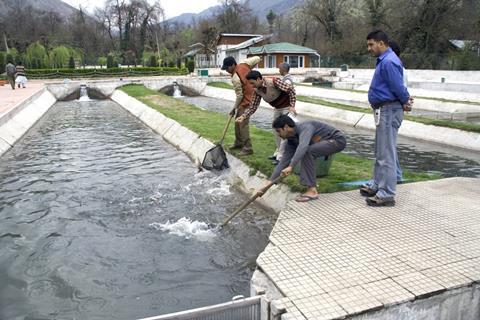
Established by the Brits with stock from Scotland in 1900, it now produces more than 150 tonnes of brown and rainbow trout and is one of 30 farms across the state. It is immaculate and a very smart attraction visited by families who walk among the fruit trees and buy fresh trout straight from the ponds. Most of Dachigam’s work is to provide advice and training and sell seed to fish farmers, more and more of whom are capitalising on Kashmir’s snow-fed streams and ponds right up to 18,000 feet.
More than 1,500km to the east, next to Bhimtal lake in Nainital District of Uttarakhand State, Kashmir links hands with the Directorate of Coldwater Fisheries Research which is now the official dynamo and link between all the Himalayan states which run 2,500km from Kashmir in the west to Arunachal in the east. Director Dr P.C. Mahanta told World Fishing the new remit for the centre (which was first set up in 1987) is to expand hill fish farming, particularly for brown, rainbow and snow trout, and mahseer (tor pititora) as a protein source and for tourism development. They are continuing their work on fishmeal-free fishfeed for fingerlings which put on up to a third more weight than the controls. Seed stock sales across the Himalayan states are also doing well, according to Centre statistician Dr N.O. Singh.
Down in the hot plains, the government is expanding the number and productivity of traditional ‘tanks’ (large ponds) in villages for domestic consumption and is encouraging stocking of town and dammed hydropower reservoirs. Dr Madasamy Sakhtivel, of the Aquaculture Foundation of India (1,000 organisational members) says that tank farmers are producing up to 10t of freshwater fish per hectare p.a. Government incentives (up to Rs40,000 - €650 - per ha.) are for freshwater shrimp but he believes they should include other fish, as well as boost seed quality and technology. Kerala is also pioneering farmed mussel production for domestic consumption and is now at 50,000t.p.a.
Tough logistics
At three million tonnes, farmed matches wild catch and puts India in the number two world spot. But coastal farming, wild landings and inland fish production all share a common problem. However, it represents a major investment opportunity. While new national highways are opening chilled transport costs are high and plagued by erratic electricity supplies at warehouse staging and re-distribution points.
Dr Sakhtivel, former Chairman and Director of the national Marine Products Export Development Authority, says poor infrastructure and logistics remain big problems. Fish sales are impeded by high transport costs when people on the eastern coast expect to pay no more than Rs60 to Rs100 (€1 to €1.6) per kg. The cost of buying and running refrigerated trucks is very high and their availability low. He believes there are investment opportunities for foreign companies expert in conversion fitting insulation and chilling units on a basic chassis. He is also a consultant to TATA Sons, the agribusiness to trucks and Jaguar cars behemoth. Tata trucks have dominated the haulage market for decades with robust but basic vehicles. The sale of its refrigerated trucks is limited. Dr Sakhtivel said “people find it difficult to hire [a reefer].”
TATA, which has been very successful at partnering with small farmers for quality vegetable production, has started to fund centres to train fishermen and fishfarmers to diversify and improve quality. Participants get Rs150 per day to help with loss of earnings, an indicator of not just how little they earn, but also an indication of how investment in the industry from abroad through joint ventures can not only be cheap but have a big effect.
So, there is a large gap in the market for medium to small size vehicles reefers. They are commonplace across Europe for different food sectors, but not in India. The basic vans are there from TATA and its competitors such as Eicher who also penetrate rural areas with their tractors. Dr Sakhtivel agreed with WF that Indian Rail has also been too slow to develop secure cold chain facilities for moving product inland from the coast and around the country. China Rail can show India the way. On the large reefer truck front, this may change as some Indian corporates try to tie up with foreign chains to develop supermarkets which will require large fleets of such vehicles.
There also need to be innovative solutions from the bottom up. While long-distance fish transport tends to rely on ice packing (rather than mounted refrigeration units on trucks), a simple but effective solution is movement of live product. Fresh fish from Bhimtal lake, for example, are often moved in water in old, road-tar barrels up to 30km or 40km to a village shop on a transit main road either by small truck or three-wheel ‘tonga’. The boom in the use of plastic, household roof water tanks across India could offer a similar container solution for fish. Dr Sakhtivel said that cheaper approaches to logistics “would certainly take off in India”.
This is a massively under-served and potentially enormous domestic market and the growing middle class is ever more aware of the protein and health value of fish. Dr Sakhtivel suggests that only 10 per cent of India’s shrimp production goes to domestic consumption and the rest for export. And even then, the main buyers are the fish cuisine aficionados of Bengal and Orissa in the northeast and the fish-curry eaters of the southern states of Goa, Kerala and Karnataka on the west coast and Tamil Nadu and Andhra Pradesh on the east.
Overall there is a shortage of product and the shrimp processing factories are running (this has been the case for years) at only one third of capacity. Further, producers will generally sell (prawns for example) to higher revenue targets abroad. So the domestic potential for increasing the farmed salt, brackish water and freshwater product offers tantalising returns with demand always way behind supply.
Paradoxically, Chinese competition in international markets could also bring Indian domestic prawn prices down. Dr Sakhtivel said overall consumption and expansion over the next five years would depend on price. The Chinese were flooding the international market with farmed American white shrimp (penaeus vannamei) and smaller Indian white shrimp (penaeus indicus) were losing out to that. However, the larger tiger prawns were still fetching good prices and are the main Indian export.
Diversification
It took drastic, coastal prawn farm closure intervention by the Supreme Court in 1996 for the infection risk to be brought under control in the over-intensive shrimp-farming sector. The battle had raged since the mid-1980s with economic and social conflict over the conversion of agricultural coastal land. Small owners were often forced out of their traditional holdings which ended up under the control of businessmen. Their ignorance and poor management led to major outbreaks of disease, damage to important water exchange mechanisms in mangrove swamps and tidal exchange for brackish water areas, and dead land caused by too much saline accumulation in the soil. This was compounded by little or no effluent treatment for evacuated water from the ponds.
Centuries-old, safe, sustainable, traditional mixed rice, shrimp and small fish production in paddy fields was undermined. The eastern coast often has to recover from cyclonic disasters as well as recent tsunami damage. But viruses can do more long-lasting damage. As experts Vivekanandan and Kurien wrote in 1998 of poor prawn husbandry, “The result was a viral attack which began to spread since 1994 wiping out most of the crop [and] throwing the whole industry into shambles”.
Dr Sakhtivel says there is more balance now and those who do the lesser ‘extensive’ stocking are doing well, but there are still farmers who have not learnt the lesson that intensive cultivation threatens long-term sustainability and a collapse in revenues through infections. Since early 2009, the Indian press has reported significant outbreaks of white muscle disease in freshwater macrobrachium Rosenbergii with 90 per cent to 100 per cent mortality in some areas. The direct impact of the disease is that, while there is a solid, regular 100,000t of tiger prawn exported, freshwater shrimp production may have dropped from 30,000t to around 15,000t, Dr Sakhtivel said. He adds: “People are aware today of the quality restrictions, and have improved a lot and are still working at it. ‘Do or die!’ If you want to export and do good business then you follow all the rules of quality and do well… otherwise, don’t come into the business.”
He says the laboratories, set up in the last few years for testing for export are working reasonably well. But the traceability issue is still a big problem for the bulk of the many small producers who are the vital first stage at the bottom of the chain. These sell on at low prices to the large combines who have the processing factories and export facilities.
Opening the cage
A few processing companies are using spare capacity by taking in foreign product orders for processing, and the government has recently relaxed the rules to allow more import of shrimp for this. Dr Sakhtivel believes more Indian companies could be interested in doing the same. However, poor infrastructure and associated cold chain and HACCP (Hazard Analysis and Critical Control Point) risks need to be sorted so they do not put off foreign customers.
Dr Sakhtivel is encouraging diversification of the large number of idle prawn farms into mixed production and reducing the dominance of prawn. He is considering fish such as grouper, snapper and cobia (which is reported to be making valuable inroads into the US market).
It could be boom time for sales of sea-cage and feeding equipment and consultancy, either through direct sale from abroad or through local production through joint ventures, taking advantage of India’s low manufacturing costs. “We don’t have any cage [operations] in India other than experimental [sites],” he said.
Research into breeding spiny lobster, which WF saw some five years ago in the lab at the Central Marine Fisheries Research Institute at Vizhinjam, near Kovalam in Kerala, has made taken its first sea-cage plunge. The first harvest took place in June from a 5m diameter, 8m deep cage which was moored off the fish-landing area. It had been stocked in January 2009 with 1,200 Panulirus homarus each weighing from 70g to 95g. According to The Hindu newspaper, local fishermen were co-opted to feed them with brown mussels and clean the cage which has been secure enough to resist wind and storms. At harvest they weighed between 250 and 300g with a value of Rupees 150,000 to 200,000 (€2,400 to €3,200. That can be multiplied by at least 10 to get the equivalent European average purchasing power equivalent (€24k to €36k).
Fisherman landing wild tiger prawns in Kerala may get only an average of between Rs150 (€2.5) to Rs300 (€3.25)per kg maximum. But they often do not take enough ice on board to maximise the life of catch volumes. Cage lobster production looks very interesting therefore.
Hatcheries along the eastern coast are also earning well from domestic seed sales and the potential is there for export revenue, provided stringent pathogenic safety is maintained. Dr Sakhtivel says many of the country’s 270 hatcheries would be interested in such business.
The old bureaucratic problems remains and he says that too many reforms have not been implemented in recent years and they need “bulldozing” through; and a lot more effort must be expended on increasing the value-added for all kinds of fish products.