



Scanmar shares its trawling experience with World Fishing and gives advice on how to increase efficiency.
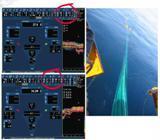
It is common knowledge that a lot of the catch seen in the trawl opening on the Trawl Eye or trawl sonar does not end up in the codend. While there are many critical factors for catch efficiency, the fact that scientific studies reveal efficiency to be as low as 20% in some cases is food for thought.
There is also a second major problem with fish escaping, which is that many of them subsequently die from injury. This occurs notably in areas of small mesh size, but not in the area with the smallest mesh. Some idea of this can be obtained by looking at how the trawl is 'cloaked'; but this does not give the full picture in areas of large mesh size, where many fish can escape but stickers are rarely found.
Clearly, reducing the quantity of fish escaping will mean a considerable efficiency improvement, and there is every indication that this is where the greatest gains are to be had.
What can be done?
Here at Scanmar we can only regret that we do not have ready answers to how large-trawl fishing can be made more efficient. But we are happy to share our experiences and our thoughts on their implications.
Even though our launches of the Door Distance, Symmetry and Trawl Speed sensors met with much scepticism, they have subsequently proved to be indispensable to many fishermen. And the Door Angle sensor has also turned out to be a very good investment.
Scanmar's experiences
• Underwater currents and course changes often cause asymmetry in the waterflow in the trawl. This produces skewing, stretching out the mesh on one side, and closing it up on the other. The Symmetry sensor is accordingly widely accepted in all types of fishing.
• Underwater currents and course changes also have a similar effect on the trawl doors, making them move at different depths. This produces an equivalent skewing in the vertical plane.
• The Trawl Speed sensor has also gradually come to prove its worth. The correct speed of the trawl through the water, regardless of the speed and direction of the underwater currents, is becoming increasingly important; if the speed is too low, strong swimmers escape from in front of the trawl, too high and a 'bucket effect' is created further back in the trawl, where the mesh is large, and fish escape.
• Some trawlermen use Scanmar's Trawl Eye and Trawl Speed sensors in both the trawl opening and the tunnel. They then get a good idea of the relative volumes visible in the opening and in the tunnel. They can also see if there is any reduction in the waterflow resulting in the bucket effect and any reduction in the tunnel height. The time taken from registering fish in the opening to seeing them in the tunnel, relative to the speed of the waterflow, allows some fishermen to estimate the size of the fish they are catching.
• The Trawl Eye mounted in the tunnel has a second key function: it shows fish that are above or below the trawl, i.e. those which have slipped through the mesh ahead of where the Trawl Eye is installed. This provides an excellent indicator of how much of the catch is escaping and, consequently, the efficiency of the trawl for that haul.
• It appears that, when a normal codend is 2/3 full, this causes a dramatic reduction in the tunnel height and waterflow; the bucket effect then arises in an area where the mesh is large enough for the fish to escape.
• Using the new SS4 sensors (combined Depth-Angle and Catch-Angle sensors), we can register a wave moving back through the trawl and the codend once there is a certain inflow of fish. This is due to the creation of a bucket effect ahead of the fish (closer to the trawl opening) which stretches out the trawl and makes it easy for the fish to get away.
• Using the same sensors, we have also recorded substantial twisting of both the trawl and the codend. This not only deforms the mesh, allowing the fish to escape, but may also change the acoustic picture in the trawl, frightening them out.
• When catching fish with small or no swim bladders, we notice that the codend gradually sinks as it fills; on occasion, the codend has been seen to be hanging down vertically. That alone is an indication that the trawl is not fishing efficiently. And there is also a danger of tearing the net when fishing near the bottom. For these observations, combined Depth Angle sensors have been used as Catch sensors.
New ideas
Based on the experiences mentioned above, observations of waterflow in the trawl under various conditions and some general knowledge of how fish swim and behave, we have come up with some ideas for things that may well be worth testing. But first, a little general knowledge and experience:
• A shoal scatters explosively right at the front of, or at a location further back in, the trawl. The reason is far from clear, but it often appears to happen when the shoal is tightly packed. Why this should occur is not known either.
• If a shoal does not scatter of its own accord, a bucket effect will arise, which in turn will make the trawl explode and the fish will escape.
• There is every indication that a greater percentage of fish escape when there are large shoals as opposed to small ones.
• Different species have different swimming abilities and also affect pressure in the trawl and its appearance in different ways. The same is true of different-sized specimens of the same species. Unless there is a clear opportunity to escape through the mesh, fish will therefore swim away from the trawl walls, towards the middle.
• If the waterflow through the mesh, especially as regards the bucket effect, is greater than the fish's swimming ability, they will disappear through the mesh where it is large enough, cloak the trawl towards the rear section, but continue backwards into the trawl where the mesh is small enough to prevent escape or 'cloaking'.
• It is obvious that the fish's swimming ability is reduced from their physical efforts as they gradually move back in the trawl, and probably more so for small fish than for large.
The question is: what can be easily done to rectify these problems?
The gear
Looking at the 'explosion' or bucket effect due to the intense congregation of fish, it might be interesting to see if one or more of the following conditions have arisen at the same time:
• Excess trawl speed
• Asymmetrical trawl
• Trawl doors at different depths
• Lower waterflow and height in the tunnel
• Twisting of the trawl/codend
• The codend 'drooping'
It is far from certain that any of these are the cause, but it may be worthwhile checking them, if for no other reason than to eliminate them as possibilities. Nonetheless, our supposition is that, in many cases, they do play a contributory role.
Catch technique
It might be interesting to examine more closely the relationship between the fish's swimming ability and the water speed at various points in the trawl, paying attention to the following factors:
1. The general situation
2. Large differences in fish size
3. By-catch where the target species has different swimming abilities from the by-catch
• From the above, it is clear that the gear must work as intended and the trawl geometry is as precise as possible.
• There is strong evidence that reducing tow speed when the fish first enter the trawl will avoid some of the concentration of fish that causes scattering and the bucket effect, and the fish will then move slowly back in the trawl, without major loss of catch.
• By reducing the water speed in the trawl, it is possible to achieve a speed that is lower than that which large fish are capable of swimming at, but greater than that of smaller specimens. The potential outcome is that large fish avoid the net wall, while the smaller ones swim with the waterflow out through the mesh.
• A similar scenario appears possible for reducing by-catch, which will escape through the mesh while the target species remains in the trawl (assuming of course that the by-catch specimens are slower swimmers).
• The inverse case may be resolved by using sorting grids within the trawl. There are several ways of doing this and they could be positioned in different parts of the trawl.
• Similarly, various panels could be located near the front of the trawl to separate out small fish at an early stage, which would allow a higher tow speed to be maintained. But this would be more appropriate with smaller concentrations of catch.
As we have indicated, the potential for improving the catch capability by altering the tow speed is not something we can document; we can only point to it as a possible solution going by our experiences.
Ideally, further experience could be garnered from individual trawlermen undertaking simple trials in their own fisheries. This might in turn result in more efficient trawl design.
Cooperation between the trawl manufacturers and maritime researchers, using collection bags for more scientific documentation, might also prove to be very interesting.