



The five pillars of a Saudi Arabian desert shrimp farm are expanding in all directions. Velo Mitrovich reports.
Everything about Saudi Arabia’s National Prawn Company (Robian) is staggering. When the Phase II expansion is completed in two years, combined all shrimp ponds into one and Monaco could fit into it 34 times. Want to move Bangkok and its 13 million inhabitants someplace less dense? They could fit into NPC’s 250sq km farm.
The workforce at the farm is around 2,500, with workers coming from 26 different countries, speaking 19 different languages. Meeting their needs are 17 mosques, a two-engine fire station, a complete medical polyclinic and a power plant producing 21.6 mega Watts. Not enough power? Don’t worry, a second power plant in is the planning stage.
Even the temperature at the Al-Lith site doesn’t pull any punches. During the summer it can easily reach 50 deg C or higher (122 deg F) with paint-stripping sandstorms frequenting the farm. During the winter months while daytime temperatures can be pleasant, at night it can drop to just above freezing.
But turning this part of a desert hell into a shrimp oasis is not enough for the progressive management team which runs NPC. Taking a hard look at what they do best, NPC is moving into the future basing itself on what it sees are its five pillars of strength and growth. These are aquaculture – shrimp, amberjack and sea cucumber farming - marine agriculture, desert construction, seafood trading and creative innovations.
MD Ahmad Rasheed Al-Ballaa is the first to admit that when he joined his brother in an attempt to grow shrimp in 1982, the two had no idea just how big NPC would grow.
Al-Ballaa’s brother had journeyed to Indonesia in the 1970s and saw a shrimp farm for the first time. To him, it seemed like the easiest way to make money. Dig a pond, put in some shrimp fry, a bit of feed and six months later you harvest your crop. Easy – that is until he got back to Saudi Arabia and started a small shrimp research project.
Most shrimp which are farmed live in either fresh or brackish water; the water in the Red Sea is considered the saltiest of any ocean body. With no ready supply of freshwater, it was more than just a passing thought of trying to move icebergs from Antarctica to the farm. However, it was decided to go with the more practical idea of farming a Red Sea shrimp species which was already adapted to the high salinity content and the extreme temperatures. Still, it was again a case of easier said than done.
“It finally dawned on us that we couldn’t farm the same species as elsewhere and it took us six years to establish our species, Peneis indicius,” said Al-Ballaa.
“In 1992 we now had the experience to start farming 800 tonnes in Farm A which is still in use today,” he said. “However, we realised we didn’t have the volume to successfully market the shrimp, plus 800 tonnes wouldn’t bring in enough money to keep the infrastructure going, such as the hatchery, ponds, processing plant, etc. We needed to greatly expand.
“We realised that what was required would be a new concept in shrimp farming; the species, where we were farming, the size that this single farm would be, all would be new concepts.”
According to Al-Ballaa, it was the chairman of the company, Sheikh Sulaiman Abdulaziz Al-Rajhi, who had this vision of scale. Al-Rajhi, along with another family, joined the brothers in 1999, giving NPC the funds to start scaling up.
“The chairman owns Al-Watania Poultry, the Middle East’s largest poultry farm, so he was used to thinking big, very big. He was the one who came here, looked, and could see just how large we could grow.”
However, before expanding what the investors were curious about was why aquaculture companies fail. At times, it seems that a search on the internet finds more aquaculture graveyards than success stories.
“Aquaculture in the desert will always be a challenge, requiring the right amount of investment if you’re going to be successful. However, what is the first thing any investor will do? They’ll look on the internet on aquaculture and see nothing but problems – companies collapsing, disease, poor markets, you name it,” said Al-Ballaa. “We had to convince our investors we were going to do things differently, but this would require from them taking a long-term view.
“Aquaculture is a high risk venture – people constantly cut corners and want their investment back as soon as possible, which is why so many companies go out of business. We have been fortunate that the board has taken from the beginning a long-term growth perspective of 20 years: investment doesn’t kill companies, cash flow does,” said Al-Ballaa. So far around $350 million (€269.7 million) has been put into the farm, with another $250 million (€192.7 million) scheduled for the next three years.
“My thinking is this: we concentrate on the right investment, then the right people, the right infrastructure, then the right biosecurity, and we will succeed. This is what sustainability is about.”
The first phase of the shrimp farm development is complete with 10 farms, each comprising between 28-30 ponds, with each pond measuring around 10 hectares, providing its processing plant with around 16,000 tonnes this year.
Expansion is well underway with a further 13 farms of the same size planned which will give a production of 42,000 tonnes.
Right on schedule, two farms in Phase II are already growing shrimp.
RAS gamble
Adjacent to NPC’s farm is the ultra-clean water of the Red Sea. With a good current, fast drop-off into deep water and no tourist industry and few inhabitants for close to 150km, it would be an ideal place to have offshore farms. That is, if it wasn’t next to impossible to get a license for one in Saudi Arabia, which restricts coastal and offshore aquaculture for a number of reasons ranging from security to environmental.
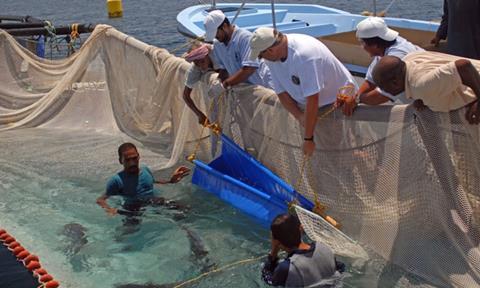
In lieu of this, NPC is building a huge recirculation aquaculture system (RAS) in order to grow amberjack (Seriola dumerili) and sea cucumbers (Holothuria scabra). Unlike many species chosen for RAS, amberjack and sea cucumbers have numerous advantages.
Both already have a well established commercial market based on wild catch – unlike cobia – and both can bring a decent price – unlike tilapia. Amberjack is especially prized in the Japanese sushi market as well as in sushi restaurants in Europe and the USA.
But, as those familiar with RAS around the world can tell you, recirculation successes can be counted on the fingers of two hands, while the number of failures require a high-end calculator to add-up.
So why does NPC think that they’ll be any different?
Cash flow is the number one reason, according to Jonathan Moir who is spearheading the project.
“The majority of all RAS projects are underfunded which means that they have cut too many corners in setting up the system. But NPC is willing to spend the money to do it right. That’s why we’ll succeed,” he said.
Already broodstock have been established for both species and while the sea cucumber side is as thrilling as watching paint dry, there is a real feeling of excitement with the amberjack.
Moir has worked on establishing the broodstock and has just recently moved fish down from the north of Saudi Arabia to the centre where the fish will be induced to spawn using photo-thermal manipulation (controlling light and water temperature into fooling fish that it is the spawning season).
Working in a similar vein to ‘just in time’ manufacturing practices, the hatchery should be finished just as the broodstock start breeding, with the nursery and the grow-tanks finished, too, just in time.
From ‘eggs to plate’ should take about one year, with harvested fish selling at 3.5kg. NPC is hoping that next year it should have its first sale which should be around 5,000 tonnes of fish.
Sea cucumber sales, too, should begin next year but because this industry is so new and there are uncertainties, estimates of total yield are not being made.
All the shrimp
Shrimp heads from processing plants can cause a huge waste problems – but not at NPC which is extracting valuable material from all parts of the head.
In a modern chemical/laboratory plant, shrimp heads are moved through a succession of vats, with each stage extracting some item of value. The first stage removes the protein from the head, which is used in non-aquaculture animal feeds. Minerals are extracted next, leaving the shells colourless as unrefined chitin.
The chitin can be further refined into chitosan powder, which is used to add fibre in weight reduction diets and in wound healing antiseptic solutions. Chitosan powder can also be further refined into glucosamine powder, which is used in vitamins and supplements for human joints.
“Because we have single-source shrimp which are 100% traceable for egg to shrimp – all raised without antibiotics – we can offer pharmaceutical companies a 100% quality guarantee which other shrimp farms cannot match,” said plant manager Ismail Kaliyan. “This makes our finished product very popular.”
The future is green
NPC is considered one of the ‘leading-edge’ companies when it comes to growing marine algae for the nutrition and pharmaceutical industries.
“There are about 200 trying to grow marine algae but only about six which have the ability to do so commercially, we’re one of them,” said M Pradeep Kumar, manager of the marine agriculture department. “The key to marine agriculture is to have clean seawater, air and sunlight, we have all three in abundance.”
The two major species of algae being grown are Dunaliella salina, a red algae which grows naturally in the Red Sea, and Nannochloropsis gaditana, a green algae from Europe.
The majority of all the green algae is being grown in 25-litre bio-reactor tubes in a controlled environment due to the algae not being to withstand high temperatures. The red algae, on-the-other-hand thrives on the environment and besides bio-reactor tubes, it is grown in outdoor raceways and ponds.
Products obtained from the two algae include phytoplankton (food and feed), omega-3 oils, pigments, plant proteins, nutra and pharmaceuticals. Bio diesel is not considered practical at this time and no effort is being made in this regards. However, if in the future technology makes it practical, then it will be considered.
Building in sand
What if you had over 400 men, skilled in building shrimp ponds in Saudi sabkhas - desert saltwater marshes? In two years time when all projects are finished, would you cut them loose and lose all that experience?
According to Mazian Bin Ali, manager of the engineering and construction department, this terrain is like nothing else out there. During high tide seawater seeps in underground turning the sabkha into a thick goop which even four-wheel vehicles cannot cross without getting stuck. When it dries out, it isn’t much better.
“The ground has hidden ancient coral clusters which can damage diggers, the dust and heat are constant, and then there is the high salinity which makes even stainless steel rust,” he said.
Instead of wiping their hands in two-years, thankful never to work in sand again, NPC’s management team is already engaged in talks to keep this workforce intact and export them around the area to places such as the Sudan, Yemen and Mauretania, which have similar terrain to duplicate the work.
“We’ve been able to put farms in this area to control seepage, to build ponds and dykes. This is not people just moving earth, it’s a very special skill,” said Dieter Moeller, director corporate strategy and business development. “If we send our workers home in two years, we’re losing skills and intellectual property.”
According to Moeller, while he wouldn’t call the plan franchising, it’s the same concept.
Working with investors in these other countries, NPC would bring its workers over to coastal sites, engineer and build the farms, hatcheries and processing centres, and then train locals on how to run the farm. Depending on the contract, NPC could also manage the farm and help in marketing the production.
Robian trading
NPC is in the process of moving away from using National Prawn Company on its products to Robian, in an effort to show that it is more than just a shrimp company.
“You would not expect a company called National Prawn to be involved in amberjack, marine agriculture, construction and other projects,” said Laurence Cook, director of corporate communications. “The name Robian has been used for sometime for our entire corporation; it will now get more prominence.”
And, in a final pillar of its new identity, Robian is working on becoming a seafood trading company, buying and selling-on other company’s products.
According to Moeller, later this year Robian will start this new project, working with companies which meets Robian’s criteria and strict quality standards.
“When you trade, you have to wonder if you can produce the same product yourself, that’s why we’re farming amberjack and sea cucumbers,” he said. But other products, he added, are too different from what you know how to do so it is better to find a good quality source and trade the products on.
“Shrimp is our core business and that will not change,” said Moeller, “but our customers are looking for something else from us. That’s what we’re going to give them.”