


Ghana''s government must do more to crack down on illegal fishing if it wants to protect its fish stocks and coastal communities and ensure food security, says the Environmental Justice Foundation (EJF).
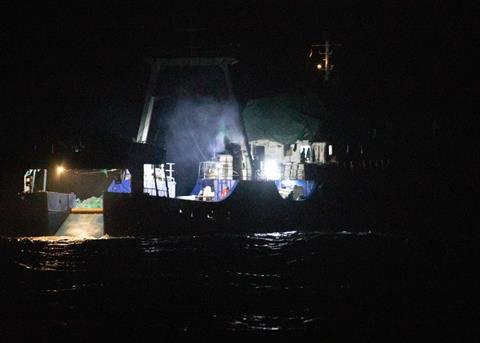
The country's small pelagic fish stocks are on the brink of collapse due in part to the destructive transshipment practice known as 'saiko', where offenders are either given a lower fine or refuse to pay entirely and are later relicensed to fish.
EJF executive director, Steve Trent, said, "Such has been the devastating impact of illegal fishing activities that Ghana now has to import around half of its fish, and local fishing communities are increasingly victims of the impact of rapidly declining fish populations."
Last year, the vessel Lu Rong Yuan Yu 956 was caught in Ghanaian waters with illegal nets and undersized fish on board. The owners simply refused to pay the statutory minimum US$1m fine. Similarly, two other Ghanaian-flagged vessels, the Meng Xin 16 and Meng Xin 29 refused to pay fines but have since been relicensed to fish.
Chinese ownership
An EJF investigation in 2018 revealed that around 90% of Ghana's industrial fleet is linked to Chinese ownership which uses opaque corporate structures to register vessels and obtain licences. These underhand dealings prevent the true beneficiaries of illegal activities being held to accounts, says the EJF.
The EJF asserts that trawlers operating under local licence using the Ghanaian flag should be 100% locally owned. It found that, although the ownership of a vessel is, on paper, Ghanaian, in the majority of cases the beneficial owner is Chinese. A report by the foundation in 2015 found that Chinese nationals captained over 95% of trawlers with active licences in Ghanaian waters.