


Iceland
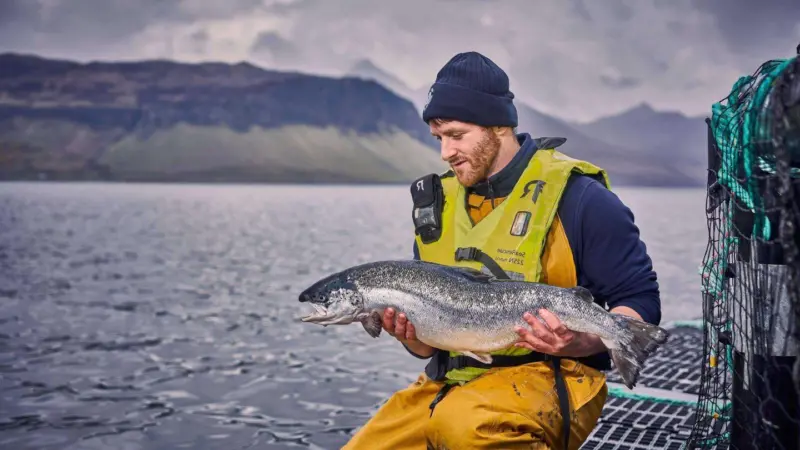
Long-line fishing is gaining ground – Long-line fishing has in recent years greatly increased its share of the total catch of bottom fish in Icelandic waters, reports Gudjón Einarsson.
In 1983 fishing with long-line amounted to 8% of the bottom fish catch, this figure rose to 16% in 2003 and to 22% in 2005. The rising of long-lining has been largely at the expence of gill netting which has now been reduced to 8% of the total bottom fish catch, down from 20% in 1983. Last year almost every third cod, Iceland’s most valuable species, was caught by long-line boats and the same goes for haddock.
Old method – new technic
Long-lining is of course an ancient method of fishing but even though the principle has remained the same for centuries there is certainly nothing archaic about modern long-line fishing. In Iceland there are almost 30 larger long-line boats now in operation equipped with automatic baiting machines and sofisticated electronic gear to help the captain monitor the fishing. The line is up to 38 miles long with over 46,000 hooks.
Fishing with long-line around Iceland has been extremely successful during the last few years, more so than with other type of fishing gear such as trawl or gill nets. The weekly catch of some of these larger boats have reached 100 tons or even more. They can operate in almost any kind of weather and are therefore able to supply the fish processing plants with fresh raw material on a steady basis, enabling the plants to serve their customers abroad without interruptions. Furthermore long-lining is increasingly considered a more environment friendly way of fishing than for example trawling, and large supermarket chains such as Carrefour prefer line fish to trawl fish. Last year 115,000 tons of fish was caught with long-line on the Icelandic fishing grounds, half of which came from these larger boats with baiting machines and the other half from some 600 small long-line boats. Now a growing number of these small boats have also aquired baiting machines and the most successful of them are fishing 1,000 tons a year or even more.
Trawls cannot be replaced by long-line
Even though fishing with long-line is favoured by environment organisations and trawling is condemned by these same groups, it is not realistic to assume that the latter method can be replaced by the former. Valuable fish stocks such as redfish, saith, Greenland halibut and all kinds of flatfish can only be successfully utilized by fishing gear that is towed such as trawl and Danish seine. That also applies to pelagic stocks like blue whiting and partially herring and capelin. Thus over 60% of the botton fish catch in Iceland is hauled in with bottom trawls or midwater trawls and likewise around 60% of the total pelagic catch is fished with midwater trawls.
Dramatic fall in capelin catches
The total catch value of the Icelandic fishing fleet in 2005 amounted to 68 billion Icelandic kronas (just over 1 billion USD) which is virtually the same figure as in the year 2004. Cod, being the most important species, rendered 37% of the total, followed by haddock (13%), herring (11%) and redfish (11%). Capelin, one of the most valuable fish stocks in Icelandic waters, has on the other hand been behaving strangely for the last 2-3 years, probably due to warmer sea temperature. The annual catch has dropped from around one million tons to 500-600,000 tons and now during this years season the allowable catch according to scientific advice was all the way down to 200,000 tons.
To make the most of a limited capelin quota the fishing companies put great emphasis on producing as much as possible for human consumption. The total export value turned out to be approximately 5 billion ISK (79 million USD) compared to 9 billion (145 million USD) the year before and a ten year average being 13,5 billion ISK.
On board production of pelagic fish, mainly capelin and herring, has greatly increased in recent years. The catch value of herring last year was up 58% from the previous year even though the catch only increased by 18%. This was largely due to more onboard production. Herring rendered 7 billion ISK (112 million USD) in catch value in the year 2005 and was the third most important species as mentioned before.
Devaluation of the Icelandic krona
Until very recently the strong value of the Icelandic krona (ISK) versus the US dollar and the Euro had been giving the fishing companies and the fish processors a hard time for quite a long time. They were getting fewer kronas for each dollar and each euro they earned from the export of fish. Even though rising fish prices in foreign currency eased the pain it was not nearly enough. Some companies could not resist the pressure and were forced to close down. Others tried to ajust and rationalize and some of them merged with other companies. Last March the Icelandic krona finally gave in, resulting in about 20% devaluation of the krona. That was a great relief to the fishing industry and other exporters. Now the situation is back to normal, they say.