



Hong Kong is looking at distant water fisheries to revive its fishing industry. David Hayes reports.
Hong Kong's fishing industry could undergo a renaissance in the next few years as the government considers support for the development of a distant waters fishing industry. Following a gradual decline in the Territory's fish catch since the early 1990s, prospects for a revival in the fishing industry's fortunes have grown recently with the completion of a feasibility study into distant waters fishery development. At the same time the government is acting to conserve and improve fishery stocks in Hong Kong territorial waters.
"We are doing some things to help the marine fishing industry," commented a source in Hong Kong's Department of Agriculture, Fisheries and Conservation, "We have just completed a consultancy study to develop offshore fisheries in Hong Kong. The conclusion was that it is feasible, so we have started to act on the study." The study identified 10 fishing grounds where sufficient marine resources are available to those Hong Kong fishermen who can secure common fisheries access. Tuna fishing in international waters is possible in the Luzon Strait off the Philippines, the West Central Pacific Ocean and the East Indian Ocean. Demersal fish resources are available in Nansha off China, East Malaysia, Indonesia's Arafura Sea, Myanmar and Northwest Australia. Squid resources are present in the Southwest Atlantic Ocean off the Falklands and Argentina, also the Northwest Pacific Ocean. Because Hong Kong is not a sovereign state, the Territory cannot enter into fishing access agreements involving diplomatic and sovereign elements with foreign states. Consequently the most realistic way for Hong Kong fishermen to access the ten fishing grounds is by forming joint ventures with Chinese or foreign companies which already have access agreements.
While many Hong Kong fishermen have expressed interest in distant waters fishing, most run traditional family-based operations and would need to adopt a more modern, commercial approach to their occupation to succeed. It would mean upgrading vessels and buying new ones, crew training, finance and coping with international sales of catch.
There was a sharp fall in landings from the mid-1980s and the government launched initiatives in the late-1990s to try to increase fish stocks in Hong Kong waters and support the fisheries industry. It began creating artificial reefs using concrete blocks, abandoned vessels and old tyres. The 'reef' footprint today has grown to 41,000 square metres, spread over seven locations in depths ranging from 10 to 25 metres.
"We are considering fishery management measures in Hong Kong waters [because] once [they are] in mainland Chinese waters our fishermen are subject to their regulations," the source said. This would include new licenses, as well as areas to protect spawning grounds. "We have marine parks for conservation already", they added.
Catch as catch can
A 1997 study showed the catch in Hong Kong waters dropped by more than 50 per cent over the previous decade due to overfishing. The move for artificial reefs, conservation areas and licenses grew out of that.
"The situation has improved a little and we need another study," and while optimistic it is expected wild landings are expected to remain reasonably steady though it is part of a world trend of less resources, they added.
Official figures show Hong Kong's fishing fleet caught 157,400 tonnes of fish in 2003, down 7.3 per cent compared with 169,800t in 2002 and 12.8 per cent below the 1998 catch of 180,000t. In 1994 landings were 211,000t and the present catch shows a declined since then of 25.6 per cent. The 2003 wild catch was equivalent to about 39 per cent of seafood consumption in Hong Kong. Pond farmers and marine cage farmers produced about one per cent of fishery products consumed locally. Consequently about 60% of fish was imported. Commercially important species are big-eye, golden thread, lizaed fish, horse-head and pomfret.
Fishing focuses on waters adjacent to the continental shelf in the South China Sea and East China Sea, extending over a 160km wide section of the shelf between the Gulf of Tonkin and the East China Sea.
More than 80 per cent of the catch comes from mainland Chinese waters and this mean complying with quite complicated mainland regulations, though there is no quota system and anything can be caught.
Hong Kong skippers are in competition with fishermen from Guangdong, Guangxi and Hainan provinces in the South China Sea and crews from Fujian province in the southern part of the East China Sea.
"Hong Kong fishermen land a certain portion of their catch in China as it is easier to land them there, but it depends on [where they can get the best] price," the source said. The trend to sell to mainland ports is increasing.
Eating and selling
Fish have to be sold through wholesale fish markets of which there are seven in Hong Kong run by the Fish Marketing Organisation, a non-government trading body. Official figures show 2003 per capita consumption remained steady at just over 35kg in 2003. Hong Kong also has a small processing industry making fish balls and surimi-type products, typically served with fried or soup noodles.
Officials said there is a lot of choice for restaurant meals, but there is no change for normal dinner at home which is usually steamed fish with rice and sometimes soup. Most fish is fresh as people like to steam fish and frozen fish does not steam well. Hong Kong imported 229,000t of chilled, live and frozen Marine fish and derivatives, up 10.6 per cent over 2000. Wild catch totalled 108,000t in 2003, up 54.3 per cent over 2000. Shellfish imports have dropped 16 per cent to 86,000t in 2003. The 2003 freshwater fish imports dropped 21.7 per cent to 36,000t compared to 2000.
Live reef fish include imports by air from Thailand, Philippines, Indonesia, China and Australia. In Hong Kong live fish for the restaurant trade are produced by cage culture, particularly green grouper, tiger grouper and coral grouper. Mangrove snappers are on offer for those with more limited budgets. Statistics show Hong Kong imported 12,120 t of live reef fish for human consumption in 2003 worth HK$845 million. Now steady, they had peaked at 21,560 t in 1997. Originally sold only in expensive restaurants, some fish species are now sold live by supermarket chains such as Welcome and Park'n'Shop where a 500 gram live fish retails for about HK$30 to $40 (US$4.00 to $5.50).
The fleet
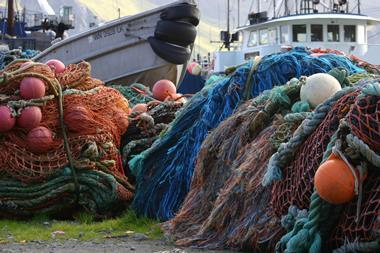
In 2003 Hong Kong's fishing fleet had 4,630 fishing vessels compared with 5,170 in 2000. Most are mechanized and more than 37 per cent are over 15m and the majority are trawlers followed by long liners and gill netters working the coast. Half the fishing fleet are sampans (up to 10 metres) catching in Hong Kong's inshore waters. Historically fishermen have been based at numerous small fishing ports and villagesaround Hong Kong. However, during the past two decades many fishermen have moved to more than 10 larger fishing harbours which also offer the advantage of acting as typhoon havens.
The decline in fishing vessel numbers has been mirrored by a reduction in the number of Hong Kong fishermen. In 2003 some 13,000 people were employed in fisheries in Hong Kong compared with 15,000 people in 2000. That includes fishermen, cage and pond farmers and oyster farmers.
"This number does not include mainland deckhands," officials said. "A typical Hong Kong vessel has two Hong Kong fishermen and up to six mainland Chinese deckhands. The new generation prefer to find a job on land so the number of fishermen numbers is down. In Hong Kong fishing is just seen only as a way of earning money. Young people here are better educated now and have more chances to get a job in another field. Fishing is a risky business and not everyone wants to do it," they added.
Many Hong Kong fishing vessels are family businesses run by husband and wife who employ mainland Chinese deckhands. The Department runs training courses for handling fishing boats and fishing gear. Seminars are organized for fish farmers to improve their husbandry skills.
Farmed fish
About 1,400 cage farm units are engaged in marine fish culture under the Marine Fish Culture Ordinance which has designated 26 fish cage zones in Hong Kong's waters. Common cage farmed species include green grouper, brown spotted grouper, Russell's snapper, mangrove snapper, cobia and pampano.
Freshwater fish ponds in Hong Kong covered almost 1,100 hectares in the late 1990s but is thought to have contracted since then as more land has gone for building development. Most freshwater fish farms are located in the northwestern New Territories. Most fish farms are engaged in carp polyculture, rearing bighead carp, silver carp, common carp and grass carp in combination with tilapia or grey mullet as the major species. Other cultured species include seabass, snakehead and catfish.
"There is no room for fish cage and pond farms to expand," the source commented, "Also, they face competition from imports from China and Southeast Asia."
Cantonese cooking is the most popular of China's regional cuisines among Chinese people and Hong Kong boasts some of the world's finest and most expensive Cantonese restaurants.
Seafood is one of the Territory's specialities and many restaurants display live fish, lobsters, prawns and other marine life in tanks and aquariums in their windows for customers to choose. "Live fish can be two to three times more expensive than chilled fish, but cage culture means some fish are more affordable," the source said, "not all cultured fish are cheap. Grouper are still expensive."
Live fish eaten at home includes sea bream, sweet lip and snapper.