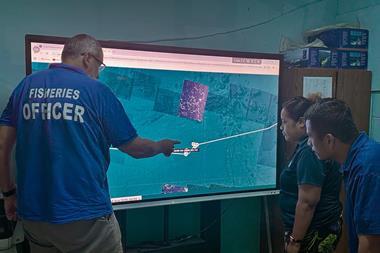




New discoveries in marine forensics by the Virginia Institute of Marine Science will allow federal seafood agents to genetically test blue marlin to quickly and accurately determine their ocean of origin.
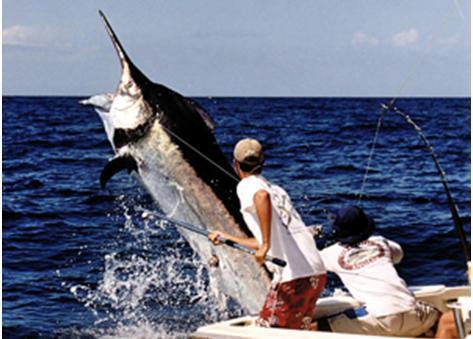
The test is needed to ensure that the blue marlin sold in US seafood markets were not taken from the Atlantic Ocean - the import and sale of blue marlin from the Pacific or Indian oceans is legal in the US, while the marketing of Atlantic blues can bring civil or criminal penalties. Regulation of Atlantic blue marlin reflects overfishing and a troubling drop in population within Atlantic waters.
Graduate Laurie Sorenson completed the work as part of her Master’s research in the College of William and Mary’s School of Marine Science at VIMS, with professor John Graves and molecular biologist Jan McDowell as her co-advisors.
Professor Graves, who chairs the US Advisory Committee to the International Commission for the Conservation of Atlantic Tunas (ICCAT), says “Blue marlin from the Atlantic can be illegally marketed as originating from the Indo-Pacific stock, which is currently unregulated. Laurie and Jan identified 10 new microsatellite markers that enforcement agencies can use to readily discriminate between Indo-Pacific and Atlantic fish.”
The new test uses “microsatellite markers” - repeating sequences of genetic material along the strands of DNA that lie within an organism’s cells. Closely related individuals - such as those within either the Atlantic or Indo-Pacific stock - tend to share similar patterns of repetition, thus providing a “genetic fingerprint” for identification.
“These new markers amplify well using samples from Atlantic and Pacific blue marlin,” says Ms Sorenson. “That means that they have value and utility in studies of both stocks. Use of these markers will provide a more powerful means of identifying the ocean of origin, allowing enforcement of regulations for this species.”
The team identified the new markers by examining blue marlin heart tissue, and tested their effectiveness by analysing tissues from 40 blue marlin - 20 from mid-Pacific waters near Hawaii, and 20 from the coast of Ghana in the equatorial eastern Atlantic. They isolated the microsatellite markers using PCR (polymerase chain reaction) and other techniques common to the geneticists’ toolbox.
“The new test provides more power to discriminate Atlantic and Indo-Pacific blue marlin,” says Ms Sorenson. “It uses a suite of markers to identify a sample’s ocean of origin with enough accuracy to be able to enforce the prohibition on the sale of Atlantic blue marlin.”
Trey Knott, a forensic biologist responsible for testing blue marlin at the NOAA’s Center for Coastal Environmental Health and Biomolecular Research in Charleston, South Carolina, is scheduled to visit VIMS this winter to be introduced to the new method. He will then transfer the testing procedure to the Charleston Lab, where he plans to put it into operational use later next year.