

France – Part 2
The economic role of France’s fisheries – Following on from last month’s Part One analysis of France’s fishing fleets, we now look at the economic impact of the industry.
In 2004 the fishing sector provided around 20,000 jobs, a decline of around 3,000 since 2002. It contributes around 2% to GDP and the sea-going employment generates a further 50,000 spin-off jobs and 40,000 indirect jobs.
However, France suffers from a structural deficit because its national production does not satisfy domestic demand. In 2004, the trade deficit for seafood production was 604,050 MT valued at €2.125billion.
Meanwhile, consumption rose to 34kg per annum in 2004 compared to 19 kg a year in 1999. The majority of fish including salmon, tuna, cod, oyster, Saint-Jacob shell and shrimps are sold in markets and up to 40 auctions between Dunkirk and St Jean-de-Luz in the north and Nice and Port-Vendres in the south. Hypermarkets and supermarkets play an important role, enjoying in excess of 67% of all fresh fish sales.
Import verses exports
Imports in 2004 rose 6% in volume to around €3billion. Principal suppliers were the UK, Norway and Spain and the main species were shrimps, scallops, coalfish, sea bream, angler, mackerel preserves, salmon and cod, but imports of fresh or frozen tuna, frozen sardine and cephalopods declined.
France exported around €1.1billion of shrimps, angler, eel, various whole marine fish, cephalopods and lobster. Exports fell in 2004 for anchovy, scallop, mackerel and tuna. Principal customers were Spain and Italy.
Aquaculture
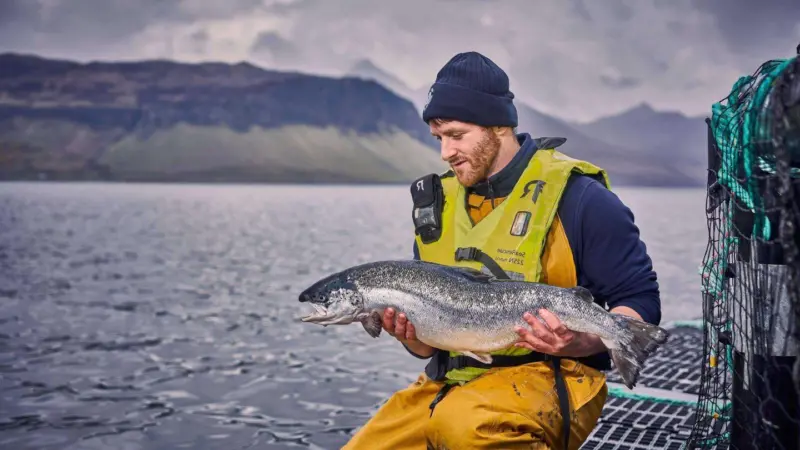
The United Nations has said the proportion of fish and shell fish supplied by aquaculture will increase to 40% of the total world fish supply by 2015 and France is at the forefront of this development.
Marine production in 2004 was dominated by mollusks – mainly oyster with 106,750 tonnes and mussels with 74,100 tonnes, generating a gross income of €600 million produced by 20,000 people in 3,700 farms, mainly privately owned.
Freshwater produce concentrated on trout with 36,611 tonnes produced by 500 farms, most of which produce less than 200 tonnes a year each, according to the French Research Institute for the Exploitation of the Seas (IFREMER).
France is the world’s third largest producer of farmed trout after Chile and Norway and consumes the bulk of its production. Around 80% of rainbow trout is also consumed domestically. France exports around 5,300 tonnes of rainbow trout mainly to Belgium and Germany and imports around 3,000 tonnes, essentially from Norway and Spain.
High-value sea bass and sea bream are both sold as whole fish, with 50% of the production being exported (about 2,400 tonnes) to the USA. France also exports up to 80% of its juvenile sea bass and sea bream.
Challenges facing Aquaculture
The government’s decision to tap into the high quality niche market follows intense competition from the Eastern Mediterranean and Southeast Asia, where labour costs are lower. The FAO also predicts fish prices in this category will continue to rise as consumers become more environmentally aware.
IFREMER believes the sector will benefit most through the production of marine fish, notably red drum as well as sturgeon caviar, selected strains for all fish species and quality labelled products.
French consumers have already stated their preference. In the first quarter of 2005, fresh salmon imports increased by over 6,000 tonnes despite the increased availability in Europe of less expensive frozen salmon fillets.
Aquaculture businesses willing to expand into the niche market have already identified the Eastern Provence, Alps, Côtes d’Azur and Corsica for potential development but are competing for these areas against a strong tourism sector.
As the world’s third biggest oyster exporter, France suffered a blow in January this year when it was forced to reduce production from 10,000 tonnes of flat oysters to 1,000 tonnes a year in a bid to protect dwindling stocks. Stocks have been slow to recover and authorities fear illness could wipe out Japanese oysters, which account for 98% of the world’s oyster output. Edouard Bedier, head of IFREMER shellfish laboratory, comments, “Oyster stocks produced in laboratory conditions have shown a greater survival rate, but we still don’t know how to produce them on a commercial scale. That is our greatest challenge.”
————————————————————————
France at a glance:
• France is situated in Western Europe, bordering the Bay of Biscay and English Channel, the Atlantic Ocean and the Mediterranean.
• It has 5,500km of coastline and 1,500km of overseas departments and territories on all oceans of the planet.
• It possesses the world’s second-largest EEZ, covering 11,035,000km², after the United States.
• Population in July 2006 is estimated to be 60,876,136
————————————————————————
Regulatory problems
France received a record £40 million fine earlier this year for failing to comply with a 1991 European Court of Justice ruling on failings in its fisheries enforcement policies and last year, the EU courts issued a £13.75 million penalty after the French government was found guilty of allowing fishermen to catch and sell immature fish.
France faces paying a similar fine every six months to the European Commission if it continues to fail to address weaknesses in the monitoring and control of fishing and landing activities and ineffective sanctions against fishermen breaking EU rules.
European fisheries and maritime affairs commissioner Joe Borg, during his visit to Brittany this year, welcomed the industry’s pledge to enhance the selectivity of fishing gear in the nephrops fishery off the Breton coast to allow the escape of young fish from trawled nets.
————————————————————————
Part 1 of this article was published in the May 2006 issue.