


Testing gentler ground gear
The new gear has only a third of the weight of a comparable set of rockhopper gear and as it generates less seabed contact, this is seen as producing less bottom impact than rockhopper gear.
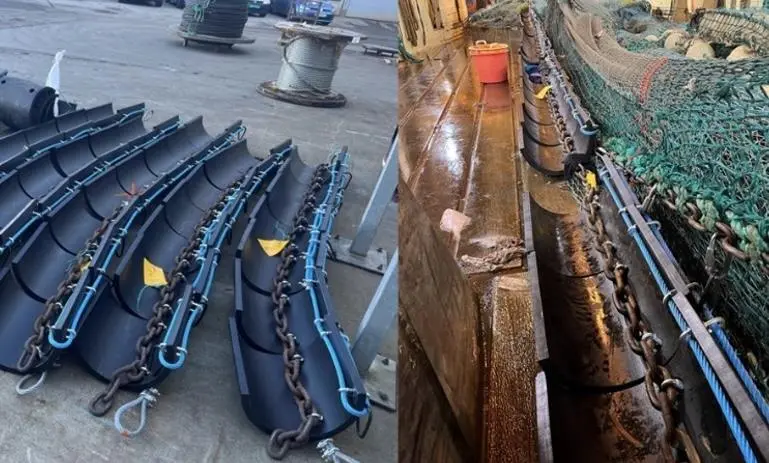
Trials at sea were carried out last year with the Directorate of Fisheries during November in connection with a couple of ongoing development projects involving the Institute of Marine Research, the University of Tromsø (UiT) and SINTEF Ocean, with the primary goals of developing new selection devices for the whitefish trawl fishery and reducing the bottom impact of trawl gears.
The idea of using these semi-circular profile sections in place of conventional footropes is not new and this was first tested a decade ago. Although it has been deployed on several research trips over the years, this is something that hasn’t previously been tried out on a commercial basis.
The gear tested this time was constructed in seven sections with a 31.2-metre overall length, and a weight of around 1,000 kg – roughly a third of the weight of rockhopper gear. Trials were carried out using a twin-rig setup, a direct comparison was possible.
Compared to the rockhopper gear, the SCSG caught approximately 50% more fish – although the researchers warn that these results should be interpreted with caution. Indications are that the SCSG gear loses around 20% less fish under the fishing line than conventional gear, while the increased spreading capacity and stability of the SCSG account for the higher catch rate.
Now the Norwegian Seafood Research Fund is allocating NOK 5 million towards further development of this type of ground gear to come up with a commercial product.
“The good results have generated great interest in the trawl sector, although the trial also showed that there are a number of technical details that should be resolved before the semi-circular gear becomes a commercial product,” a representative of the fund stated.
“As a reduction in CO₂ compensation and an increase in the CO₂ tax are on the agenda for the fishing fleet, it will be fundamentally important to find new technologies that can make fishing more efficient, reduce fuel consumption and reduce environmental impact.”
The Norwegian Seafood Research Fund is seeking applications for a project to develop semi-circular gear into a commercial product, which includes scale model tests in a flume tank to fine-tune geometry and functionality, before full-scale trials under commercial conditions with results fully documented.
Related Articles
 FISHING TECHNOLOGY
 NEW VESSELS
 FISHING TECHNOLOGY