




AI and the art of informed decisions
It’s all about making it possible for users to make the most fully informed decisions possible, said Jón Heiðar Pálsson, who heads sales at Icelandic software leader Wise.

Located in Iceland, Wise has built up a strong reputation for its accounting and business software systems that are in use around the world, based on Microsoft Dynamics 365 Business Central. The Wise offerings include WiseFish, tailored for seafood companies, and he commented that somewhere between 80 and 90% of all Icelandic quotas are managed via a Wise system in one way or another as WiseFish in particular was a revolutionary tool when it first appeared on the market 25 years ago.
“The fundamanetal difference between what WiseFish can do and other systems is that WiseFish holds all of the information relating to the seafood value chain in one place, whch provides a unique overview of the process as a whole, from catching, through processing, and all the way to sales and distribution,” he explained.
By building on the foundations offered by Microsoft’s Business Central, today used by more than 160,000 companies around the world, the service side of the system is fully covered, plus there are tailored add-ons that cover particular taxation requirements, different languages, and more. There are agents in most countries able to install standard systems, and to provide service for additional packages as required.
“In the past, all this information was here and there across the value chain. But the arrival of WiseFish made it possible to bring all of these elements together into a single, central database, eliminating the need to enter the same information more than once, instead enabling the data to flow,” he said.
“When Navision, which later became Business Central, appeared on the scene there was finally a tool that could harmonise databases and simplify processes. What we at Wise have done is to tailor the “fish” interface for this system. There was no need to go deep into developing a business and inventory framework, because that was already there, and instead we were able to focus completely on crafting and fine-tuning an interface that would meet the demands of the seafood sector. So WiseFish was the first system that brought together every strand of information a seafood company needs in a single package.”
Digital transformation
The technical advances of the last few years and decades have resulted in significant changes to the seafood industry. The digital transformation gathered pace during the 1990s, laying the groundwork for synthesised production processes and the development of communications technology that are behind today’s innovations.
Reliable information is the basis of good decision-making. By linking systems such as Marel’s Innova production systems and Wise peripherals with WiseFish users can maintain a complete overview of fisheries, production, inventory, sales and distribution with far more precision than has been possible before, and can take business decisions based on this up-to-date data.
Much of the production process is now automated, and the introduction of artificial intelligence isn’t far away – and for Jón Heiðar Pálsson, this is a dream that’s about to come true.
“Put yourself in the shoes of a production manager who takes delivery of 20 tonnes of fish. That’s raw material that can be used to manufacture more than a hundred different products. The decisions that need to be taken depend on a whole range of factors, such as how long the fish have been in ice, which packaging is most economic, what prices various products fetch, what products buyers are asking for, and so much more. There are thirty to forty indicators that the production manager needs to evaluate very rapidly to know how best to deal with this raw material,” he said, commenting that in future artificial intelligence will be increasingly employed to define the most effective production strategies for the limited resources that are available.
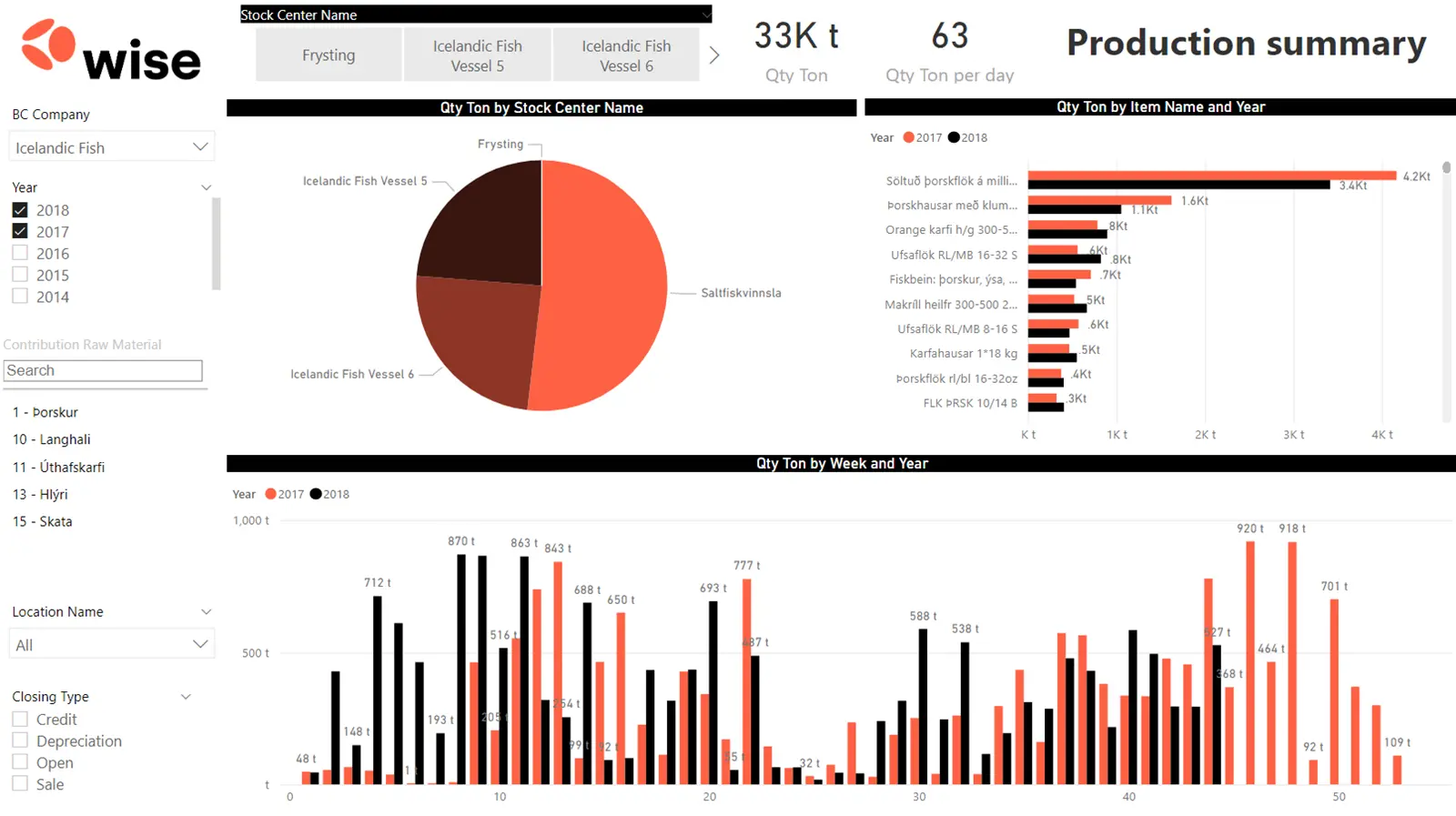
“With this rapid growth in the digital world, it should be able to draw information from around a hundred points in sales, catching and production histories that can be collated in a single location to assist in taking the most effective decisions. This is the dream we’re working towards,” he said.
“We have gradually been building up a set of data streams and information held in the system, which will make this possible. Fishing trips are registered in WiseFish, with data on catch, temperature, position and more, making it possible to monitor the raw material and have information on what’s in the fishroom, in which tubs, when it was iced, and so on. When the fishing vessel docks, the production manager has already planned production routes for the fish. This is where artificial intelligence can be fully utilised in assisted decision-making, taking into account what the market is looking for and what the sales people are selling at that point.”
He added that artificial intelligence also holds the keys to market prediction that can be of significant use in sales and marketing.
“The sales team can see exactly what is in stock, and a transparent production process that can be easily adjusted to market requirements means that sales can also see what will be in stock. This gives the sales team an advantage as they can offer customers products that are still raw material in a fishing vessel’s hold.”
New year, new WiseFish
A new version of WiseFish can be expected in early 2022 and the company’s technical department is busy with the final stages of development along with consultants Itera as they make the software better and even more user friendly. The intention is to have Wise systems available on the Microsoft marketplace, and this calls for some strict requirements concerning quality, functionality and support to be met. Rather than an intergral system, the new version comes as an addition to Business Central, which facilitiates installation and updates for both users and their partners. At the same time, Microsoft’s cloud solution is being taken into use, opening further opportunities – such as for the use of artificial intelligence.
“At Wise we want to take this idea all the way, so that all WiseFish users can upload specific data to the cloud anonymously, providing access to detailed comparison data that can be highly beneficial,” Jón Heiðar Pálsson said.
This comparison capacity combined with everything that artificial intelligence can offer are expected to generate more than just financial advantages. The result is expected to be a leaner, more streamlined process as a whole that supports sustainable practices. As the carbon footprint of their purchases becomes increasingly important to consumers, a system that helps manage the entire chain from the deck to the consumer’s plate eliminates unnecessary movements, reducing fuel consumption and therefore emissions. This also minimises risk to the product’s quality and shelf life by reducing the hazards of unexpected temperature changes.
“By taking advantage of complete solutions and artificial intelligence, we can take things further than we do today. It’s challenging to take decisions when the volume of data available is so broad,” he said.
“Using the technology means better decisions are taken, and that maximises the value of every box of fish that’s landed.”
Related Articles
 FISHING TECHNOLOGY
 NEW VESSELS
 FISHING TECHNOLOGY