




Korea introduces migrant fishing crew protection plan
Korea’s Ministry of Oceans and Fisheries (MOF) has established its new “Plan for Further Enhancement for Working Conditions of Migrant Fishers on Distant Water Fishing Vessels”, which it developed in cooperation with NGOs Advocates for Public Interest Law (APIL) and Environmental Justice Foundation (EJF), and also the distant water fishing industry.
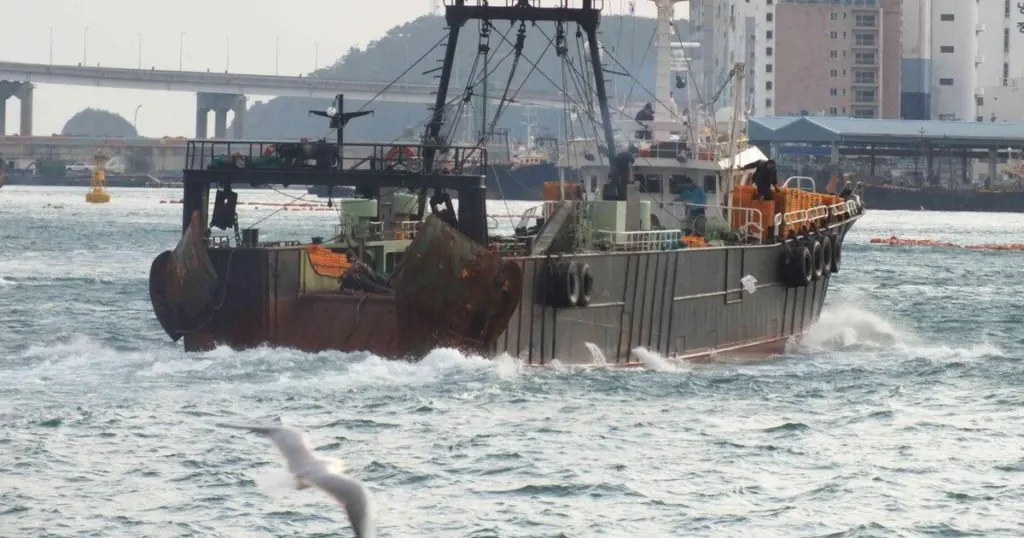
Announcing the plan, the government explained that the characteristics of distant water fishing, with long-term fishing operations, make it difficult to conduct on-site inspections on working conditions and report human rights violations right away.
In December 2020, it prepared and implemented an improvement plan to strengthen the labour rights of migrant workers on distant water fishing vessels, which resulted in considerable improvements, including applying minimum wage standards and charging recruitment fees to vessel companies. However, civil society has continued to raise the need for further improvements in the working conditions of migrant fishers, criticising that human rights violations on distant water fishing vessel still remain.
In response, MOF, EJF, APIL and the distant water fishing industry have jointly established the new plan. This followed multiple meetings to update improvement of working conditions for migrant fishers of distant water fishing vessels.
Considering the characteristics of the distant water operation, the plan focuses on preventing possible human rights violations by imposing substantial sanctions on violators and strengthening victim protection. It also stops any deductions or the withholding of fishers’ wages under the pretext of savings or recruitment fees, MOL said.
Additionally, a comparative study on the wage standards and payment system between Korea and other leading countries will be designed at the meeting of the Tripartite Council to promote upgraded conditions for the migrant fishers’ wages scheme including improved standards on wages and payment, and recognition of fishers’ career history and upgraded bonus. This meeting is scheduled for the second-half of 2024.
There will also be an enforced port of call for tuna longliners during their sailing itinerary within one year of their initial departure for fishing operations.
With regards to periods of rest, employment contract provisions will include the entitlement for migrant fishers to have extra hours’ rest in return for their excessive work. Also, a survey will be conducted upon the crews’ disembarkation to establish whether they were rightly provided with their entitlements during their work, and given a minimum of 10 rest hours per day (including six consecutive hours).
Substantial sanctions such as reduced quota will be imposed on violators.
Furthermore, due to the difficulty in attesting to an alleged violation against the ban on confiscation of migrant fishers’ passports, a personal locker, a storage with individually-allocated area, will be installed at the public space, such as dining room or lounge.
MOL advised social media platforms could be used to conduct random inspection on the working conditions and that an anonymous bulletin board will enable migrant fishers to report any discriminatory treatment and human rights abuse onboard.
Vessels suspicious of repeated violations of human rights protection will be blacklisted, resulting in random inspection conducted jointly by MOF and the NGOs. Also, consultations and cooperations with distant water industry stakeholders will be sought for phased application of the C188, Work in Fishing Convention 2007 of the International Labor Organization(ILO) to the related industry.
“This is an international best-practice and holds significant meaning as it is the first time that the government, NGOs, and the industry have jointly formulated a plan through communication. [The Ministry] will closely monitor the implementation of the plan aimed at improving the working conditions of migrant fishers, and strengthening the protection of their rights, and will strive to ensure that all seafarers work in a safe environment without any discrimination,” Oceans and Fisheries Minister Kang Do-Hyung said.
“We view the government’s proactive engagement with stakeholders in formulating the plan as a positive trend, and we look forward to continued consultations to ensure active implementation of the Plan on the ground its tangible impact on enhancing human rights of migrant fishers.” said APIL CEO Jung Shinyoung and EJF CEO Steve Trent.
Both added that they anticipate continuous improvement on the matters that were not included in the plan this time around.
Related Articles
 FISHERIES
 FISHERIES
 FISHERIES