



Arctic scalloper connected
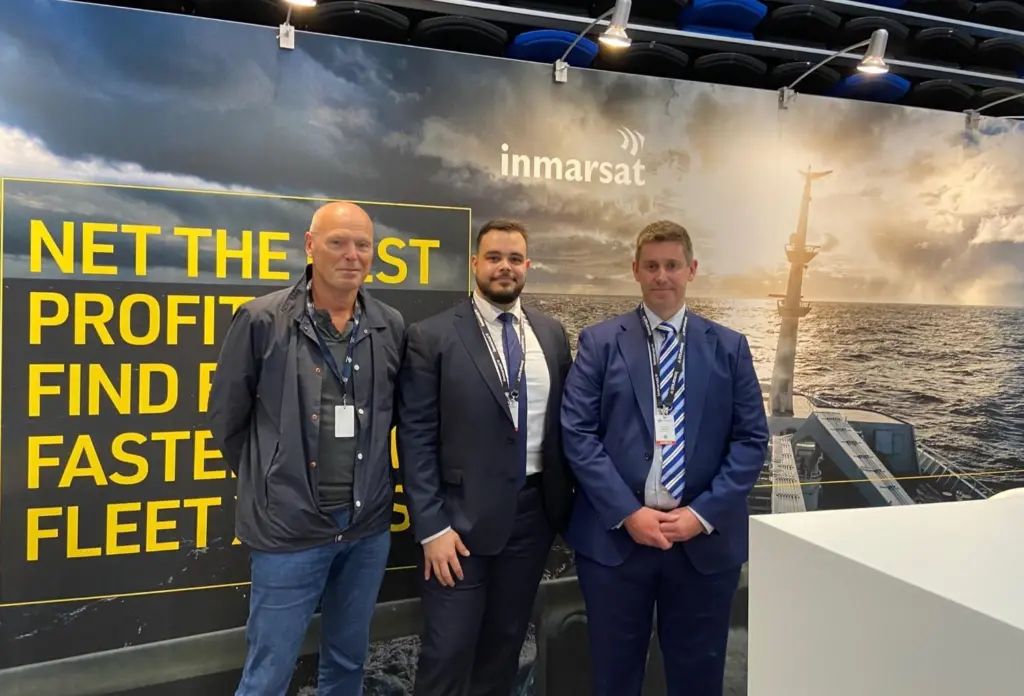
Norwegian company Tau Tech is to begin sustainable scallop harvesting in the Barents Sea and will use Inmarsat’s maritime broadband service Fleet Express following the signing of an agreement at Nor-Fishing 2022.
While traditional seabed dredging of scallops has not been allowed by Norwegian authorities for 30 years, due to its damaging effects on marine ecosystems, in cooperation with the Institute of Marine Research, the Directorate of Fisheries and other leading marine experts, Tau Tech has proven over the past five years that its innovative technology makes it possible to identify, select and sort shells without destroying surrounding vegetation and life.
The company’s new approach to scallop harvesting will start in the autumn with the aim to revive the harvesting of the valuable seafood resource at a commercial scale.
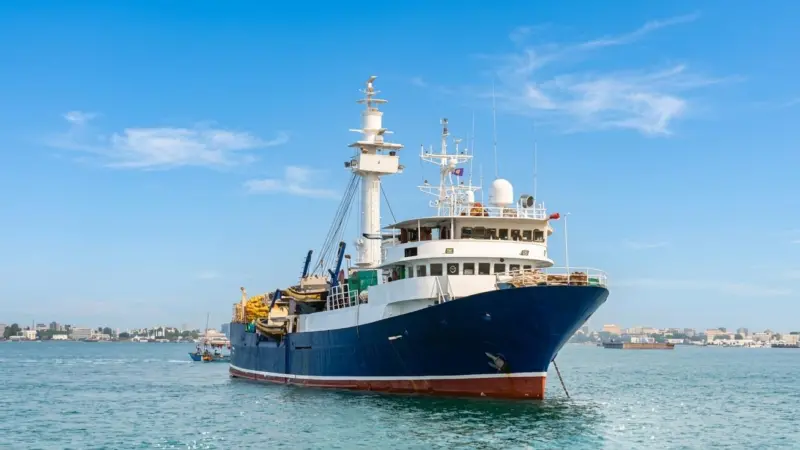
“Our unique precision seabed harvesting technology enables us to harvest seafood gently, yet efficiently without damaging their fragile surroundings,” Tau Tech’s Technical Manager Jan Rogne explained. “Inmarsat’s Fleet Xpress installed on our vessel Arctic Pearl, will help us to carry out our operations in a sustainable way and allow us to adopt new services and applications to further enhance operational sustainability, safety and security as new challenges arise.”
Arctic Pearl Captain Svein Ole Sæther said, “Inmarsat’s planned new Arctic satellites are particularly interesting to us, as they will greatly improve connectivity and communications in some of the most hard-to-reach areas on earth.”
Inmarsat Maritime Regional Sales Director Scott Middleton said that Tau Tech’s new solution “opens the door” to re-establish commercial scallop seabed harvesting on a fully-sustainable basis.
“Inmarsat is proud to support the company’s project in the Barents Sea – delivering connectivity and providing the option to digitalise and enhance vessel operations in the long term.”
Middleton also commented that digitalisation in the fishing sector is “fast catching up”, with Inmarsat working closely with fishing vessel operators to deliver integrated and scalable satellite communication solutions to match their operational needs and enable crew welfare.
Through the Fleet Edge platform, Inmarsat’s Fleet Xpress offers shipowners access to a broad portfolio of value-added services and supports a flexible, step-by-step approach to digitalisation. Services are delivered via a secure, dedicated network with no impact on mission-critical bandwidth.
According to Inmarsat, the Arctic Circle represents a rapidly growing connectivity region for high-quality broadband with increasing requirements from maritime customers and its GX10A and 10B satellites will be the world’s first mobile broadband payloads dedicated to the Arctic region.
It says the multi-beam, high-throughput HEO (highly elliptical orbit) payloads will ensure continuous coverage and offer the ability to direct capacity in real-time to the areas of highest demand.
The expansion of Inmarsat’s Global Xpress (GX) network is being delivered in partnership with Space Norway and its subsidiary Space Norway HEOSAT as part of the Arctic Satellite Broadband Mission.
Related Articles
 FISHING TECHNOLOGY
 FISHING TECHNOLOGY
 COMMENT