





Eco-friendly alternative to bottom trawling for India
The trawling industry in India tends to be shrimp-oriented, due to its economic importance and export value.
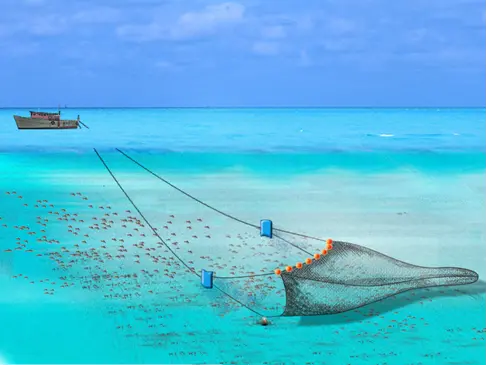
However, Indian trawler fishermen cannot depend on shrimp alone for viable commercial operations anymore, due to proliferation of trawlers and overfishing of target resources. There are over 29,000 trawlers operating in small-scale mechanised sector of India.
Trawler fishermen have been required to adopt appropriate fishing gear to expand their reach to harvest large demersal and semi-pelagic species which are beyond the reach of currently existing designs of shrimp/fish trawls. A responsible fishing regime, which is promoted in India and around the world, requires that the selectivity of the gear has to be improved and its negative environmental impact has to be reduced, in order to protect the biodiversity and environment and to ensure long-term sustainability of the fishery resources.
It is in this context that the Central Institute of Fisheries Technology (CIFT) has developed a semi-pelagic trawl system for the benefit of the mechanised trawling sector.
Resource specific trawls for semi-pelagic resources have a comparatively low impact on the benthic biota. In the semi-pelagic trawl system the otter boards remain in touch with the bottom, but the trawl floats at some distance above the bottom.
CIFT semi-pelagic trawl system
The CIFT semi-pelagic trawl system, called CIFT SPTS, was developed after extensive field-testing. It is capable of attaining catch rates beyond 200 kg.h-1 in moderately productive grounds and selectively harvest fast swimming demersal and semi-pelagic finfish and cephalopods, which are generally beyond the reach of conventional bottom trawls, currently used in commercial trawl fisheries in India.
CIFT SPTS has been developed by a team of researchers from the Fishing Technology Division of CIFT, after extensive field trials and observations, using acoustic gear monitoring instrumentation and inference from statistical evaluation of catch.
The system consists of an 18m four-panel semi-pelagic trawl with double bridles, front weights of 25kg each and vertically cambered high aspect ratio otter boards (trawl doors) of 85kg each.
Advantages of CIFT SPTS
Major advantages of the CIFT SPTS over the conventional shrimp/fish demersal trawl systems in vogue in the Indian fishing industry include:
- Conventional bottom trawls are proven to cause high bottom impact on the benthos. As the semi-pelagic trawl is designed to operate at some distance above the bottom, the bottom impact of semi-pelagic trawl is significantly lower, making it an ecologically friendly gear, compared to bottom trawls.
- Results of performance evaluation and biodiversity analysis have shown that CIFT SPTS has significantly high resource specificity for off-bottom finfish, which are generally large in size, fast swimming and exhibit shoaling characteristics. Conventional bottom trawls have poor resource specificity and size selectivity and have greater impact on biodiversity and sustainability.
- Conventional bottom shrimp and fish trawls have low vertical opening, mostly limited to 1-1.5m and hence their catches are limited to species living close to the bottom. Due to higher vertical opening up to 4.0m realised in CIFT SPTS, resources that are beyond reach of conventional bottom trawls, could be efficiently harvested.
- Significantly high sheer-drag ratio of vertically cambered high aspect ratio otter boards, makes the system energy-efficient, compared to conventional flat rectangular and V-form otter boards. The vertically cambered high aspect ratio otter boards have dual-purpose capabilities and can also be deployed for conventional bottom trawling.
CIFT SPTS is indigenously developed and is best suited to Indian fishing conditions and fishery resources. The gear system has been developed and optimised taking into consideration the biological, behavioural and distribution characteristics of tropical demersal and semi-pelagic finfish and cephalopod resources and technical capabilities of the small-scale mechanised trawler fleet, operating in Indian waters. About two million tonnes of estimated potential fishery resources in the Indian Exclusive Economic zone would be accessible to the semi-pelagic trawl system.
CIFT SPTS with exchangeable codends is prescribed for harvesting non-shrimp trawl resources (55mm codend for small demersals like mackerel and horse mackerel and 166mm codend for tall bodied fishes like pomfrets), based on codend selectivity studies.
CIFT says that the adoption and responsible use of CIFT SPTS will be a boon to the Indian small-scale trawling industry, to enhance fish production and profits and minimise the environmental impacts of trawling.
Shrimp trawls when operated should be equipped with bycatch reduction devices (BRDs) and should target shrimp alone, in order to conserve fishery resources and minimise biodiversity loss due to trawling.
Release of the technology
The technology advisory was released for the benefit of the fishing industry by Dr B Meenakumari, Deputy Director General (Fisheries), Indian Council of Agricultural Research, at function organised at CIFT, well-attended by representatives from State Fisheries Departments, fisheries development agencies, NGOs and the fishing industry. Also in attendance were Dr K Gopakumar, former DDG (Fisheries), ICAR; Dr K Ravindran and Dr K Devadasan, former Directors of CIFT, Dr VC George, former HOD (Fishing Technology) and former Scientists and Technical Officers of Fishing Technology Division.
Related Articles
 FISHING TECHNOLOGY
 NEW VESSELS
 FISHING TECHNOLOGY