




Dynex Data – best new product
Icelandic company Hampidjan won the Icelandic Fisheries Award for Best New Product Launched at the Show for its Dynex Data headline sounder cable.
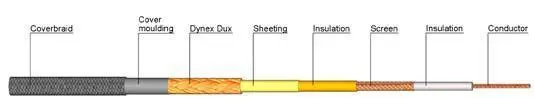
The company says that the cable has been three years in development in a process that demanded investment in new equipment to make production possible, and during which Hampidjan’s engineers overcame a number of technical obstacles.
The cable is the link between the headline sonar and the display in the ship’s wheelhouse, giving the skipper a realtime image that shows the trawl’s horizontal and vertical opening, as well as recording marks of fish entering the trawl mouth.
The Dynex Data cable has many advantages over the conventional steel cable, including:
• It is higher in the water and does not foul the warps in a turn.
• It does not lie high in the water when fishing on shoal marks, so the fish are less likely to be spooked.
• It is lighter, with a relative density of 1.28, compared to 4.47 for steel cables.
• It has the same or better breaking strength than steel cables.
• It does not rust.
• It does not go over and behind the trawl if too much cable is shot away.
• Contact with Dynex Data does not damage the trawl or warps.
The owners of Faroese pelagic flagship Tróndur í Gøtu were Hampidjan’s first customers for its Dynex Data cable.
Tróndur í Gøtu is a sophisticated and well-equipped purser/trawler, fitted out – unusually for a new vessel – with a pair of sounder cable winches on the aft gantry. The decision was taken after discussions with the owners to load one of these two sounder cable winches with Dynex Data cable to test it under real conditions.
The ship was set to steam home after the capelin season in Icelandic waters last winter, having made a landing at Fáskrúdsfjördur, when 3,000m of Dynex Data cable were loaded onto one of the drums.
Tróndur í Gøtu’s pelagic trawl was shot away with 800m of Dynex Warp and towed at a depth of 200m off the Faroese coast. One thousand metres of Dynex Data cable were also shot and the gear was towed for a couple of hours with a tension on the cable winch of 1.70 – 2 tonnes. As the gear was hauled, the cable was seen to sit well on the cable drum without digging its way in between the previous layers. Signal strength to the wheelhouse was excellent and images from the headline sonar were both clear and steady.
According to Valdimar Einisson, service manager at Simrad Konsgberg agent Fridrik A Jónsson ehf, the signal quality was good, communication with the gear was perfect and interference was minimal compared to the usual experience with steel cable. The resistance in the Dynex Data cable was measured at 40ohms at 3,000m.
This low resistance means that there is less loss of strength, which is a major advantage. Mr Einisson said that the voltage used depends on the type of headline sonar used. The old FS3300 model uses only 110v DC, but newer models such as the FS925, TS10, TS15 and FS70 are made to run on 220v DC. In spite of this, many pelagic vessels are still using 110v with the newer equipment.
Related Articles
 ICELANDIC FISHERIES EXHIBITION
 WORLD FISHING EVENTS
 WORLD FISHING EVENTS