

Denmark
Danish fisheries about to enter a new era – Hans Morten Sundnes examines the state of Danish fisheries and the likely impact of new quota arrangements to come into force at the beginning of next year
No one actually knows what will happen after New Year’s Eve this year when Denmark wakes up to fixed, annual quotas for the main species in its fisheries. But the Danish fish industry now seems to share an optimism for the new regulations. That includes the processing industry and exporters, who no matter what, will keep on dreaming about a New Year without a net of duties and other import regulations. The dream of growth in the ponds and nets of Danish aquaculture might become true.
To make it simple, we could write that Denmark consists of the Northern pointed finger of Jutland in addition to 443 named islands and that it all represents some kind of border between the salty North Sea and the less salty Baltic. But nothing is simple. The Danes reckon to be surrounded by at least four or five seas: the Eastern Baltic in the “far East”, the Western Baltic around the isles, Kattegat in the North East, Skagerrak in the North, and the North Sea to the West.
To simplify again, the North Sea is far and away the most important for Danish fisheries. In 2005 about 900,000 tonnes of fish was landed in Denmark. The landing value of this was 2.9 billion Danish Kroner (DKr). Two thirds of this value was harvested in the North Sea, 16% in the Skagerrak and 9% in the Eastern Baltic.
In general Danish fisheries can be divided into consumer fisheries and industrial fisheries. The value of consumer landings in 2005 was DKr 2.4 billion, but accounted for only 290,000 tonnes of the total catch. On the other hand the value of industrial fish was 433,000 tonnes worth DKr 543 million. The 68,000 tonnes of mussel constitutes its own category. The most important consumer fish were cod, herring, crawfish and plaice. The main targets for the industrial fisheries have been sand eel, Norway pout, sprat, capelin, horse mackerel and blue whiting.
Shadows and light
Facing five seas, however, also means dealing with five worries. Cod, sprat and herring of the Baltic struggle in the polluted, brackish waters. The levels of plaice and sole in the North Sea have been defined as unsustainable. The condition of the North Sea and Skagerrak sand eel stock has been in severe decline for a number of years. And when the scientists of ICES presented their advice for cod fishing in the North Sea, Skagerrak and Eastern Channel in 2004, the recommendation was zero – it still is. (Despite this, Norway and the EU have agreed on a TAC of 23,205 tonnes of cod for 2006.) Even the mussel stock has declined.
Still the bright spots are there. First of all it seems that both industry and the authorities take the situation seriously. A long-term mangangement plan has been established for cod, plaice and sole. Concerning the sand eel, the European Commission reopened the fisheries on 19th June this year. The total allowable catch (TAC) in the North Sea and Skagerrak for 2006 was set at 300,000 tonnes. This actually disappointed both Danish fishermen and authorities since Danish scientists felt that the stock could bear 200,000 more. But in the end they didn’t manage to fill the quota. The Danish government has, on the other hand, pointed out that the fishermen have a potential to use the blue whiting and a few consumer species. The crawfish quota was actually raised for 2006. The mussel fisheries have decided to reduce their efforts, while there have been iniatitives to move to a different kind of mussel cultivation.
The new European Fisheries Fund will of course make it easier for the fisheries and industry to adjust and to establish a sustainable exploitation of the resources. In June this year Denmark’s Minister of Fisheries declared that he expected DKr 125 million annually for the period 2007-2013.
Crushing millions
Another positive sign is that both fishery for human consumption and industrial production increased in both volume and value during the first quarter of 2006.
3,274 fishing vessels are registered in Denmark. This fleet can be divided into three main groups – gillnet, purse seine and trawl. Three quarters of the boats belong to the gillnet group, but in terms of tonnage, engine power or insurance value, the trawler share actually comes to three quarters of the whole. In total, about 5,000 people are employed in the fisheries, and both the fishermen and the vessels of Denmark are mainly organised in the Danish Fishermen’s Association (DFA).
Besides the struggle for a healthy, rich ocean with high TACs, two issues in particular have attracted the attention of the DFA and the fishermen last year. One is about “crushing steel and cutting wood.” Too many boats and too little fish is the background for the political decision to grant considerable support for crush fishing vessels. On July 20th 2006 the total support in 2006 was set at DKr 240 million. DFA’s chairman, Flemming Kristensen, stated that he was very satisfied with the amount.
A new world
The Fisheries Association is also, by and large, supporting the new regulation which will establish a “new world” for Danish fisheries from January 1st, 2007. The agreement marks a significant departure from the policy pursued so far according to which fishermen were allocated vessel “rations” for merely two weeks or one month at a time. Instead, fishermen will be allocated a fixed share of the annual national quota in the form of so-called vessel quota shares. The system implies that both vessels and quota shares may be traded in a way where the “fish follow the vessel tonnage“.
This is contrary to the ITQ system, where quotas can be traded separately. Historical catches in the period 2003-2005 will lay the foundation for measurement of each individual quota. The regulation is meant to support a structural development within the Danish fishing sector that will result in a more profitable industry and a renewal of the Danish fishing fleet.
“One of the main objectives of the reform has been to strengthen profitability by improving the framework and by increasing predictability for the fishing industry, which will enable the individual fisherman to plan for much longer than just one month ahead,” Minister for Food, Agriculture and Fisheries, Hans Christian Schmidt, says. The Minister also believes the regulation will reduce the discarding of fish at sea.
“With an annual quota, the individual fisherman will no longer have to stay within a tight short-term quota. Therefore, fishermen will not feel forced, to the same extent, to throw good, edible fish back into the sea,” Minister Schmidt points out.
The World Wildlife Foundation, which originally had a seat on the committee that prepared the regulation, does not agree. WWF Denmark in fact left the committee, pointing out that the new quota system will destroy coastal fisheries and freeze the ownership structure. The reform has indeed been controversal, especially among those who caught little fish in 2003-2005. In fact a lot of fishermen are still uncertain about the consequences. But the DFA believes the total effect will be good.
“Danish Fishermen’s Association is of the opinion that the new quota system will be economically beneficial for fishermen, making them able to predict by themselves when to catch the fish. It will also make it more attractive for young people to become fishmermen, and it will make it easier to finance new boats and modernise the fleet,” DFA spokesman Kim Vejrup told World Fishing.
Duties and ponds
Vitality in Danish fisheries and survival of stocks are, of course, in the interest of the national processing industry and the exporters. But it’s a long time since the land industry and the salesmen started seeking raw material and seafood outside Danish seas. We mentioned that the fish loaded in Danish harbours amounted to a volume of 900,000 tonnes and a value of DKr 2.9 billion. This is enough to be ranked among the leading fishery nations in the EU. But the turnover of the industry is DKr 20 billion, ranking it as the 6th largest exporter of seafood in the world. Obviously, Denmark has to import a huge amount of the fish; in fact it imports 70% of its fish and crustaceans.
Before we go further, the special relationship between Denmark and the former colony Greenland has to be mentioned. Today, Greenland is self-governed and outside the EU. But if we look at the list of major Danish food companies today, we find names like Royal Greenland and Polar Seafood Greenland near the top. The mother companies in Greenland export cold water shrimps, halibut and other fish from Greenlandic waters to their subsidiaries in Denmark.
But also tiger prawns from Southeast Asia and a lot of new exotic products find their way to the open minded Danes. So does much Norwegian salmon, which might be the most important fish for the Danish processing industry. Import duties have made it profitable to process the Norwegian redfish within the European Union but the salmon trade war between the EU and Norway has placed Danish industry “between the devil and the deep blue sea.”
The EU decision to set minimum prices for salmon is shortsighted and not fruitful, the leader of the Danish Seafood Association (DSA), Poul Melgaard Jensen, recently said. He also wants to remove, or reduce, the complex duties on seafood imports in general.
Danish processing and export companies are represented either by DSA or the Association of Danish Fish Processing Industries and Exporters. Overall, 5,000 people are employed in 66 Danish processing companies and the same number of trading firms.
Melgaard Jensen, of DSA, speaks for some 60 of these. He wants the Danish authorities and the EU to realise that progress for the Danish industry today and in the future, depends on imports. The view that Danish fish farming will contribute to the progress is shared by the associations and the authorities.
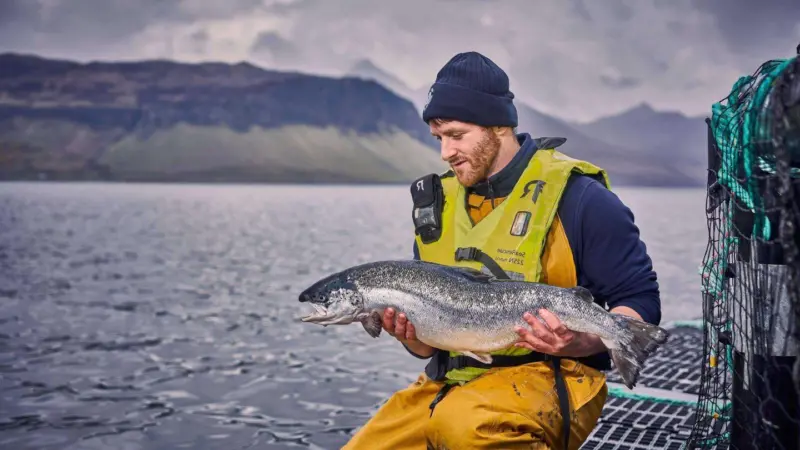
In May this year the conservative government presented its vision for 2007-2013. Today Danish aquaculture produces 40,000 tonnes. However, within just 10 years, this is expected to triple to some 120,000 tonnes, based on growth in trout farming at sea and in ponds, farming of eel and even new species like turbot, sole, cod and perch. The processing industry hopes that this will also create more stable deliveries. On the other hand the farm fish have to eat, so taking care of the sand eel stock has never been more important.