




Damen delivers ‘silent’ research vessel
Damen Shipyards Group has delivered the research vessel ‘Simon Stevin’ to its Belgian client DAB Vloot, the Flemish governmental fleet operator.
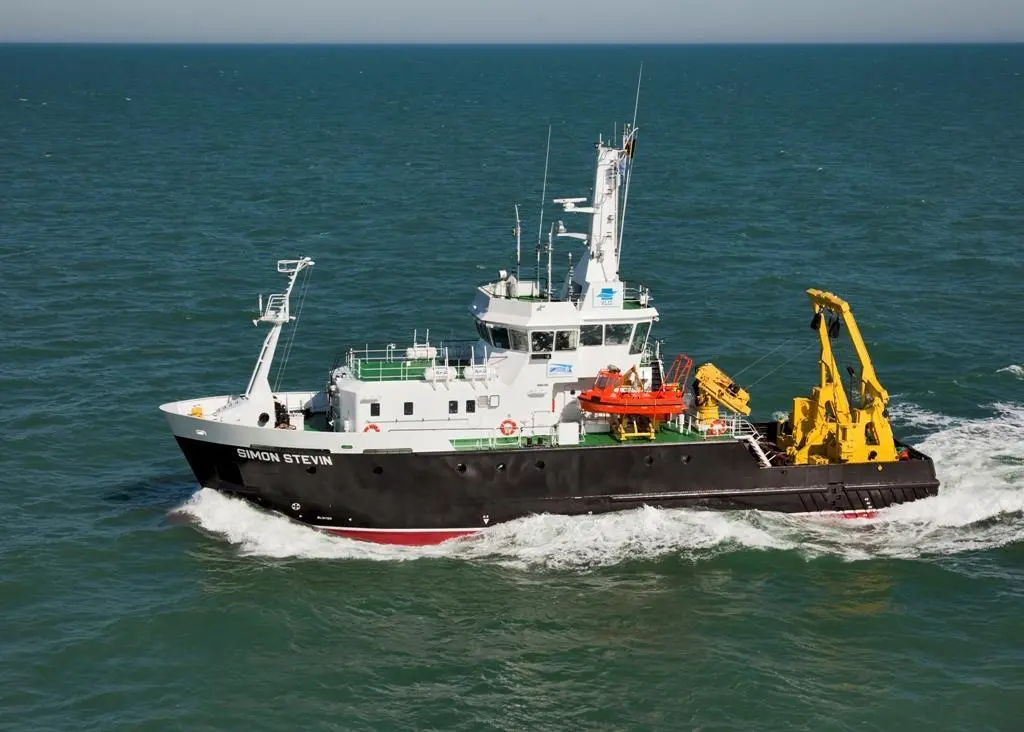
The vessel was jointly designed by Damen Shipyards Gorinchem and VLIZ, the Flemish Institute for the Sea.
The Simon Stevin will be used for Flemish multidisciplinary research programs that are undertaken by VLIZ, Belgian universities and other scientific institutions in the North Sea for studies in oceanography, fishing, marine biology, microbiology, chemistry and archaeology.
The vessel has been named after the influential Flemish mathematician and engineer Simon Stevin (1548-1620) who designed and executed many civil works related to water technology and marine engineering.
The design and lay-out of the vessel is optimised to have very low underwater noise levels and be able to sail in ‘silent mode’, and the Simon Stevin is the smallest vessel in the world (36x9m) that complies with ICES Standard 209, a standard that limits Underwater Radiated Noise.
The scientists and researchers have both a ‘dry’ and a ‘wet’ laboratory at their disposal on the main deck. On the forecastle deck there’s a survey room (containing the servers and most computers) for data analysis. When the net drum is dismantled, the aft deck offers room for additional containerised laboratories.
The basic characteristics of the vessel are a tiltable A-frame on the aft deck, a number of winches for hydrographical survey work, soil sampling and fishing, two laboratories, a 200kW bowthruster, a Dynamic Positioning system, and a free deck space of 45m² allowing space for two containers. Underneath the vessel (and integrated in its keel) a ‘blister’ is installed, i.e. a pod containing a multi-beam echosounder and other equipment for 3D-imaging of the sea bed.
A set of purpose-built fishing winches, uniquely installed below-deck, allow the Simon Stevin to apply several fishing methods.
The Simon Stevin has (sleeping)accommodation, including a separate messroom, for 10 crew and 10 scientists when going on multi-day missions. For day-trips the vessels can take up to 30 persons onboard.
The vessel is propelled by two 520kW electric motors, which are flexibly mounted to reduce subsea noise levels. Three generator sets supply the electricity for the propulsion system, the winches and other electrical equipment. Up to 9.5 knots the Simon Stevin is able to sail in ‘silent mode’; its maximum speed is 12 knots.
Related Articles
 FISHERIES
 FISHERIES
 WORLD FISHING EVENTS