





Continuous process solves problems with thawing
A lot of attention has been paid to the freezing of fish; to ensure that the core temperature is reduced to the required level as speedily as possible. However, thawing, particularly of fish or shellfish for further processing, is also of critical importance. And, as is the case with freezing, many different methods are employed.
In some seafood processing plants, thawing consists of leaving frozen blocks at ambient temperature overnight before work starts the next day. In others, frozen blocks are immersed in tanks of cold water to thaw before processing takes place. In both cases, thawing will not be uniform – fish at the centre of the blocks will be at a lower temperature that that at the perimeter. In extreme conditions, the material at the extremities of the blocks could start to spoil.
There are other methods of thawing, of course, such as placing frozen fish in sealed chambers where the interior temperature is raised.
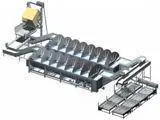
3X Technology of Iceland has developed a new method of continuous thawing which, it believes, overcomes the disadvantages of existing systems. Frozen fish, or shellfish, is passed through a long tank of heated water using a mechanical screw. The water temperature and the time taken for the blocks to pass along the tank are controlled to ensure that the fish is thawed to the degree required for further processing.
3X says that its new system has been used for successfully thawing frozen whole and headless mackerel, herring, plus whitefish and shellfish, in 2-35kg blocks.
As well as improving product quality and yield, compared with other thawing methods, the 3X system also reduces labour and other costs, the company claims. It says that savings can also be made in water usage, with only 20% of water required compared with conventional water thawing, and electricity.
3X Technology had a mini version of its thawing unit on its stand at Seafood Processing Europe in Brussels where it attracted a lot of interest. Its normal thawing units comprise stainless steel (AISI 304) tanks, which are 10 or 13.6m long – volumes 12 and 19m2 respectively – with capacities of 1-2 and 2-3t of frozen fish per hour. The water inside the tanks is heated by steam injection or by a hot water heat exchanger.
Cleaning is made easy by the open design, plus there are doors at the ends of the tanks. The thawing systems can be customised to suit individual requirements, the company says.
Thawing capacity depends on the size of fish/blocks being thawed, water temperature, freezing method and material type. However, throughput on a single tank is typically 1.5-2.5 tonnes per hour, while the thawing time ranges from one to three hours depending on the product. The water temperature is adjustable from 0-15oC and the core temperature of the material, after thawing, is -1 to 10oC, depending on requirements.
A dual thawing system where two tanks are placed side by side is also available and has the capacity to thaw 40-80t of fish per day. It has an advanced setup for semi- to full automation of the inlet and outlet ends of the tanks.
Related Articles
 PROCESSING & REFRIGERATION
 SEAFOOD
 SEAFOOD