

Bakkafrost orders hybrid wellboat
As part of Faroese salmon producer Bakkafrost’s strategy to produce larger quantities of sustainable farmed salmon, it has ordered a new wellboat to be built at the Sefine shipyard in Turkey, with a 2022 delivery date.
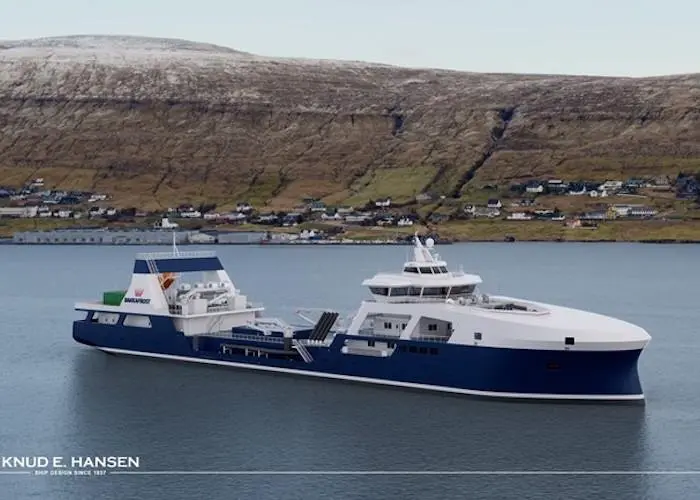
This new wellboat will have a 109 metre overall length and a 22 metre beam, with a 10,000m3 overall capacity. Four wells have capacity for 7000m3 of sea water, plus tanks for 3000m3 of fresh water – providing a 1000 tonne carrying capacity.
As part of its policy to reduce carbon footprint, the new wellboat is to be fitted with battery storage, ensuring optimal energy consumption at all times. The vessel will also have shore power connections, making it very quiet in operation when at the quayside.
The new Bakkafrost vessel will also have dynamic positioning, enabling it to keep station in a fixed position at sea, and providing opportunities to perform tasks in the open sea.
“At Bakkafrost, we continuously look at how we can reduce the biological risk in our operations, and the new wellboat contributes to the task to ensure a stable and healthy production,” a company spokesman said.
The wellboat comes with technology that can produce fresh water from sea water, which is used for de-lousing operations.
With a 6000m3/24 hours fresh water production capacity, it will be able to carry out salmon treatment without leaving the area to be resupplied with fresh water.
“The new wellboat is a vital step towards reaching the strategic goals of having a total capacity of 100,000 tonnes of salmon, and to be able to process 500 tonnes a day at the factory in Glyvrar,” Bakkafrost states.
“The need for vessels to perform different tasks is growing significantly in the future. The need of transportat of smolt will increase significantly, as we have started to farm smolt on land. In future, smolts will weigh between 500 and 700 grams before released to the cages. In addition, the vessels will perform tasks in relation to de-lousing and other gill-related challenges as well as transport of bigger salmon in relation to open sea farming.”
Related Articles
 AQUACULTURE
 AQUACULTURE
 AQUACULTURE