


An ocean of opportunity for offshore aquaculture
The Offshore Mariculture Conference was held in Barcelona, Spain, on 6-8 April 2016.
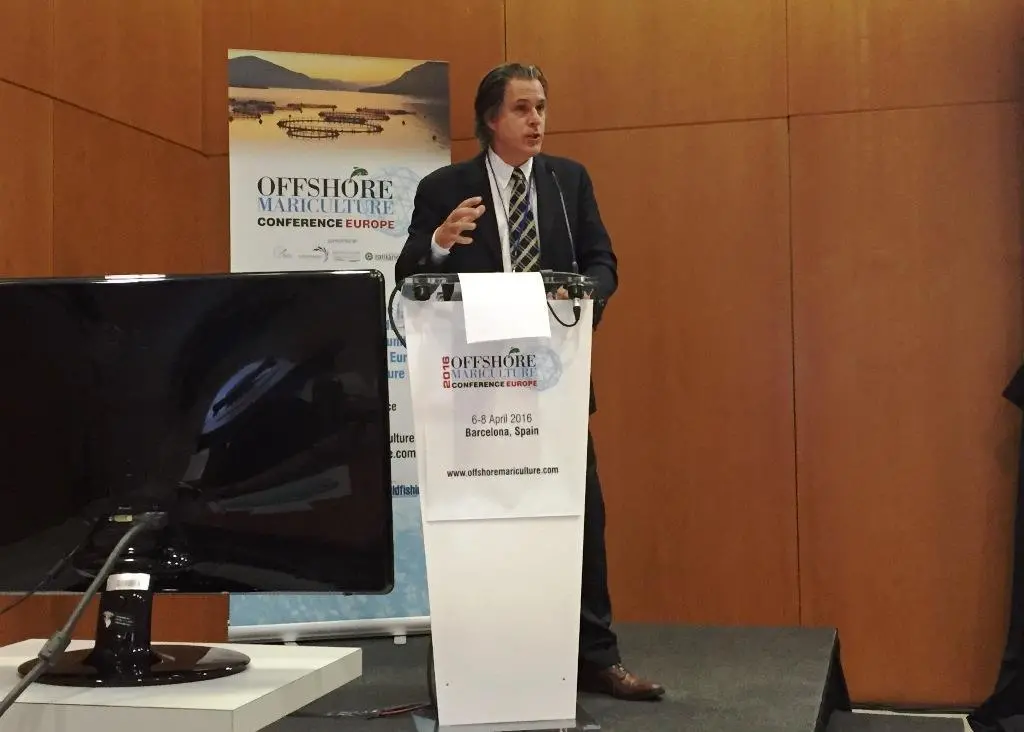
On the first day of the conference more than 110 delegates from across the world were welcomed to Barcelona by Conference Chairman Alessandro Lovatelli, Aquaculture Officer for the Food & Agriculture Organization of the United Nations (FAO).
In his keynote address, Bernardo Basurco de Lara, Vice-President, Sociedad Espanola de Cuicultura stressed that the economic crisis seen in Europe over the past few years has had an impact on Spain’s aquaculture industry – the sector has shrunk from around 70 active cage farms in Spanish waters in 2008, to 46 in 2014. However, production capacity on those farms has risen in that time, he added.
Ernesto Penas Lado, Directorate A – Policy development and coordination DG Mare, then stated that the conference was taking place at a time when expanding aquaculture to offshore areas is becoming increasingly practical. Lado went on to say that, even with few offshore developments, the EU aquaculture sector employs around 85,000 people and is worth between €3.5 and €4 billion to the economy each year. Although a small component of the overall maritime economy, aquaculture is one of the five pillars of the EU’s Blue Growth strategy, the maritime component for achieving smart, sustainable and inclusive growth in the Union. Aquaculture has a high profile in the strategy because it has the potential to deliver sustainable jobs and growth. A large amount of this untapped potential lies offshore. Until recently the costs of technology and the economic incentive associated with moving offshore were not aligned, but this is changing rapidly.
Investments in research and development through H2020, Fp7 and other programmes, such as MARIBE and DIVERSIFY, which were presented at OMC, have resulted in huge improvements in the extent of our knowledge of marine ecosystems. Lado went on to reassure delegates that more projects are already following suit – €46m will be spent on aquaculture related research projects in 2016 and 2017. With the world population estimated to reach more than eight billion by 2030, the demand for fish will continue to grow steadily. The key is that we continue to grow our knowledge, improve our technologies, and manage them correctly. If we follow these principles, there is an ocean of opportunity for offshore aquaculture, he said.
US behind
The United States has struggled to take advantage of its great potential for aquaculture, noted Michael Rubino, director in the office of aquaculture at NOAA Fisheries Service, and the second keynote speaker at OMC. While the US is ranked first in the world in offshore potential, given environmental and economic factors, it has fallen well behind when compared with the likes of Norway. In fact, aquaculture has taken a dip since the early 2000s, as “farmers see greater returns producing corn than catfish”, he said. However, the uptick since 2010 has marked a change in proceedings; the popularity of oysters in large numbers of bars in cities has spurred aquaculture of the species, and given the practice some much-needed social acceptance too.
There are a number of new projects on the horizon Rubino said, but getting permission to operate remains a drawn-out process. He revealed that since the Gulf of Mexico aquaculture plan was passed in January 2016, there have not been any new applications to farm viable species.
The first session of the day saw Donna Lanzetta, CEO of Manna Fish Farms, presenting how the company hopes to be the first finfish farm in US federal waters. It is still in the process of securing permits, but entrepreneur Lanzetta is determined to see her plans for the site, which is 14 nautical miles off the east coast of Long Island, come to fruition.
Should the company gain the required permits — a process which is difficult — it will farm striped bass in submersible pods, not unlike those pioneered by Neil Sims in his Vellela Project. Growing in stages, Lanzetta hopes to reach 24 pods, each capable of producing 95 metric tons of bass at harvest. She hopes the firm will help research bluefin tuna farming and revealed that Manna plans to grow into a multi-trophic system, producing shellfish, seaweed and macro-algae as well as finfish.
Oil and gas
Eleni Papathanasopoulou from the Plymouth Marine Laboratory, told delegates that the UK has a large number of existing offshore oil and gas structures, the potential of which is “worth exploring” for aquaculture. There are 302 such installations off the UK coast – between 19 and 150 miles offshore – and by 2018, 50 of these will be approaching or already in the process of decomissioning, she said. Over the next 30 years, all of them will need to be decomissioned.
The large, heavy structures will need to stop their current activities, but could be used for aquaculture of some description. A number of factors would need to be considered, including physical, biological and chemical ones. However, the UK’s single current offshore farm – a mussel operation off Scotland – has been found to have improved its environment in terms of water quality and biodiversity.
Interesting presentation were also given on large scale offshore seaweed farming, renewable energy for offshore fish farm sites, presentations on the MARIBE and DIVERSIFY projects and preparing for investment in offshore cage production in Southeast Asia.
Summing up the first day, Lovatelli, made the following observations:
- Social licenses and resources competition are still influencing the development of marine aquaculture
- Spatial competition and the costs of moving offshore are pushing people to think of using decommissioned offshore facilities such as oil rigs. These costs have to be reduced as much as possible
- New products and companies are coming up that will provide professional service in both the design and building of fish farms
- The EU is committed to seeing the aquaculture industry grow
- Diversifying to different species is an issue, hence the support shown by the EU for research into news species
- The potential for the USA to develop its aquaculture is enormous
Velella Project
The second day of the conference kicked off with an update from an old friend of OMC, Neil Anthony Sims, on the Velella Project, which is still waiting on permits to be granted for the latest iterations. Sims hopes that the Delta version can go to sea this year.
The Delta will be a larger version of the Gamma – a submersible pod attached to a single mooring point off the coast of Hawaii. The plan is for the Delta to contain a greater number of fish in a larger pen, around 15,000.
Javier Ponce, Architect and Founder of Smart Floating Farms, then gave an aspirational presentation in which, with the current challenges of cities growing, land consumption, massive imports and climate change, he proposed the Smart Floating Farms project as a complementary alternative to other food production systems. The project deals with the symbiosis/combination of different existing technologies in order to produce fresh and healthy food closer to our homes. Based on a polyculture multi-layered Floating Platform, it combines mariculture, hydroponics and photovoltaics (solar power).
A number of different cage and net technologies were also presented, including that of Meeker Management Services, which started with a system of wooden square pens, hewn from logs. When President/Owner, Mike Meeker saw his more modern investments destroyed by ice flows (for the second time) he resolved to design a system which could overcome the problem. The resulting cage – his ‘Stormsafe Submersible’ – is equally applicable for offshore aquaculture as it is in lakes, he said.
Cooke Aquaculture also gave an insight to the company’s operations in Canada and included valuable feedback to the suppliers on the equipment currently in use.
Paul Holthus, founding president and CEO of the World Ocean Council, said that the body was creating an ‘ocean investment platform’ in a bid to get all ocean users cooperating on identifying issues, opportunities and challenges. Aquaculture is one sector which comes under the ‘opportunities’ heading, and it is hoped this collaborative approach can identify the companies with solutions, bring them together, and advance how the oceans are used.
To round off the day, delegates were given an insight into research institute IRTA’s Aquaculture Program by Director, Dolors Furones Nozal, who highlighted the scope of the programme and it’s aims.
Closing the conference, Lovatelli stressed that time should be spent telling people what aquaculture is and the nutritional importance of fish – we need to communicate with the public so that they understand that if we want fish on our tables, we have to farm it.
What we learned from the two day conference is that the industry has really progressed. There is a 1:1 food conversion now and feed development has moved very fast. Aquaculture can have very little impact on the environment – if done properly – and these points NEED to be communicated effectively to the people. They need to be continually reminded of the importance of aquaculture, but no single company can do this – governments need to get involved.
Technical visits
On the third and final day of the conference, delegates were offered the fantastic opportunity to take part in two technical visits – one to the Mercabarna Central Fish Market in Barcelona and the other to the IRTA research institute.
During the visit to Mercabarna delegates saw first-hand how such a huge market operates. The market has an area of 24,000m2 and employs 700 people.
The annual turnover is 80,000t of seafood products, of which 81% is fresh and 19% is frozen. Fifty-two business operate at 80 sales points at the fish market, which is visited by 1,500 professional purchasers every day.
The best-selling fish are hake, angler fish, cuttlefish, salmon and anchovy, and the best-selling seafood are mussels, clams, prawns, striped venus clams and king prawns.
The next visit was to IRTA, a research institute owned by the Government of Catalonia. IRTA’s mission is to contribute to modernising, improving, boosting competitiveness, and fostering sustainable development in the sectors of aquaculture, fishing, agriculture, food and agroforestry.
Delegates were given a tour of the facility and the opportunity to take a look at some of the research being undertaken by IRTA. Specific areas of research include nutrition of fish crustaceans and molluscs; aquatic animal health; cultivation techniques for species of interest and new aquaculture species; and recirculation aquaculture systems. It was fascinating for delegates to see some of these projects up close.
The organisers would like to thank the sponsors, Fusion Marine, and also Badinotti, FISA, Gale Marine and Hvalpsund Net who all exhibited.
Details of the 2018 Offshore Mariculture Conference will be released shortly.
Related Articles
 OFFSHORE MARICULTURE CONFERENCE
 OFFSHORE MARICULTURE CONFERENCE
 OFFSHORE MARICULTURE CONFERENCE