



All change in Mauritania
Pieter Tesch finds the West African country is no longer willing to bow to pressure from European fishing giants. In future it wants to hold on to at least half its catch.
A revolution is taking place in the Mauritanian fishing industry. Established international interests in the country, including the Spanish demersal and The Netherlands’ pelagic freezer sectors, will have to accept that things are changing and that the Mauritanian character is changing “for the better of Mauritania”, said Bellahi Brahin Vall, director of Industrie de Peche & Representation (IPR).
Vall, a Mauritanian-born, up-and-coming fishing agent and entrepreneur who has Irish nationality, explained that the days have definitely gone whereby the government in the country’s capital of Nouakchott would happily sell fishing licences to the EU, Russia, China etc. The Mauritanian government now wants to ‘Mauritainise’ its fishing industry as much as possible through commercial measures and policies.
This stance was something the minister for fisheries and economic development, Aghdhefna Ould Eyih, strongly affirmed in an interview with WF. “It is the government’s and my personal objective to have 50% of our total catch of pelagic, demersal, cephalopods (octopus etc) and crustaceans (mainly shrimp) landed and processed in Mauritania,” he said.
The test for this objective will come next year when the current five-year-old fisheries treaty with the EU will be up for renewal and renegotiation. There are a number of stakeholders who think it will lapse and the Mauritanian government will revert to the policy of private agreements with EU fishing firms, as was the case up to the end of the 1990s when the first EU treaty was signed.
The European Commission won’t be happy to a see a return to private agreements as it would lose its control over EU vessels and firms in Mauritania. On the other hand, some non-fishing EU nations baulk at the annual payment of €86 million ($103.6 million) to Mauritania for fishing rights when it’s only member states like Spain and The Netherlands that benefit.
On the Mauritanian side, there is unhappiness about the lack of progress by EU companies in setting up onshore freezing and processing plants despite promises from the European Commission to encourage this over the lives of successive five-year treaties.
“For years the European Commission and EU firms have been talking about setting up processing plants to increase landings in Mauritania instead of the catches being transferred at sea to reefers or discharged in Las Palmas, but nothing substantial has happened. Now we need to see words becoming action,” said Eyih.
“I believe that the Commission in Brussels has good intentions, but I have already told them and the EU fishing firms that the 50% landing target is the Mauritanian aim. While I have no reason to doubt getting a positive response from the EU, the Commission and fishing firms should have no doubt that Mauritania takes this very seriously.”
European interference
The minister declined to clarify what the Mauritanian government would do if it couldn’t reach an agreement with the European Commission about the terms to renew the fisheries treaty, but Vall believed that despite opposition from Brussels the Mauritanian government would respond to approaches from the main EU fishing interests present in Mauritania.
“I understand there have already been two Spanish delegations in Mauritania exploring the possibility of a return to private agreements in case the EU treaty is not renewed,” said Vall.
“Mauritanians themselves would not be too disappointed to see the EU treaty lapse as they are unhappy with Brussels’ interference, in particular the influence of environmental lobbyists.”
The green lobby has succeeded amongst other things in holding up a potentially profitable Dutch-sponsored shellfish project to harvest the unexploited beds of Venus clams. This despite conditions drawn up by the Mauritanian fisheries institute IMROP to protect the environment, and the potential of onshore processing plants exporting to the EU and worldwide generating revenues and creating much needed employment in Mauritania.
Eyih stressed the Mauritanian government would not contemplate anything that would potentially damage the marine environment. “We need both ecologically and economically sustainable fisheries for the long-term interest of the people of Mauritania.”
The director general of the Ministry of Economic Affairs and Development, Mohamed El Hassan Ould Boukhreiss, echoed Eyih’s view. “My department fully supports our colleagues in the Fisheries and Maritime Economy Ministry, we basically take the same approach regarding the exploitation of our other natural resources, whether oil and gas, or minerals from iron to gold.
“We are moving away from a situation from when all the raw materials were exported without creating any additional added value or employment benefits.”
“Fishing is of course different from oil, gas and mineral exploitation because the latter three are finite resources. But the former, if properly managed, is a permanent resource and therefore my department fully supports the plans to have at least 50% of the catch processed onshore for export,” said Boukhreiss.
He explained his department and the Fisheries Ministry had drawn up plans to increase and improve existing port facilities at the capital Nouakchott and the northern port of Nouadhibou on the Cap Blanc peninsula, which is the main port for foreign trawlers. They will also create new ports and allocate suitable land for the processing plants that are needed to reach the 50% landing target.
Under the programme, a new pelagic port will be created 45km south of Nouakchott and a new pelagic port in the bay of Nouadhibou. Work has already started on the extension of the commercial port in Nouakchott and in Nouadhibou, which is the best natural harbour on the Atlantic from Agadir in Morocco to Liberia.
An EU-sponsored project to clear 57 shipwrecks in the bay is to commence this autumn.
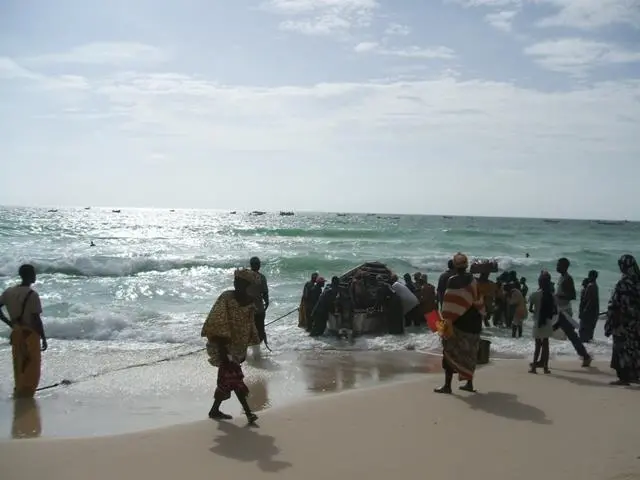
Equally important for Mauritania are the collateral plans to improve the landing and processing facilities for the numerous artisan fishermen who go out to sea in often no more than wooden canoes with outboards. These fishermen’s catches don’t reach their full profit potential because of the lack of onshore processing facilities.
Under the plans the existing artisanal ports at Nouakchott and Nouadhibou, which are in reality no more than where the canoes are beached, will be improved including processing plants, as well as a purpose built new artisanal port 45km north of the Senegal river that marks the border of Mauritania’s southerly neighbour.
Immigration issues
A major issue facing the fisheries minister is the domination of the artisan fishing sector by Senegalese canoes and crews, many of which would be illegal in Mauritania.
Mauritania’s government is trying to solve two issues: Firstly, to increase the income from the artisan fisheries by providing better processing facilities to serve the domestic as well as the export market; and secondly, to regularise a potentially destabilising element in Mauritanian society – illegal immigration.
The population of Mauritania is no more than 3.3 million, but it is conservatively estimated that there are at least 500,000 people from neighbouring West African countries living illegally in country whose main aim is to use Mauritania as a springboard to get into Europe, either over land through the Moroccan-controlled western Sahara and Morocco or by the treacherous sea route to the Canary Islands.
“The EU expects us to stem this flow of desperate young men in search of an opportunity to make a living for their families back home. Mauritania allows the Spanish Guardia Civil to patrol our waters and we detain the people they catch, but that is only half the picture; Mauritania should be assisted to create employment for these people that will also be of benefit to Mauritania,” said Boukhreiss.
“I believe that at least 90% of the artisan fishermen working from Nouakchott are Senegalese, but because of a lack of processing facilities for the low volume but potentially high-value tropical round fish species, they can only scrape a living. Crime or the suicidal trip to the Canaries becomes attractive as a result,” said Vall, who was once a fish merchant buying fish from these fishermen.
A related issue facing Eyih as fisheries minister is to find the right balance between the artisan interests and the mainly Spanish demersal trawlers that compete for tropical round fish and octopus.
Mauritanian fishermen use pots to catch octopus but the Spanish use trawls. The Spanish also target shrimp but that there is less overlap with the artisan fisheries.
To protect the artisan interest the then Mauritanian fisheries minister Sidi Mohamed Ould Sidina, a former director of the IMROP fisheries institute in Nouadhibou, reached an agreement in 2006 to reduce the EU fishing effort by 45%, mainly in the demersal sector, while it increased its annual contribution from €84 million ($101.2 million) to €86 million per annum. But the lack of processing facilities has so far hampered the potential progress for the sector.
Sidina also agreed to create a new category (11) for the pelagic sector besides the already existing category nine for the pelagic freezer sector, which is dominated by the Dutch Pelagic Freezer Trawler Association (PFA).
There is no doubt Eyih wants to continue Sidina’s reforms of Mauritania’s fishing industry by increasing the country’s interests in both the catching and processing sectors.
He will certainly again ask for a reduction of EU effort and a higher annual fee for fishing rights, or if no agreement is reached he would propose a return to private agreements, but this time with the insistence on increased Mauritanian partnership and ownership in catching and processing.
To loosen the grip that the PFA holds over the EU share of the fisheries on small pelagics such as horse mackerel, mackerel and sardines, Eyih has allowed – on the advice of Vall – RWS trawlers to feed into factory ships at sea due to the lack of onshore processing facilities. The RSW trawlers were unable to land in Mauritania while the long journey to Las Palmas on Grand Canaria would make the catch no longer suitable for human consumption, only fishmeal, and hence less profitable.
In fact two years two years ago when the EU treaty was being reviewed there was the danger that Category 11 would be scrapped by Brussels because of a lack of licences being taken up. Since then Irish fishing and processing firm Atlantic Dawn has been fishing with some of its RSW trawlers feeding into the firm’s Ocean Fresh factory ship.
Eyih is further considering, again on the advice of Vall, to lift Mauritania’s prohibition on pair trawling for the small pelagic sector on a year long trial, which can be renewed for up to two years, to make it more attractive for Irish and Scottish skippers who prefer to trawl in pairs.
“I had lived in Ireland for years and therefore I would like to make it possible for the Irish pelagic fleet to avail [themselves] of the alternative opportunities in Mauritania but which are being denied to them because of a lack of onshore processing facilities and the prohibition on pair trawling. It is my wish to make Mauritania more attractive for Irish and Scottish pelagic skippers and operators,” said Vall.
He added that IPR has just received planning permission for a freezing and processing plant in Nouadhibou for pelagic fish.
Mauritania is right at the centre for the market for frozen pelagic fish for human consumption from Nigeria to Egypt, said Vall.