




Accurate bulk weighing on a moving ship? This is how it’s done…
Weighing fish on board a trawler that is constantly moving is a serious challenge – yet PENKO Engineering has found a way to solve the problem and when 121 metre factory trawler Navigator, owned by Icelandic company Úthafsskip was having its factory deck refitted by Afak Techniek, based at Katwijk in the Netherlands, a PENKO Engineering weighing application project formed a key element, reports Bart Driessen.
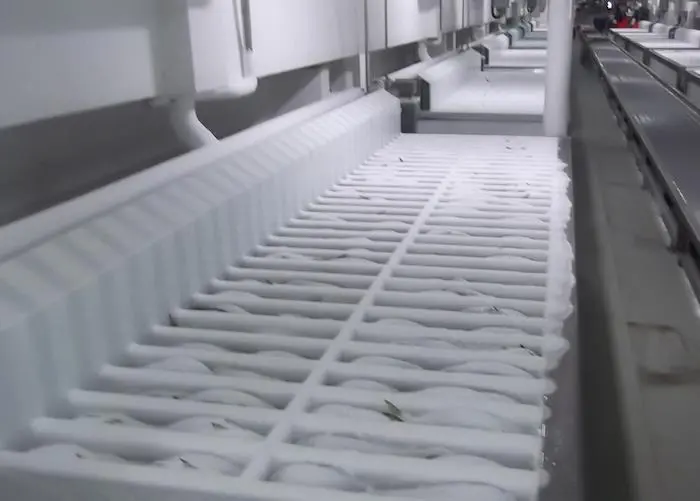
Afak Techniek is a leading contractor for projects of this kind, and specialises in developing and building machinery for fish processing companies. Its systems are used in shore-based plants and on board fishing vessels. Afak manages the assembly of the transport, sorting and stacking installations. PENKO and Afak Techniek have been working together for over 25 years, and the two companies have completed many projects within the fishing industry, ranging from weighing and transport to batching systems for fish.
PENKO’s contribution to these projects has been to fully automate the transport, sorting and stacking of the fish products, as well as to supply and install the associated control systems, PLCs and control cabinets for the weighing technology. In the Navigator project, PENKO’s main responsibility was to supply the required weighing technology, with pelagic fish species weighed and batched to within 1% of the desired weight. This level of accuracy with which bulk quantities can now be weighed in a motion environment, is a major innovation.
Mario van den Heuvel is the PENKO Field Service Engineer who has been at the centre of this project. Together with his colleagues, he wrote the code for the weighing installation on board Navigator, which freezes its catch at sea, operating mainly in the Atlantic and Indian Oceans.
“The reason why fishing companies want to weigh and package their products as accurately as possible is primarily a question of money. Delivering extra fish actually represents a loss of income,” he said.
“On a large processing vessel such as Navigator, this can easily amount to thousands of kilos of fish given away for free. That’s why accuracy is hugely important for weighing and batching. Through accurate weighing, the fisher can minimise the quantity of extra fish delivered. The challenge for us was thus to provide a weighing solution that worked much more accurately than any existing solutions.”
“Extremely accurate weighing is not really a challenge for us. We’ve been doing that for a long time now. Our weighing instruments carry out 1600 measurements per second, and as far as I’m aware, this speed has yet to be matched by anyone else. However, weighing things on board a large ship is another story. ‘Weigh’ and ‘wave’ may sound similar, but in practice the two don’t go together at all,” he said.
“The sea is always in motion, and the resulting swell means that each measurement is constantly changing. This is especially true if you are trying to weigh fish on a conveyor belt. You can compensate for the swell using advanced software, but even that’s not enough to solve the problem, as the engines and machinery on the ship are at least as important a factor. The ship’s engine, its prop shaft, and different kinds of pumps, winches and lifting equipment all produce vibrations that have an even bigger impact on the weighing data.”
He explained that the solution is to compensate for all of these deviations in the output signal. The measurements themselves are carried out using ten load cells that are mounted along the entire length of the conveyor belts. The initial deviations were measured by weighing the belts on dry land.
“Then we measured the deviations at sea, with the conveyor belt both empty and packed with fish. Based on the differences we detect, we can determine a corrected measurement value. This gives us a corrected value that comes very close to the actual value regardless of the circumstances. So what we’re doing is ‘corrected’ weighing.”
In addition to weighing, the system is also required to batch the fish into precise amounts, and on board Navigator a 1280kg batch is collected at the end of the conveyor belt. From there, the fish is manually separated into the 64 containers of vertical plate freezer, each holding 20kg. Once frozen, these are then stored in the refrigerated fishroom.
“An important requirement for batching is that the batch size should never fall below 1280 kilos. At the same time, the extra quantity of fish in each batch needs to be as small as possible,” Mario van den Heuvel said.
During tests, the PENKO team managed to reduce the extra quantity per batch to a minimum; working out a way for the batching system to do this both automatically and very quickly.
“After just five batching operations, the excess per batch was around 0.5%. That means it would certainly be possible to weigh smaller amounts of fish,” he said.
“It’s technically possible to produce batches of any size. The batching works perfectly and very fast. It’s also possible to adjust the batch size – the user has the freedom to do that. However, I have ensured that not everybody has access to the various settings. The batch size setting can only be adjusted by the factory manager, for example. This will avoid errors and ambiguity. This is why access to automated machinery needs to be authorised using passwords.”
Making data accessible
He commented that an additional aspect of modern machine automation is providing access to all kinds of data, and the weighing system on board Navigator has also been equipped with a system for storing and analysing data.
“To make data accessible, every new weighing application we deliver comes with DataReporter.,” he said.
“DataReporter allows the user to collect data for storage in databases. Its second function is to present data in a clear way using graphs, while the third function is diagnostic. This refers to the analysis of batches, formulas and downtimes, alongside other diagnostic functions. A new feature of DataReporter is that the solution can now log and report on 15 different processes at the same time. This also makes it possible to generate reports and analyses based on data stored in SQL. The crew of Navigator is particularly interested in trend analysis relating both to batching and to filling and packaging the fish.”
Related Articles
 PROCESSING & REFRIGERATION
 SEAFOOD
 SEAFOOD