




The complexities of fisheries management make it difficult to comprehend all the variables in our homeports, reports Alan Haig-Brown.
To try to evaluate them in a foreign fishing port is even more difficult. However a little ignorance of all the social and political nuances can make a visit rewarding if for no other reason than to see the different gear used and species caught. In mid-June, my Thai-speaking wife and I visited the fishing port at Songkhla. Over the years we have visited several Thai ports but there always remains more to learn.
In Songkhla, we wanted to compare a major landing site for medium and big boats with a village landing for small boats. As always in Thailand, in most fishing communities, people are proud of their work and happy to share knowledge. Visiting the Songkhla Fishing Port #2 at sunset, things were quiet and the concrete landing area was scrubbed clean. Only one boat, a larger carrier boat with a Malaysian flag, was offloading an unidentified species in plastic barrels to a truck.
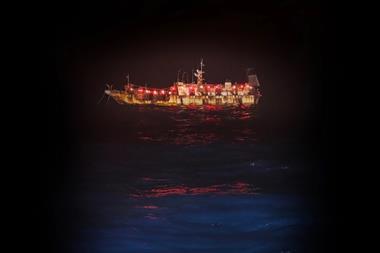
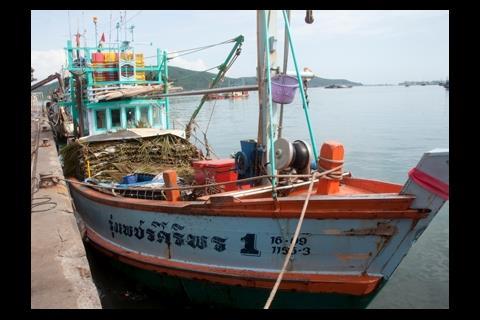
The next morning, we arrived back at the port a little after 7am. A classic wooden Thai-style fish boat was alongside. Strings of lights and layers of booms laced fore and aft along the starboard side and over the main deck. This falling net light boat rig has gained favour in the southern Thailand anchovy and squid fishery. The net is shaped in a rectangle with the length of the boat forming one side and the length of the extended booms determining the other side. When the lights have attracted enough fish, the net is dropped. A lead line pulls it rapidly down around the tight packed fish. The bottom is pursed and the catch brought aboard.
Anchovies
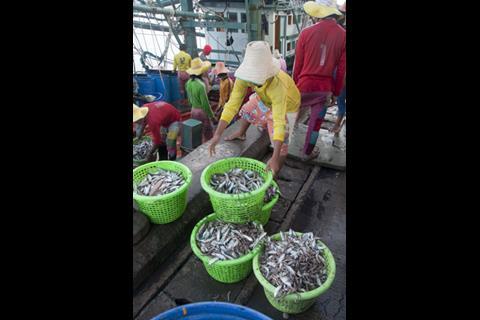
The catch of the first boat, returning from a one-week trip, was primarily anchovies with a significant bycatch of sardine like fish. The crew also brought ashore small catches of fish that they jigged while the boat waited on its lights. These catches were labeled with the crewmember’s name and then bought by women who had assembled for the purpose of buying bycatch. The sardine-sized fish were brought ashore in about 10 baskets and then further sorted by species, for purchase by women buyers.
The targeted anchovies were loaded into a half dozen large plastic barrels in the back of a pick-up truck. A group of three technicians, under the direction of Ms Gingkarn Viboolphan, from the Marine Fisheries Research & Technology Institute of the Songkhla, Khao Seng Division of the Thai Department of Fisheries, took samples from the 3,000kg anchovy catch. These were then checked one by one with non-anchovies measured and catalogued by size and species. At the same time as the sampling is being done, Mr Noppakun Thurapat, from the same institution, is monitoring the targeted and the bycatch landings. Having asked the vessel’s captain for his fishing areas, he is able to track where the fish are coming from.
Khun Noppakun is not the only one monitoring the off-load. Mr Anan Yodmanee, Deputy Manager of the Songkhla Fishing Port #2 has each visiting vessel complete a Fisheries Catch Quantity form with date and time of landing, vessel name, company representative, fishing grounds (including foreign waters), species, quantities caught as well as gear type and more. The data from the completed forms is compiled and sent to the main office of the Fisheries Marketing Organization in Bangkok. The boat is charged a berthing fee as well as fees for species and quantities off loaded.
While the first drop-net boat was off loading, a second drop-net boat came in to the landing. This vessel had a similarly mixed catch but with the sardine-type fish the primary catch and the anchovies a smaller bycatch. Over the morning other boats arrived with similar catches. A trawler of about 20 metres arrived with a catch of squid in plastic bags containing two or three per bag. At the far end of the pier a 16metre boat was loaded with palm frond FADS that the skipper explained he sank alongside of his gillnets in Vietnamese waters. It is a two day trip from Songkhla across the mouth of the Gulf of Thailand to Vietnam.
A little later a big wooden boat of about 30 metres arrived from Indonesian waters. A Thai carrier boat, it had a load of what the middlemen identified as frozen and bagged ribbon and larger silver scabbard fish ( plaa mangkon, plaa dap ngern in Thai). This was an unusual cargo for the port and generated considerable interest. While some was consigned previously, the balance would be auctioned to factory reps in attendance
Wanting to learn about the small boat fishery we went to the nearby fishing village of Khao Seng near Samila Beach. With a small fleet of Southern Thai style boats ( known as reau koh lae) anchored just off the sandy beach, the Muslim village, has 46 boats owned and operated by 46 families. Fisherman Mr Buraing Dasee has lived all his 43 years in the village and bought his boat 20 years ago in Pattani for 100,000 baht (US$3,225.00). He estimates a similar boat would cost twice that today. With three people on his boat, he travels over 30km offshore to target jack mackerel with his sunken gill or tangle nets. Incidental catch includes crab and seasonally tonggol tuna. Khun Buraing explained that fishing has provided for him and his family and he hopes that his 18-year old son will follow him into the fishery. While there are some challenges with the larger boats when fishing offshore, he is generally able to avoid them. He is more concerned by the oil development that is happening with little or no consultation. Although land tenure is poorly defined in the village he says, that he can’t imagine being a noodle vendor or construction worker, “the sea is my life and salt is in my blood”.
Among the larger boats in the Gulf of Thailand, such local allegiance is not so pronounced. Many of the crew are temporary and sometimes non-documented workers, from Myanmar and Cambodia. Owners tend to be shore based rather than owner-operators. Catches and fleets on the Gulf of Thailand have declined over the past decade. Many blame this on a lack of enforcement of mesh size and too many trawlers. Thais have a long history of fishing the waters of neighboring nations and this trend continues wherever it is possible to get permits. A visit to a local shipyard demonstrated the ongoing nature of this trend. Deputy Manager Bang Vineahan, of the Duang Pramong Shipyard explained that they do the bulk of repair work for fleets in the area and have typically built one new wooden boat per year. This year they are building two boats of about 20 metres for a Thai owner who will send them to fish in Indonesian waters. Built of takien wood they continue the long Thai tradition of building sturdy and attractive fishing boats. At the same time they symbolise the uncertainty of the commercial fishery in the shallow waters of the Gulf of Thailand.