


Opinion: Enhancing fishing safety and sustainability through simulator training
Simulators are playing a crucial role in training fishing crews to fish more safely, accurately and sustainably, explains Martin Reiten, VP Ship’s Bridge Simulation at Kongsberg Digital.
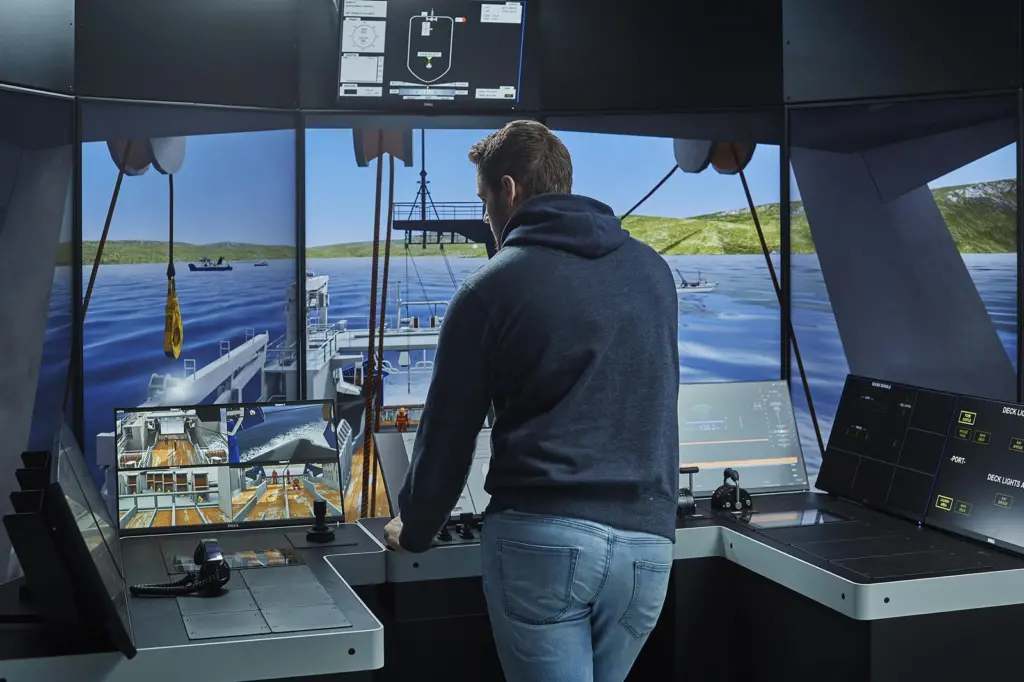
The fishing industry has changed a great deal in recent years. Not only have fishing vessels become far more advanced in their design, construction and capabilities, but so has the equipment onboard. However, new technology requires a new standard of training if accidents are to be prevented. Unfamiliarity with operational techniques and processes can, in the worst cases, lead to disaster in the extreme working conditions which fishing crews have to endure.
Add to this the increasing global pressure to fish sustainably, avoiding by-catch, where fish of the wrong size and species are accidentally caught in a trawl, and it can be seen that fishing crews have plenty to think about, plenty to do and priorities to juggle – and need to be able to react quickly. The ideal fishing crew combines a solid work ethic with an ability to concentrate regardless of weather conditions and sea states.
It takes a cool head to pursue this occupation with any degree of success. A sea-fishing career requires an exceptionally high level of training to achieve an equally high level of competence; even more so with the IMO’s introduction some years ago of STCW-F certification and minimum training requirements for crews on seagoing fishing vessels of 24 metres and above.
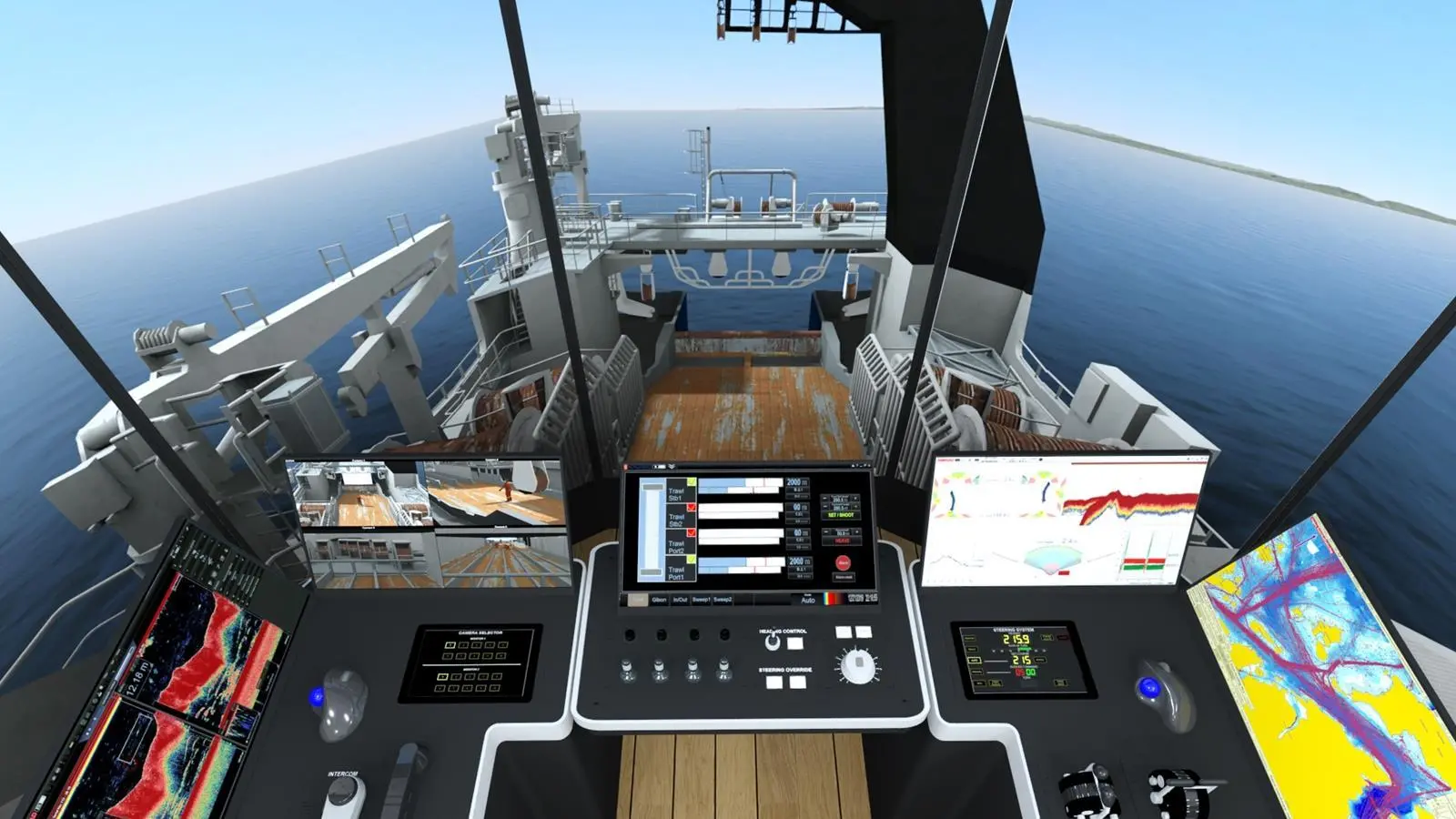
Mindful of the complex web of operational, budgetary and statutory obligations any training programme must recognise, Kongsberg Digital’s K-Sim Fishery Simulator has brought a new degree of authenticity to schooling fishing trainees since its launch in 2018. Methodical from the ground up, the simulator satisfies both the STCW-F training preconditions and DNV standards for certification of maritime simulator systems. However, the bare stats can’t possibly convey the breadth of immersive, hands-on educational value the simulator provides.
It offers a visual and hydrodynamic experience which genuinely is as close to the real thing as it’s possible to get without physically being on board a fishing vessel. From the perspective of instructors and trainees, it’s actually better, because the complete spectrum of training exercises can of course be implemented, monitored and controlled in conditions of complete safety.
Establishing familiarity
The precise replication of a fishing vessel bridge and external visuals enables trainees to thoroughly familiarise themselves with all the operational and navigational tasks and procedures they will subsequently have to carry out in real-life situations, with the simulator’s advanced physics engine accommodating a range of different environments and fluctuating weather patterns.
The exercises drill into every aspect of commercial fishing practices to ensure that learning is meticulous. In lessons on sonar deployment to locate fish in the vessel’s vicinity, for example, trainees will practice parameter adjustments and learn how sonar targets can be classified to identify the species of fish, their size distribution and total biomass. The exercises will also instil an awareness of the pressing need to reduce bycatch, whereby marine organisms other than the target species and size are unintentionally caught.
There is a high degree of detail in simulating fishing operations scenarios. Students learn how to optimally pay out, relocate and haul in demersal and pelagic lines, and gain close familiarity with equipment such as warp and net winches, ground gear and spooling devices. Instructors can control weather, current and seabed conditions to expose trainees to the widest variety of contingencies, and exercises can be replayed so that instructors can issue itemised performance assessments.
Purse seine functionality
In May this year, Kongsberg Digital announced a new project funded by FHF (the Norwegian Seafood Research Fund) for the development of its K-Sim Fishery simulator to incorporate a new purse seine application. The integration of purse seine capabilities has been designed to aid research, bolster safety and efficiency in operations and enhance fishing gear, elevate fish quality and mitigate catch losses. The new simulator feature will also serve as a valuable tool for educating and training individuals in this fishing technique, promoting safer and more sustainable fishing practices.
Today’s fishing operations are advanced and require highly competent crew onboard the vessels. By adding the new purse seine functionality, even more commercial fishermen can now access valuable training to increase safety and efficiency as well as provide a more sustainable approach to operations. We are proud to be able to contribute to the development of the fishing industry, which is crucial for a large proportion of the world’s population.
Making industry more sustainable
Today, there is much talk of sustainability and with good reason. We are at a point in history where we have a chance to turn a negative trend around, to stop depleting and damaging the resources of our planet and start protecting and preserving them.
Few would dispute the oceans represent one of our most critical and valuable resources. More than 250 million people depend directly on fisheries and aquaculture for their livelihood, and more than one billion people in poorer countries rely on fish as their primary source of nutrition. Of the 17 UN sustainability goals we must meet to turn the trend, goal number 14 focuses on life below water: To conserve and sustainably use the oceans, seas, and marine resources.
In its latest sustainability report the UN says, “While there has been some progress in expanding marine protected areas, combating illegal, unreported and unregulated fishing, banning fishing subsidies and supporting small-scale fishers, action is not advancing at the speed or scale required to meet goal 14. To counter these trends, swift and coordinated global action is imperative. This entails increasing funding for ocean science, intensifying conservation efforts, advancing nature- and ecosystem-based solutions, addressing the interconnections and impacts of human-induced pressures, and urgently turning the tide on climate change to safeguard the planet’s largest ecosystem.”
Tackling high rates of accidents
As the numbers indicate, fisheries are a vital industry for the world’s population. Unfortunately, as illustrated in several recent reports, they have historically had a high rate of accidents, and with large-scale fishing, new challenges arise.
Governments are working with shipowners and fishermen around the world to better understand the cause of accidents, and all parties are keen to find new solutions to this persisting problem. A survey from the Nordic Council of Ministers on prevention of accidents in Nordic fisheries reported the following: “The fishermen’s assessment of safety training and education shows that it has been an extremely important element in the prevention of occupational accidents and in promoting safety in general.”
Are simulators the solution?
Kongsberg is a developer and supplier of technologies that can help the fisheries industry meet the dual challenge of safety and sustainability: Simulators for safety training of seafarers and fishermen, and sensor systems to help them find and catch fish in the most sustainable manner possible.
As vice president for ship’s bridge simulation in Kongsberg Digital, one part of my job particularly close to my heart is finding ways in which advanced maritime simulation can support the UN Sustainability goals and provide a safer working environment for the people working in the maritime industries.
I truly believe, as does the IMO, that using a simulator as an advanced educational tool enables much better situational awareness than students would otherwise get in a classroom setting or by reading a book. With simulators, you enter a parallel reality where you can really test things and understand the consequences of your decisions. And you can gain this knowledge without putting your own health and safety or that of others at risk, and with no risk to assets or the environment.
Kongsberg Digital supplies hardware for training facilities, but we also want to make simulation available to a wider range of users and stakeholders – enabling them to train anywhere and anytime – vastly increasing the safety of crew and the environment. This now applies equally to fisheries. Simulator training can help educate and protect commercial fishermen while moving the industry toward safer and more sustainable fishing practices for the future.