



New-gen pelagic catcher
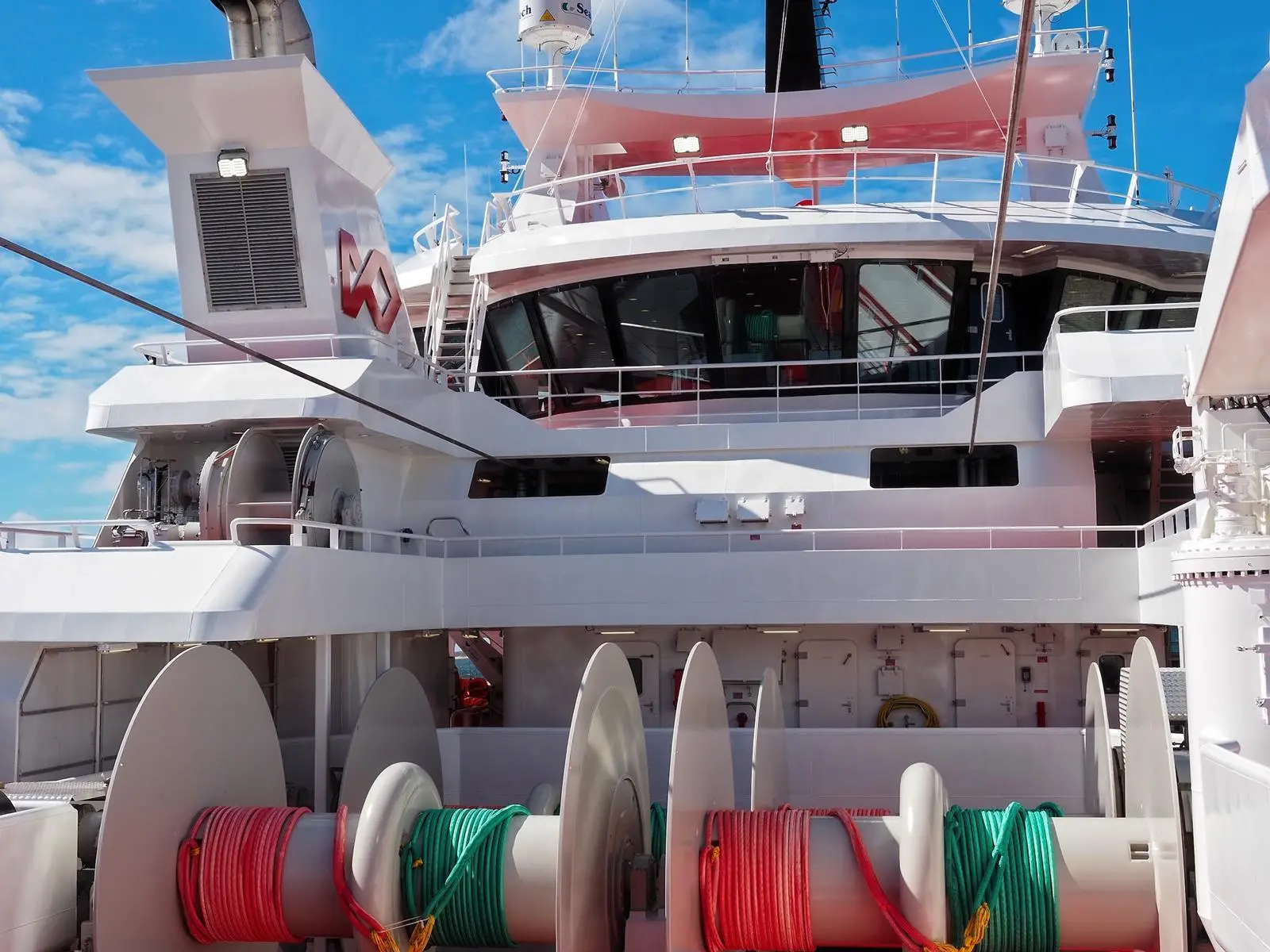
Built to operate under the Danish flag for its Swedish owners, pelagic vessel Astrid is the latest step in a strategy by the Johansson family to take a long-term view of the future.
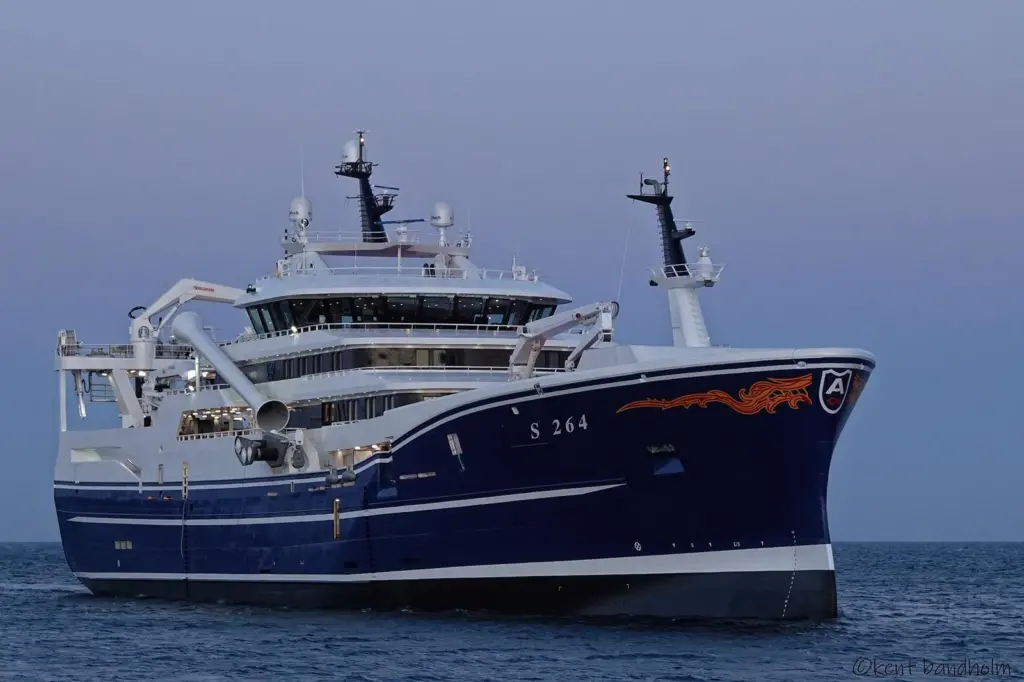
Astrid is one of the largest modern pelagic fishing vessels, designed for a high carrying capacity and to operate with minimal fuel consumption and emissions.
It’s only a few years since the previous vessel of the same name was delivered. Also, a Karstensen build, the 2014 Astrid has been sold to Norwegian owners, and the company has also sold Rockall, which went to another Swedish fishing company. Today, the Johansson family operate Astrid Marie under the Swedish flag and now the new Astrid on the Danish registry.
Skagen is at the centre of much of the activity, although the family are based on the island of Rörö in the Swedish archipelago, where its origins go back to the 1950s when Leif Johansson brought together a group of partners to start fishing with the original Astrid. His sons Tomas and Börje followed him into the business, which became increasingly international as they took part in the matjes fishery in Skagen, which established their first links with the Danish industry, subsequently acquiring a number of Danish fishing companies with their vessels and quotas.
Leif Johansson’s grandsons Kristian, Johannes and Daniel are now the ones who are taking this company onto the next level with the latest Astrid, which was built at Karstensen Shipyard Poland and arrived in Skagen in November 2021 for outfitting.
At-sea optimisation
With a requirement for a high-capacity pelagic vessel capable of operating with minimal CO2 and NOx emissions, the result is a design optimised for 80% of its time at sea free sailing, envisaging pelagic stocks shifting to more distant grounds, which in turn calls for a greater flexibility, carrying capacity and operating efficiency to maintain profitable operation.
The 91.8-metre, 17-metre breadth Astrid has a 3,225-cubic metre capacity in its 13 RSW tanks, with a heavyweight chiller setup based on a triple PTG FrioNordica 1,300kW/1.118.000kCal/h system. The vacuum system for discharging is nothing lightweight, and Önnereds Svets supplied this with three 4,000-litre tanks and six 87kW compressor units.
Astrid’s owners opted for a complete Wärtsilä propulsion system, with a 12V31 main engine developing 7,320kW and driving a 4800mm diameter 4G1190 propeller via an SCV 112/2-PDC68 reduction gearbox with a 3,300kW Marelli MJRM 710 shaft generator coupled to the PTO.
Twin gensets are Caterpillar C32 units, each producing 940kWe and the harbour set is a 500kW C18.
The main engine is the primary source of power for both propulsion and deck systems, with the shaft generator clutched in during hauling and shooting to supply the winches, and clutched out while towing.
Thrusters are 1,400kW Brunvoll units fore and aft. Kongsberg supplied the high-lift flap rudder and the Tenfjord SR 723 steering gear.
Comprehensive fit-out
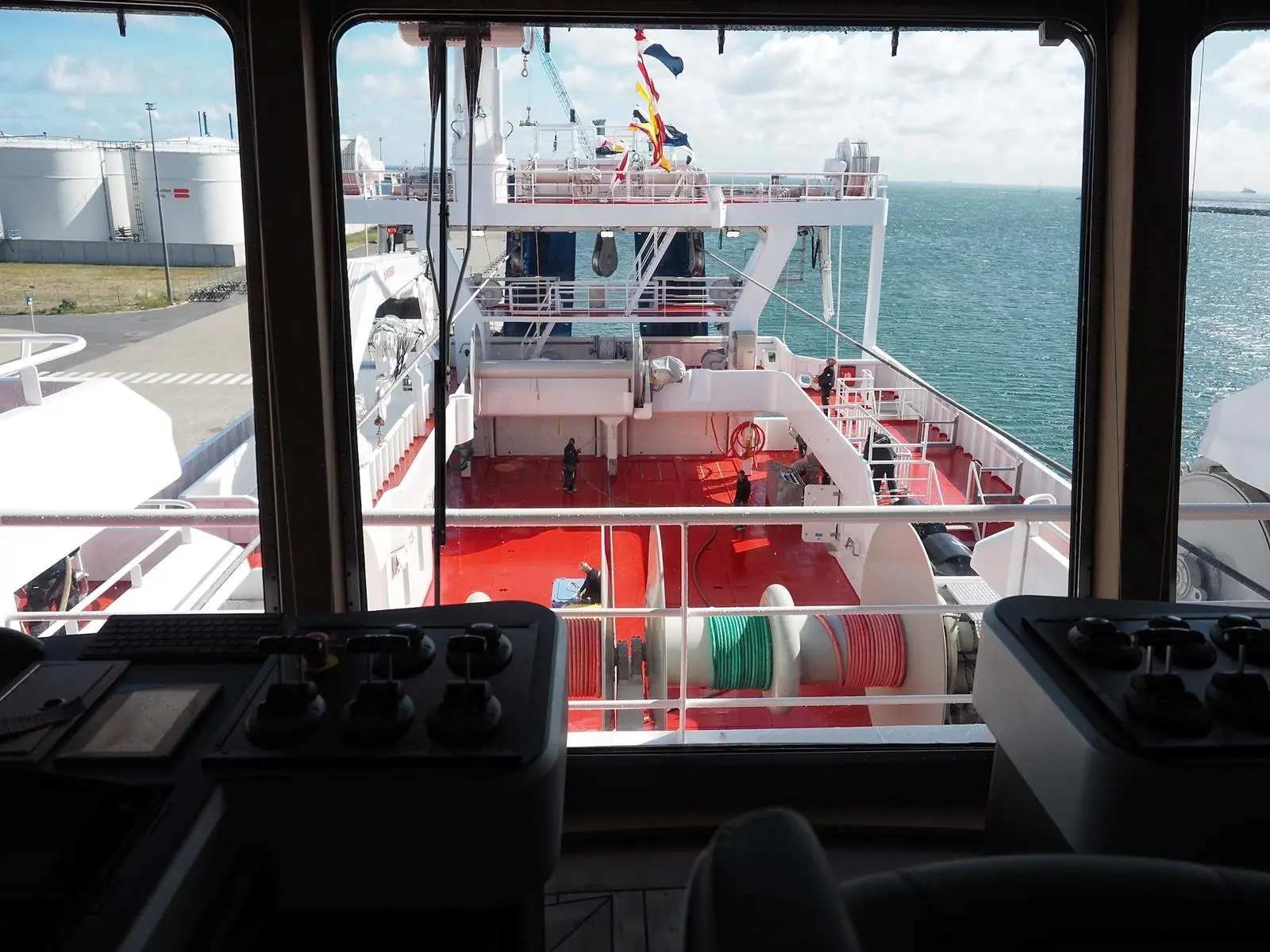
Kongsberg Brattvaag was also chosen for the all-electric trawl layout, with a pair of 97-tonne winches and pairs of 140-tonne and 100-tonne net drums, plus 90-tonne tail-end and topline winches. The package includes the 40-tonne purse and 15-tonne auxiliary purse winches, while MacGregor Triplex supplied the purse seine and fish pumping rig.
The net winch is an electric Triplex 1020 with a 32-tonne pull and there is a KNR-120 net crane and KNR-75 cranes fore and aft. The three 20-inch fish pumps are from MacGregor Rapp, and come with electric cable and hose reels.
Astrid’s wheelhouse arrangement has a Furuno Smart Bridge with five 55-inch Olorin monitors facing the two control positions. A further 16 32-inch and six 27-inch screens from Hatteland are fitted around the wheelhouse.
The key fishfinders are the low-frequency 15-25kHz FSV-25S and medium-frequency 80kHz FSV-85 sonars from Furuno and the Simrad sonars, a 25KhZ ST94, a high-frequency CS-94 and the FS-70 trawl sonar. The array of sounders comes from the same stables, with a Simrad ES80, Furuno FCV-38, FCV-1900 and FSS3-BB sets, plus an 80kHz WASSP 3D sonar.
The current monitor is a Furuno CI68 set and the network of gear-mounted sensors is a Marport array.
Plotters are a Furuno FMD-3200 ECDIS system, a pair of MaxSea Time Zero sets, a 3D Olex and a Sodena plotter.
The radars are all Furuno sets and the two gyro RGC-80 compasses and the AP-70 autopilot are from Simrad, while the GPS, AIS and GPS compasses are all from Furuno.
There are two Sailor 900 V-sat communications systems and a Sailor Sat-TV installation, while the GMDSS A3 installation and the VHF sets are all Furuno equipment.
Related Articles
 VESSELS & SHIPYARDS
 VESSELS & SHIPYARDS
 NEW VESSELS