


Lord Benyon: I want UK salmon farming to lead the way on sustainability
Through policy reform and innovation support, the UK government wants to realise its vision of a thriving and sustainable fishing and seafood industry and a healthy marine environment, according to Lord (Richard) Benyon, Minister of State for the Department for Environment Food & Rural Affairs (Defra) and also the Foreign, Commonwealth and Development Office (FCDO).
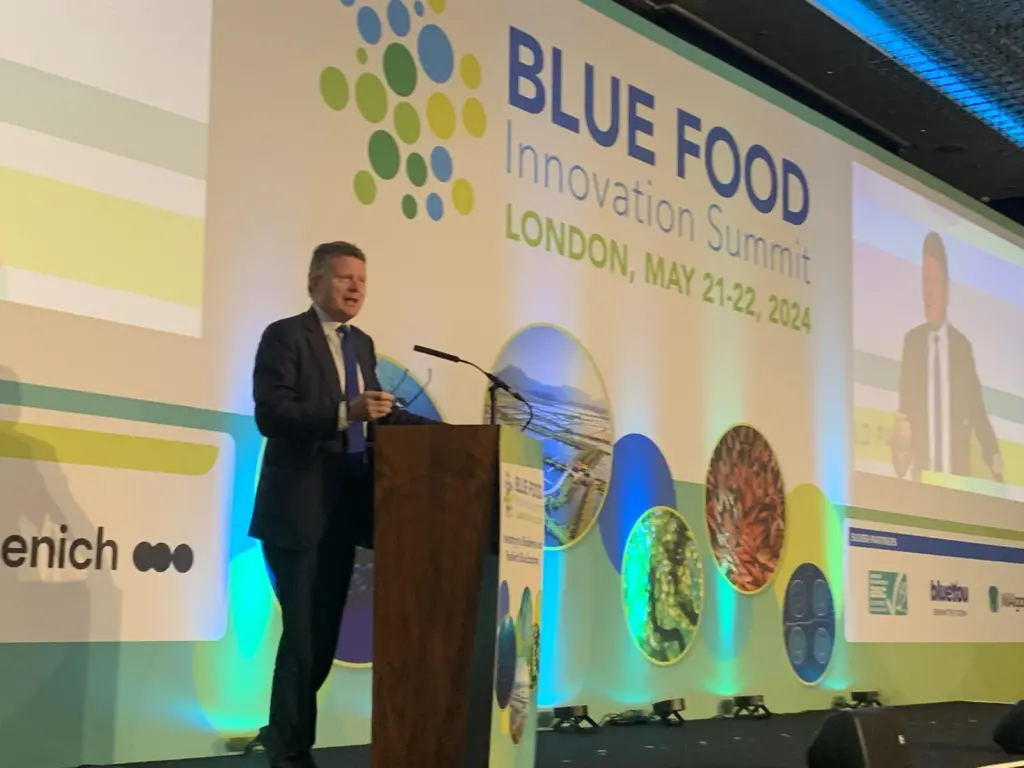
Delivering the opening address at the 2024 Blue Food Innovation Summit, held in London on 21 and 22 May, Benyon said: “We are rightly proud of the high-quality, sustainable and traceable seafood that can be found in or farmed in the ocean around the United Kingdom. Our wild-caught and farmed produce contribute to a balanced and nutritious diet, thriving local coastal communities and our food security.”
He also cited the UN Food and Agriculture Organisation (FAO) prediction of the huge increase in global demand for aquatic foods over the next five years with seafood production expected to reach 182 million tonnes by 2030 (an increase of 24 million tonnes on 2020’s figures) and its expectation that the planet’s population will increase from the current 8 billion to 10 billion by 2050. And added: “Responding to that increasing global demand for protein in a way that enhances our marine environment remains one of the greatest policy challenges we collectively face. And we must remember that whatever we do in UK waters, whatever part we play in driving towards sustainability, it [won’t] matter if we’re not part of a global necessity to protect the viability of our oceans.”
Innovation and technology have a huge role to play in the development of the UK’s aquaculture industry, including its most important blue food and the country’s leading food export – Atlantic salmon, explained the minister. He acknowledged most of the salmon volume is produced in Scotland, but stressed that it’s also a species that’s “massively important” to the UK food economy, generating GBP 760 million a year in gross added value, with 1.2 billion salmon and salmon products sold annually, and employing 4,000 people – many of which are in remote locations.
“But there are problems within the industry,” Benyon said. “There’s sea lice and the effect that it’s having on the wider marine environment with high levels of mortality, [and] issues such as antibiotics…Right across British farming, we’ve seen use of antibiotics plummet, and 2021 may have been a one-off, but in a year that saw 80% reductions in some sectors, and an average of 35% reduction, salmon farming spiked with a 113% increase in antibiotics.
“I know that has come down since, but I say this in all honesty, and as a consumer – somebody who wants to feed an omega-3 rich product to my children and myself – we have to continue to work hard to make sure this industry keeps moving in the direction of sustainability.
“It has come a long way. It’s technologically advanced. It is an example of the huge importance of innovation. And much of that has been aimed not just at improving productivity but also sustainability and reducing the negative environmental impacts. And I know that the salmon sector is already investing heavily new technologies and farming practices, such as farming in more exposed locations with stronger currents and greater dilution effects, and with new treatment capabilities for gill and sea lice [challenges].”
Benyon acknowledged that closed containment, land-based systems and large smolt strategies can decrease the amount of time salmon spend in the sea and thus the prevalence of sea lice and disease. He also pointed to Defra-funded projects that are now underway that are looking to control and treat sea lice.
“There is, however, more to be done. And I’m very keen to see the UK lead the way in terms of sustainable salmon farming. Continued innovation will be critical to enable the sector to protect the environment whilst also responding to the increasing consumer demand. And we have to remember across all these sectors, that as consumers going into retailers, we park our environmental consciousness with a brand, and the moment we feel that that brand is not operating in a sustainable way, we go somewhere else. That’s the power of the consumer and we have to remember it.”
The minister also highlighted that the framework for developing policy in the UK has changed in recent years, with the country’s departure from the European Union opening up the opportunity to revisit that framework across government and “nowhere more so” than in relation to fisheries, seafood and the marine environment.
“The Fisheries Act 2020 set aside that new framework. Key to that act are its eight objectives, and crucially amongst them, our objectives on climate change, sustainability and marine ecosystems. Building on that act, the government has taken forward a 25-year environment plan and an environmental improvement plan for England. Both plans include targets and actions for ensuring that our fisheries management policies are sustainable, and that we do more to achieve good environmental status in our seas.”
Benyon told the summit, he believes UK seas can be returned to a sustainable basis, but that frameworks, legislation and plans “are only ever the starting point”, and that they must be accompanied by concrete action developed where possible through collaboration with partners across central and local government, across civil society and the private sector.
Central to the ambition of the Fisheries Act is the creation of fisheries management plans, which will guide how the UK sustainably and adaptively manages its fish stocks, he said.
“These plans aim to recognise the importance of a healthy marine environment by introducing an ecosystem-based approach to managing our fisheries.
“Having published the first five fisheries management plans in December, we will shortly consult on the next five ahead of their publication this year. Fisheries management plans will help the UK to deliver long term sustainability of both our fish stocks and the fishing industry and will help secure the continued availability of seafood into the future.”
The minister also highlighted the recent publication of new policies mandating the implementation of remote electronic monitoring for fisheries and England. The aim, he explained, is to harness innovative technology – using cameras, gear sensors, GPS sensors etc – to automatically gather data on fishing activities and for that data to then be analysed using including artificial intelligence technology. This will in turn generate insights that improve management, control and scientific assessments.
Having tested the technology for several years, it’s exciting to now be preparing to implement it at scale in English waters, beginning this summer, he said. “I’m very much looking forward to the outputs of this work.”