



Russian fish farmers source equipment at home
Russia’s heavy dependence on imported fish farming equipment is likely to change, as the Covid-19 pandemic has spurred the ruble’’s depreciation and consequently made any imported products less affordable.
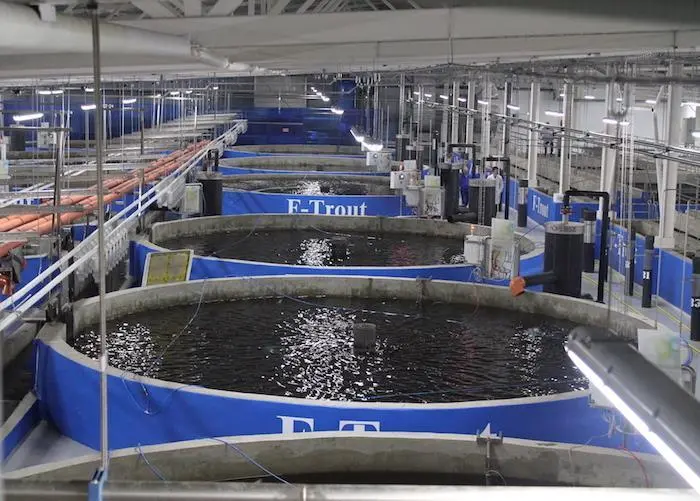
During the first nine months of 2020, Russian aquaculture production totalled 238,000 tonnes, 18% up compared to the same period of the previous year, according to estimates by the Federal Agency for Fisheries. There are 13,200 fish farmers officially registered in the country, about 60% of which are small-scale operations with modest equipment requirements. The Agency reports that only 16.1% of production was grown in cages in 2020.
“Russian business is buying technologies, equipment, and broodstock abroad, primarily in Norway – the closest country to us, with which we have a [strong] partnership,” said the Agency’s deputy head, Vasily Sokolov, commenting on the sector’s reliance on imported hardware. He added that the Russian authorities expect Norwegian businesses increasingly to invest in localising some production capacity in Russia.
Vasily Sokolov predicts that Russia will have a significant need for imported fish farming equipment and raw materials in the coming years. The demand for salmon feed is expected to hit 200,000 tonnes in 2021, climbing to 400,000 tonnes in 2030 on the back of the domestic salmon production’s outstanding growth, he said.
The acute shortage of high-quality equipment in Russia is seen as one of the factors constraining the Russian aquaculture sector’s growth.
This became a serious concern for the Russian Aquaculture Company in the initial period of the coronavirus pandemic. It has to import broodstock, feed, equipment, and polystyrol and was concerned that supplies could be halted, according to Ilya Sosnov, general director of Russian Aquaculture, adding that the supplies of imported goods fortunately turned out to be unaffected.
The ruble’s exchange rate has plummeted by 20% since the beginning of the pandemic, making all imported products more expensive on the Russian market. At the same time, domestic production is reported to be growing.
Despite the complaints of fish farmers, Russian equipment producers are gradually replacing imports on the domestic market, said Nikolay Belkovsky, director of fish farming equipment supplier Salmo Ru.
“Currently, it is extremely hard to assess the share of imported equipment on the domestic market. I doubt this data can be found anywhere. No doubt, the share of Russian equipment is growing, especially in some product categories,” he said.
“For instance, a substantial part of the aeration equipment for ponds and pool farms – way above 50% according to my estimates – is produced by our company. We are steadily increasing our capacity, and are noticing a clear market growth. The equipment for cage farms lately has also been of Russian origin. In this segment, the leader is Luxsol – supplying the netting and other components,” Nikolay Belkovsky added.
He said that all types of drum filters for recirculating aquaculture systems are manufactured in Russia by a Sochi-based company Fishtechno.
“In some product categories imported goods have a stronger position on the market. These are fish loaders, separators, analytical equipment, and containers for fish transportation,” he added.
Salmo Ru has not noticed any impact of the pandemic on demand for fish farming equipment in Russia, while the ruble’s devaluation resulted in problems for companies relying on imported equipment.
“All kinds of goods require maintenance and updates, which have to be carried out taking local industry circumstances into account. So in this area, local companies have a major advantage,” he said.
An increasing number of Russian companies are perfecting production of fish farming systems. Kronstad Marine Plant has recently invested Rub120 million ($2 million) to begin production of semi-automated fish gutting lines, working with technology provided by Norwegian company PE Bjordal AS. This development reportedly has been welcomed by fish farmers.
Russia needs to get rid of its import-dependence on fish farming equipment, commented Valentin Balashov, chairman of the Interregional Association of the Northern Basin’s Coastal Fishermen.
Imperfect market
Price remains the primary factor determining the Russian customers’ market choices, said Ara Kandalyan, director of the consulting firm Fish Agro.
“They fail to understand that the technologies may differ. A Zaporozhian Cossack [a notoriously bad Soviet-era car] is very different to a Mercedes. In a year when fish don’t grow, or worse – they die, they call asking what to do. I say that the ship has sailed, and you get what you pay for,” Ara Kandalyan said.
In a market where reliable information is not always easily available, consulting services are in demand among fish farmers in Russia. Fish Agro runs webinars, setting out how to put together a state-of-the-art farm, choosing the best equipment for recirculating aquaculture systems.
Equipment suppliers in Russia also vary significantly. According to Ara Kandalyan, there is one supplier taking advantage of its connections at government level to sell the aquaculture industry equivalent of the Cossack. He added that there is also a proliferation of emerging consulting companies.
“Just recently one emerged, a company which installed a farm and then decided to sell its experience. In this case, we have a threat of poor technological advice being spread, but there’s hardly any way to prevent that,” he said, commenting that the question remains of when the market might improve.
“There are all the same faces at the industry exhibitions, so the situation isn’t going to change in the midst of a pandemic and the Russian population’s falling purchasing power,” he added.
Import replacement
The Russian fish farming equipment market is steadily growing, with some categories of clients are opting for domestic equipment, said Anton Pelcher, general director of the Russian company Aquafermer, which designs and builds aquaculture installations.
“As of today, we are the biggest team of professionals on the Russian market. Our main advantages are the full list of services and our own production. We have everything from designers to installation and maintenance,” he said.
According to Anton Pelcher, there was a major shift in demand in favour of locally produced equipment in 2015 – the year of the ruble’s deepest slump over the past decade.
“Currently, we import up to 20% of equipment. In the big farms segment, import still has a dominant position. It appears that when it comes to investments above Rub1 billion ($16 million) for clients, it is easier to trust the widely known brands, even if it means paying more,” he said.
The pandemic does not appear to have had a major impact on the Russian aquaculture market. Some projects were frozen at the beginning of 2020, but the initial shock passed swiftly, and all works resumed in two to three months, Anton Pelcher reported.
“The market is gradually growing due to continuing support for the Russian agricultural industry [the government considers aquaculture a part of agriculture], and the global trend of switching to modern technologies,” he said.