



Seafish using Flume Tank for trawl gear training
The UK’s Seafish is committed to providing trawl gear technology training for UK fishermen, and, with assistance from European funding, the organisation runs trawl gear technology training courses at the Flume Tank in the North Sea Centre in Hirtshals, Denmark, which is operated by the Norwegian Institute SINTEF.
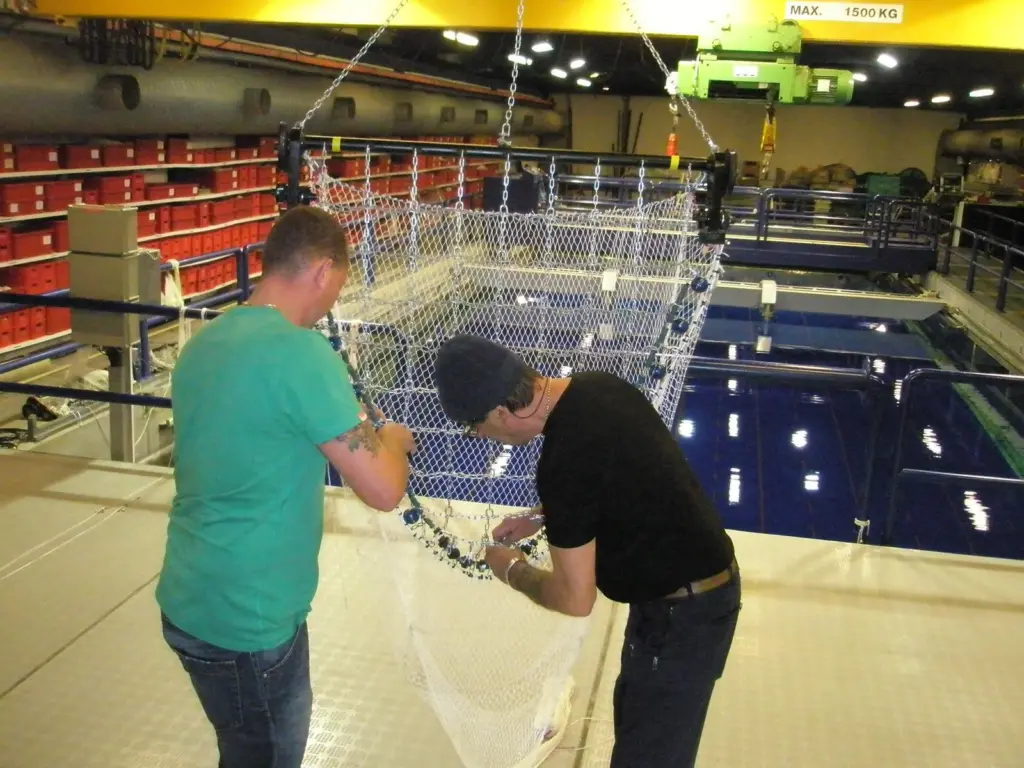
The courses are led by experienced Seafish Gear Technologist, Mike Montgomerie. As an ex-fisherman, Mr Montgomerie understands the complex gear issues confronting fishermen every day. In the past four years, over 200 fishermen from around the UK have benefitted from the flume tank course. These fishermen have come from a wide range of vessels, ranging from the smaller under 10m vessels towing twin/triple sole rigs in SE England, through to the 30m trawlers targeting deep water species to the west of Scotland.
Using scale models for demonstration, the courses cover all aspects of trawl gear from long-winged low nets for bottom species through a full range of demersal gear to midwater pelagic trawls, a wide selection of trawl door designs and a variety of sweep/ bridle combinations. Each course begins with a basic two panel trawl in the flume tank to familiarise the skippers with what is possible in the flume tank using the model gear. Then there is a run through of the initial rigging of a trawl such as rigging the trawl on the groundgear, demonstrating the effects of the various methods used. In addition, the sessions move on to everyday alterations to bridle lengths, flotation, door spread, towing speed, and so on.
Most of the skippers have a good understanding of what happens as they make these changes, but all are surprised how these alterations can make unexpected changes to other areas of the gear. A run through of trawls and rigging arrangements ensure the fishermen have an understanding of all gear designs and how these features affect the performance of the trawl.
Throughout the course, reference is made to several parameters that are vitally important to the fishermen in their daily work, such as door spread, wing end spread, headline height, sweep angle and warp to depth ratio. As a standard part of the course, it is clarified what these terms mean and why they can be so important to a fisherman. The fishermen leave Hirtshals armed with some basic calculations, using measurements that are readily available to them and easy to apply to their own gear.
Trawl doors is a favourite topic for the skippers as it seems that there is more misinformation in circulation about trawl doors than any other aspect of the fishing industry. The first point is to demonstrate how the various designs work, what effect the common alterations have on the doors and, in doing so, correct some of the common misconceptions of trawl door performance. Seafish also investigates, and solves, some of the more frequent problems the fishermen have with trawl doors, such as heeling in, falling down, pitching up etc. Each of these problems is dealt with using model doors of a design similar to those used by the fishermen onboard their own vessels, trying to replicate the exact difficulties they are having, and find a practical solution.
An essential part of all courses is to familiarise the fishermen with a wide range of methods of reducing discards and improving selectivity of their trawls. Many of the model trawls have selective devices fitted as standard. So, throughout the course, the participants get constant reminders of how these devices work, how they are fitted and how effective they are for different species. Devices demonstrated include square mesh panels, large diamond mesh panels and coverless trawls, various types of separator panels, inclined grids, and several different cod end and extension configurations involving square mesh (T45), T90 and diamond mesh.
Although all types of trawl gear are demonstrated during the courses, emphasis is put on the actual gear used by the fishermen themselves, for this reason we try ensure that each course group consist of fishermen who are using similar gear.
In recent years, Seafish has had a variety of Scottish deep water skippers interested in looking at flying their trawl doors off the seabed to decrease seabed contact. Twin rig fishermen have been keen to look at low coverless trawls, while SW skippers have wanted to try a new model of trawl doors that decrease ground contact. Seafish has also worked with beam trawl skippers looking to further improve on the modifications made during the CEFAS 50% project, with many of the groups interested in making their gear more selective.
Towards the end of each course, the fishermen are asked to fill out a questionnaire for an evaluation of the course. From this, it is evident that all the fishermen have enjoyed the course, learned a lot and felt that they would go home with a much greater understanding of their gear and be able to operate it in a more efficient, environmentally friendly manner.
Seafish is planning organising more of these successful Trawl Gear Technology Courses at Hirtshals flume Tank in 2012.
Related Articles
 FISHING TECHNOLOGY
 NEW VESSELS
 FISHING TECHNOLOGY