

High hopes as iFarm Version 3 gets underway
Cermaq, BioSort and Scale AQ’s third version of iFarm has been installed in Norway. This small step could become a giant leap for salmon farming if the technology proves successful.
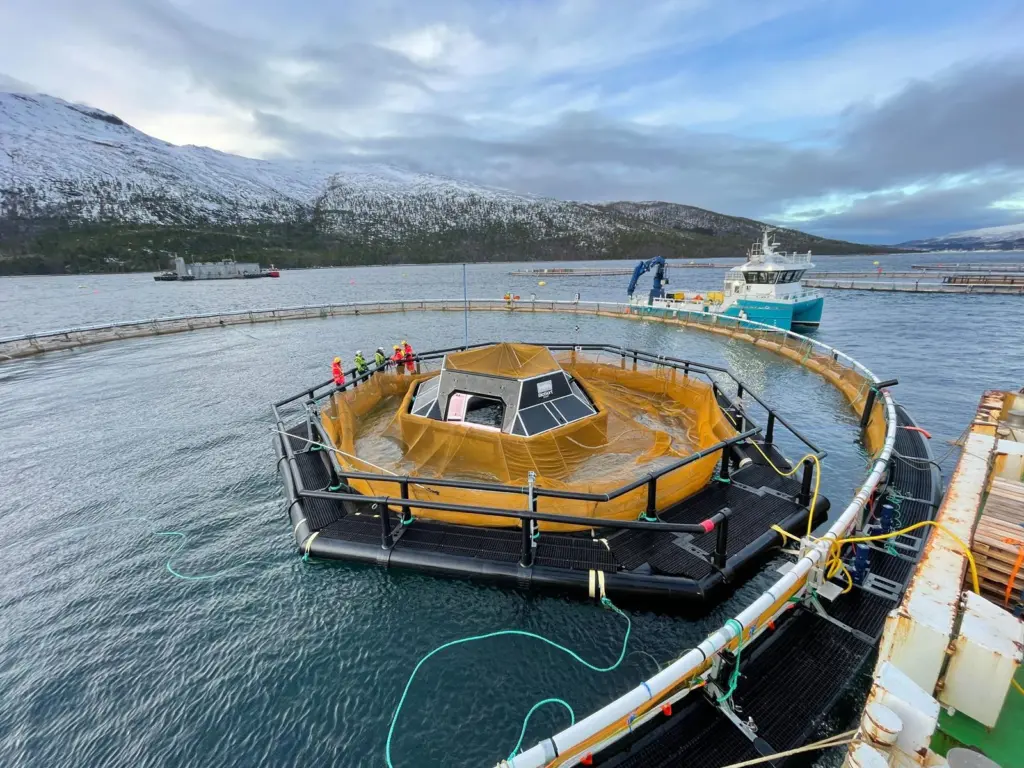
Facial recognition tools are used in criminal investigations or when tagging people on social media, but over the past few years, they have also been appearing in aquaculture. In January 2020, Norwegian fish farmer Cermaq and the technology firms BioSort with support from ScaleAQ formally launched the first version of iFarm, a system that uses artificial intelligence (AI) and machine learning in facial recognition software to improve the management and oversight of salmon farming.
Three years on, and iFarm’s third version has been installed in pens at Hellarvika, a Cermaq farm in Steigen. Version Three will mostly focus on sensors, data collection, machine learning, and further development of the fish sorting mechanism. Sensors will retrieve high-quality images and follow up key parameters such as fish ID, lice, growth and welfare.
Most salmon farms currently assess the health of their fish as a group. If some are found to have lice, diseases or parasites, the whole farm is treated. But the iFarm system aims to assess each individual fish for growth, sea lice, disease, lesions and other factors that affect health and welfare. This allows farmers to determine how fast each fish grows and check for any problems.
Each iFarm pen contains around 150,000 salmon. Around every four days, they come to the surface and take a gulp of air to regulate their swim bladders. When they do this, they are guided through a sensor arrangement where cameras can recognise and monitor them individually before recording data on them based on their unique markings and structure. Any sick individual can then be treated, stopping or limiting the spread of disease and dramatically reducing the extent of treatment and associated costs as it no longer becomes necessary to treat an entire farm.
“Sea lice and mortality are two important challenges that iFarm has been aiming to address over the past few years, along with building a history or health record for each individual fish so that they can be monitored and sorted according to their conditions,” BioSort Managing Director Geir Stang Hauge told WF.
“Fish that have sea lice will be sent to a treatment unit, while those with skin lesions are handled according to their needs. The most unique feature of iFarm is the ability to remove individuals from a pen for a particular treatment. One of the core things with iFarm is helping farmers to be more targeted in their treatment approach and this emphasis on the individual plays a huge role.”
Step-by-step learning
The main focus of Versions One and Two were understanding how iFarm affects fish behaviour, perfecting system construction, ensuring that the fish are well and have good welfare, and testing two versions of the sensor housing and cameras. This offered insights into camera arrangement, lighting and data processing to create health records for each fish.
First and second-generation sensor arrangements and camera units were also tested to collect statistics for lice growth and get the best possible images. This involved establishing specific illumination around the fish and photographing each one from multiple angles. Meanwhile, a lot of work was carried out on operational adaptations, such as sorting, cleaning cameras and maintaining equipment.
Version Three aims to make it easier to catch swimming fish individually by further developing a robotic mechanism that was established a year ago. Meanwhile, the sorting mechanism will be made more autonomous so that together with the iFarm sensor system, it can make its own decisions based on defined criteria such as the discovery of lice or wounds. The sorting mechanism will also be simpler than the previous versions of iFarm with less motors.
The process will require the development of precise machine vision, rapid processing of large amounts of data, and interaction with a mechanical sorting unit with its own control systems. An automated cleaning system has also been installed to enable the cleaning of lamps and cameras, while a new fish transport system is being implemented to lead the fish through a pipe and bring them close to the surface in the same pen for treatment or removal.
“At Hellarvika, the key thing for us now is to gain momentum on the AI or computer vision part, in other words what we can see on each fish,” said Hauge. “We want to be able to see the different stages of sea lice or wounds as early as possible and have the data to be able to analyse a particular population. Perhaps the most important thing for us this year is to have plenty to show for when it comes to what we can do automatically. The other important aspect is the sorting and handling of the fish. Right now, we are working on the newly-installed sensor arrangement as well as feeding and fish behaviour, and we believe that with Version Three, we will have much more of a proof-of-concept. However, iFarm is very much a step-by-step process, where we learn new things from each version and improve upon those.”
Unique insights
iFarm aside, Hauge believes that AI and technology are proving their versatility in salmon farming, promising to deliver greater efficiencies and insights.
They can enable farmers to count sea lice quickly and easily or closely monitor the size of their fish, he said, while autonomous feeding is another area that is getting a lot of attention in terms of AI. Indeed, Hauge and his team have been investigating fish growth drivers in subsea feeding – feeding the fish at a deeper depth to offer better protection from sea lice.
As for iFarm, it can give farmers access to a technology that can offer considerable protection against sea lice and greatly reduce mortality. Shifting from stock-based aquaculture to individualised follow-up and care will greatly impact on fish health and welfare, enabling early disease detection and implementation of countermeasures to stop infections from spreading.
The iFarm system, which should be ready for commercial use in a few years, is likely to be in high demand.
“There is a lot of interest in iFarm and increasing talk in aquaculture circles of the welfare of individual salmon as opposed to groups,” said Hauge. “With 150,000 to 200,000 fish in a pen, it’s difficult to see how sea lice attach to the fish, spread through a population, or whether some fish are impacted more than others. But the potential to monitor every single fish, coupled with big data analysis on the population, will provide farmers with unique insights and understandings of important elements that they don’t fully comprehend yet. We look forward to installing iFarm on customers’ farms when all the key features are fully up and running.”
Related Articles
 PROCESSING & REFRIGERATION
 PROCESSING & REFRIGERATION
 PROCESSING & REFRIGERATION