The 6 February 2023 earthquake that shook Turkey and neighbouring Syria and took tens of thousands of lives massively disrupted the Turkish seafood industry, with the immediate suspension of all fishing and aquaculture activities, but the country remains steadfast in its resolve to implement ambitious plans geared towards raising both its domestic fish output and its exports this year.
Turkey’s trout production heartland – Kahramanmaraş province in the southeast of the country – was at the epicentre of the earthquake. According to calculations made by Kahramanmaraş authorities, the earthquake ked to a 40% drop in the region’s fish production. Historically, the area has produced up to 17 million tonnes of trout per year, with its exports going to 54 countries.
Kahramanmaraş Fishermen’s Association President İbrahim Sarı confirmed that approximately 14 facilities were damaged and that the trout production will decrease to 10 million tonnes this year. Sarı pointed out that Turkey’s largest trout processing facility is also located in Kahramanmaraş.
“The fish produced here are supplied around the world, especially to Qatar, Russia, the Netherlands and Arab countries. After the earthquake, our fish farming and processing facilities were affected the most,” he said.
Sarı told WF that the Fisheries Ministry is working on restoring operations.
“We are trying to bring Kahramanmaraş back to normal life in terms of fishing. Mass deaths occurred with the water cut off in all land facilities. In order to bring it back to normal, we will try to raise it above the level it is with small reinforcements and support every year.”
According to Sarı, the target is for Kahramanmaraş to produce 20 million tonnes of trout in 2024.
Growth through subsidies
With seas on three sides, Turkey has a coastline of 8,333 km. Most of its fish activities are conducted in the country’s territorial waters of the Black Sea, Aegean Sea, the Mediterranean, in the Sea of Marmara and the straits of Bosphorus and Dardanelles. About 100 fish species with an economic value are caught in the country.
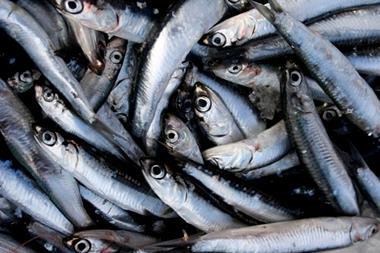
Approximately 60% of Turkey’s catch is accounted for by anchovies, 8.1% are sardines, 7.4% are mackerel and 8.7% is made up of other species such as bonito, sprats, haddock, bream mackerel and bluefish.
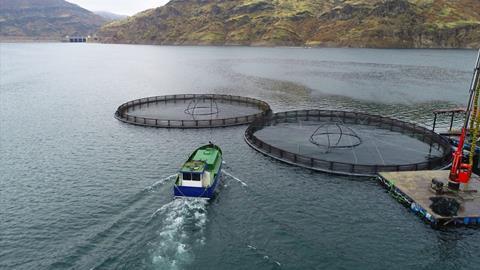
In recent years, Turkey has significantly progressed its aquaculture sector and its further growth will be a priority for the country’s national government in years to come. This was recently confirmed by representatives of the Turkish Ministry of Agriculture and Forestry, which plans to create conditions for further increases in both the output and the regions supplying domestically-farmed fish.
Meanwhile, state subsidies to more than 800 Turkish aquaculture farms has totalled TRY 1.64 billion (approximately US$ 160 million) and there’s a strong possibility this support will continue.
In terms of farmed species, Turkey has become the world’s leading producer of seabream and seabass, and ranks second in the production of rainbow trout. Its aquaculture sector also provides direct employment for 40,000 people.
Thanks to state support, aquaculture production in Turkey grew from 61,000 tonnes in 2002 to approximately 514,000 tonnes in 2022. Exports, meanwhile, grew from 27,000 tonnes in 2002 to 251,000 tonnes in 2022, and from $97 million to $1.7 billion in value terms.
However, due to the earthquake, these figures will be significantly lower this year.
The government also has plans to further develop the Turkish Trout Project that started in 2017. This is aimed at promoting the “Turkish Trout” brand throughout the world and boosting the popularity of salmonid farming in the country.
According to the country’s Ministry of Agriculture, Turkey’s production increased from approximately 5,000 tonnes in the 2000s to almost 31,500 tonnes in 2021 and 45,000 tonnes in 2022. That helped lift exports from $56.8 million in 2020 to $130.9 million in 2021 and $312.3 million in 2022.
Overall, Turkish aquaculture exports exceeded $1.5 billion in 2022, with 70% of the trade accounted for by Aegean companies.
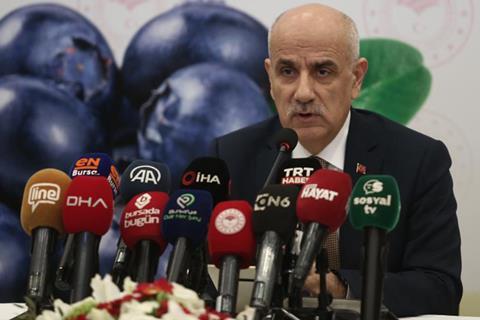
Minister of Agriculture and Forestry Vahit Kirişci said the government will continue the support the domestic fishing industry while also protecting domestic fish stocks.
Kirişci also expects the country’ aquaculture exports to reach a value of $2 billion, although this target could be missed due to the earthquake.
As a rule, fish grown in Turkish waters are exported to more than 100 countries, primarily the European Union, but also Japan, the United States, Russia and South Korea.
Kirişci also confirmed that in the last 20 years, state support to domestic fisherman and aquaculture companies has exceeded TRY 20 billion, most of which went to small-scale fisheries and fish farms and primarily to cover production costs, fuel etc.
Fisheries support
Looking ahead, Turkey plans to increase its fishing activities in international waters. Currently, around 70 vessels are operating in the territorial waters of other countries, mainly in Mauritania, Guinea Bissau and Georgia. Annual earnings from these operations have fluctuated between $400 and $600 million.
Furthermore, as part of state plans to protect domestic fisheries resources, at least 15 different fish species have been released into Turkish waters in recent times.
“That were mainly halibut in Southeast Anatolia, grouper, seabass in the Mediterranean, seabream and seabass in the Aegean, turbot, sturgeon and natural trout in the Black Sea. We are one of the most proficient countries in terms of fishing with different species. We released approximately 84 million juvenile fish, one for each of our citizens in our waters 2022. Hopefully, the amount of fisheries will be 100 million in the second-half of 2023, commemorating the 100th anniversary of our Republic,” Kirişci said.
As for protection, so far, a total 87 conservation areas have been created for the protection and sustainability of fisheries stocks. Particular attention is also being paid to combating poaching.
The Turkish government also plans to create conditions for the restoration of anchovy exports – the country’s main fisheries species. Its overriding hope is that increases in domestic fish production and catches will lead drive up the country’s currently low fish consumption. Per capita fish consumption fluctuates between 8-10 kg, and the main reasons for this trend have been identified as the low purchasing power of local citizens, the relatively small domestic production and high prices.
As a rule, most of the seafood consumed in Turkey is fresh fish. The Black Sea accounts for 76% of Turkey’s fish production, especially anchovy, and the Sea of Marmara provides 10% of the catch. However, since 2007, Marmara has faced algal bloom challenges, and there have been large fluctuations in the Aegean Sea catch.
With regards to the country’s fleet, prior to 2002, the Turkish fishing fleet had been steadily growing, but since the 2010s, Turkish fisherman have preferred to operate larger trawlers. As of 2011, the Turkish fishing fleet has consisted of about 30,000 vessels.