



There was a slight upturn in the status of commercial fisheries in the United States, according to the new 2022 Status of Stocks report from the National Oceanic and Atmospheric Administration (NOAA).

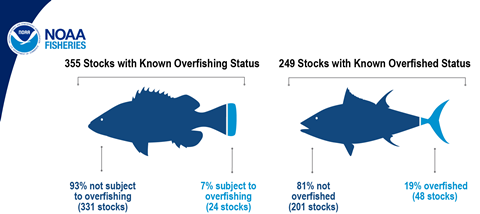
Of the 490 fish stocks managed by NOAA Fisheries, 93% are not subject to overfishing and 81% are not overfished. These numbers show slight improvements compared to the 2021 figures of 92% and 80%, respectively. Other positive trends seen included the number of stocks on the overfishing list decreasing by two to 24, and the number of overfished stocks decreasing by three to 48.
NOAA Fisheries also implemented new island-based fishery management plans for Puerto Rico, St Thomas and St John, and St Croix this year, consolidating existing Caribbean fishery management plans and bringing 32 new stocks under NOAA’s management authority. These new plans account for differences between fishing sectors, available markets for harvested products, fishermen and their fishing communities, and the social and cultural attributes unique to each island area.
“This annual report reveals the US. remains a global leader in maintaining the sustainable fisheries that drive the blue economy, support coastal communities and play a key role in marine ecosystems,” NOAA Administrator Rick Spinrad said. “NOAA and our partners continue to build on the country’s successful fisheries management approach by advancing policies and plans that help address changing conditions.”
The data also confirms that US commercial and recreational fishing supports 1.7 million full- and part-time jobs across the broader economy, generated over US$253 billion in sales impacts and contributed $79.4 billion to the gross domestic product (GDP).
“Managing fisheries sustainably is an adaptive process, relying on sound science and innovation to conserve species and habitat, and meet the challenge of increasing our nation’s seafood supply in the face of climate change,” NOAA Fisheries Assistant Administrator Janet Coit said. “NOAA Fisheries conducted 198 stock assessments in fiscal year 2022, and our work in partnership with the Regional Fishery Management Councils under the Magnuson-Stevens Fishery Conservation and Management Act continues to be key to rebuilding and maintaining sustainable fish stocks.”
NOAA researchers recently developed global forecasts that can provide up to a year’s advance notice of marine heatwaves that can cause sudden and dramatic increases in ocean temperatures. These forecasts will help fishing fleets, ocean managers and coastal communities anticipate significant changes in ocean ecosystems.
Additionally, the NOAA Fisheries’ distribution website tool provides information to track the location and movement of marine fish and invertebrate species in US waters.