

Free fuel from your own backyard!
Like most good ideas, this one came out of a row. Italian Engineer Franco Piermartini had watched local citizens battling in public meetings with bureaucrats and service companies who wanted to set up an incinerator to burn a town’s ever-growing mountain of waste.
The citizens, writes Peter O’Neill, were dead set on Not in My Backyard (NIMBY) and ‘no thanks’ to smoke and dangerous gases from poorly-burnt plastic bags producing cancer-causing dioxin. The council wanted to cut waste disposal costs and maybe generate some ‘free’ electricity. Using industrial waste to generate power is old hat and attractive to town councils who can afford a small ‘power-station’ compared to the average €1 billion for the cost of a regular 1,000MW station.
Franco’s brilliant solution was to put a small ‘power station’ on board a ship powered by waste to produce steam to drive its propulsion and onboard electrical generating systems. The NIMBY problem would literally disappear from view. In the current fuel crisis the ‘waste fuel’ would not only be cheap – it might even turn a profit. Franco’s colleague, engineer Michael X. Cabibbo, speaking by phone from Rome, says it costs about $700 to ship a container of waste from Europe to the Far East. Then there are costs for the council taking it to a compacting centre and on by road to a port etc. Plus they say it could bring in revenue under Kyoto on the CO2 tax front.
Franco’s first move was to get a patent for the process of putting the plant on board a vessel. This was done, alongside presentations in the Italian Parliament, by the company set up for the project — Worldwide Ecological Shipping & Transport – WEST.
WEST set out to prove that not only would this avoid NIMBY problems, it offered major fuel cost savings and large eco benefits against pollution caused by low-grade and now very expensive bunker. They state a vessel using 46,000t of bunker fuel per annum produces 2,840t of sulphur dioxide while the equivalent ‘waste’ fuel ship, using 175,175t of waste, would produce only 35t of sulphur dioxide.
WEST Engineer Gulielmo Sessa told World Fishing at the World Marine Technology Conference in London that one litre of bunker would be replaced by a about three litres of compacted waste. The obvious candidates are container ships. They have calculated that Europe has to get rid of a (conservative) minimum of 250 million tonnes of waste each year and of that at least 10 per cent would be ideal for waste burning. Without getting into the detail, there are at least 100 container ships operating in Europe at the moment which could benefit. Waste is already compacted into containers, so they would put their ‘fuel’ containers on the deck. Various conveyor systems could be used to move the waste from the containers into the engine room for feeding into the power plant which could be 20MW or 40MW – whatever rating the ship needed. Their tests show that waste gases can easily be controlled by ‘scrubbers’ (filters to extract certain noxious gases) through the exhaust and funnel systems. The waste plant wins significantly on all points, with a slight margin on dioxins which can be tackled with extra scrubbers.
Remember, this is not about taking the hot air from your diesel engines to heat the water in the captain’s private sauna or to power heat converters to produce ice for hold refrigeration. This is steam power straight from the pipes around the old locomotive hot-box. The residual furnace fly-ash waste can be stored in the same containers for possible re-sale (brick-making is one sector) at ports en route or on return to port. And every port can supply fresh containers of waste!
They modelled waste to steam on a Hyundai 4,800 TEU container ship, which had a 42MW power configuration, and found big purchase and operational savings from. This was based on a bunker rate of $30 per tonne. As we write the current bunker rate is $300 per tonne.
Smoke your fish
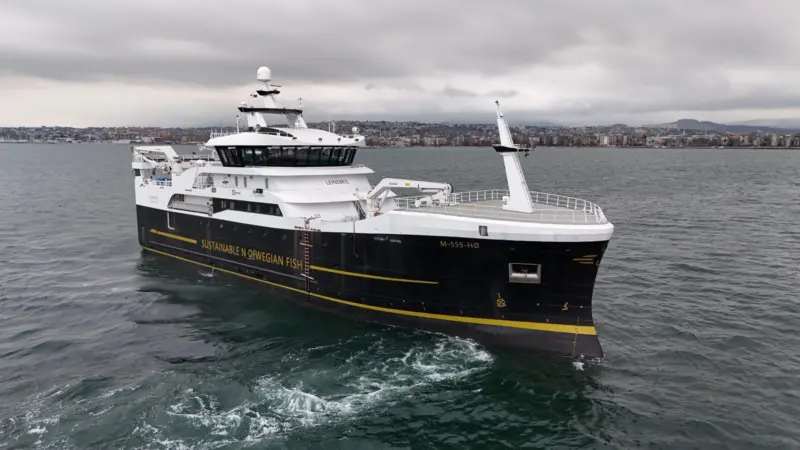
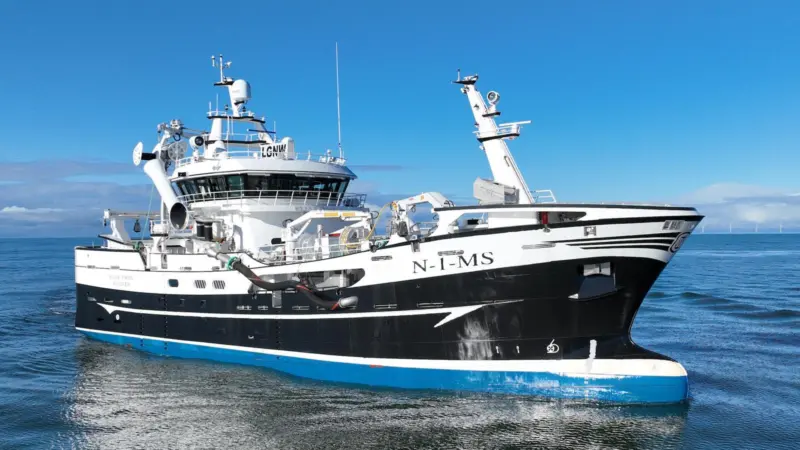
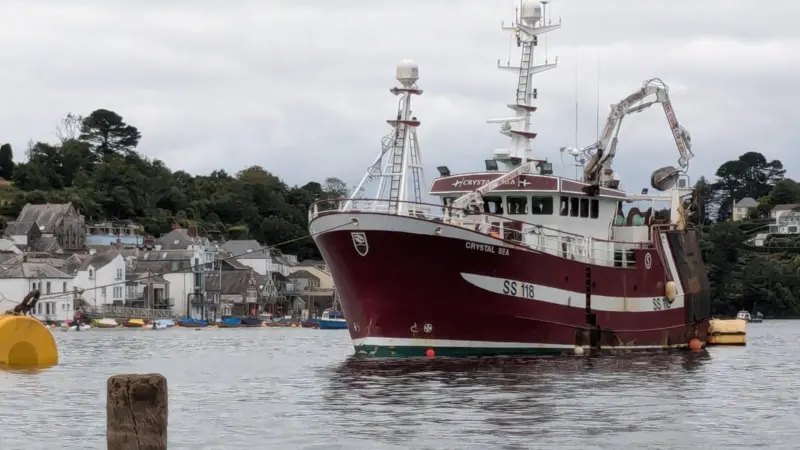
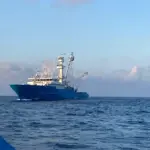
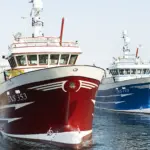
Containerships would seem to be the obvious candidates and Michael says they are the main long-term target. However the good news is that they are talking with a whole range of authorities from Brussels through an Italian MEP to the IMO, about starting with a 50-70 metre fishing vessel. These are major consumers of oil when trawling. Secondly, they could store compacted waste in various packaging in their empty holds and space previously occupied by liquid bunker, on the way out to fish as well as on the deck. They could also take on waste at sea from refuelling barge ships of course (the same Greenlanders used to bunker their industrial trawlers at sea to avoid Danish port fuel tax). Michael says that adding three metres build to a 70-metre vessel would even out the one litre: three-litre fuel to waste differential.
In addition, with most new trawlers and long-liners doing processing on board of the catch, most of the fish waste, including difficult to extract oils, could be extruded into a pressure spray and burn very well in the furnace.
This would be even more attractive for factory ships where there is often a problem of handling excess waste after products such as fishfeed meal has been extracted after the high-value fillet products have been through gutting.
Colleagues on World Fishing’s sister publication The Motor Ship are more expert in these matters but it is fair to say that the maintenance issues associated with banks of diesel engines, particularly at sea, are far more complex than straight steam to power conversion systems. So there should be major savings on that front, as well as the long-term issue of replacement diesel engines.
Michael says they are due to hold more talks next month in Brussels about EU support. They are a tiny team with a big and simple idea. There must be some smart, multi-millionaire shipowner out there in the fishing sector who wants to become famous as the first to follow WEST’s motto ‘un passo indietro verso il futuro’ — “A step back into the future!”