



Cabo Verde accepts WTO fisheries subsidies agreement
Cabo Verde has officially deposited its instrument of acceptance of the World Trade Organisation’s (WTO) Agreement on Fisheries Subsidies, with the West African country’s instrument of acceptance bringing the total number of WTO members to have formally accepted the agreement to 56. The WTO now has 51% of what is needed for the agreement to come into effect (two-thirds of the WTO membership).
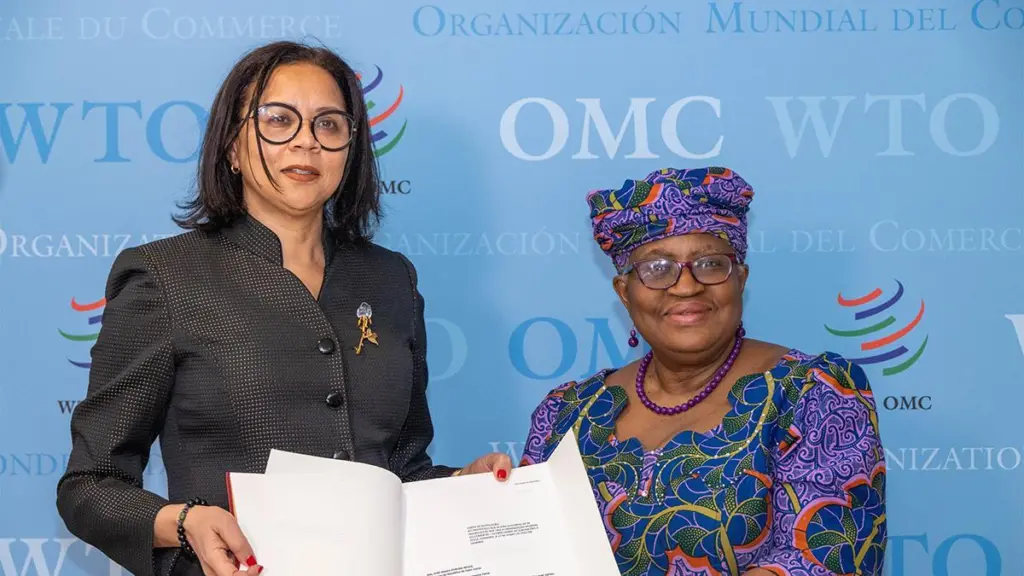
WTO Director-General Ngozi Okonjo-Iweala said she was delighted that Cabo Verde had formally accepted the agreement.
“The significance of coastal fisheries to Cabo Verde cannot be overstated: 80% of its people reside along the coast, and these waters sustain food security and livelihoods as well as the wider national economy. We look forward to witnessing the positive impact of the agreement on the well-being of Cabo Verde’s coastal communities, and hope more WTO members will follow suit so that this important agreement enters into force soon,” she said.
Cabo Verde Ambassador Clara Manuela da Luz Delgado Jesus, who presented the instrument of acceptance to Okonjo-Iweala on 26 January 2024 said her country has a vested interest in a healthy and effective management of the ocean’s fisheries resources.
“I am glad to note that the WTO Protocol on Fisheries Subsidies goes in this direction. Cabo Verde has, therefore, taken the decision to formally accept this protocol. I am sure that this protocol will greatly contribute to the reinforcement of measures to protect and preserve fisheries.”
Delgado added that Cabo Verde is looking forward to the protocol’s early entry into force.
“To that end, we respectfully encourage other states that have not done so to join us by depositing their instrument of acceptance of this protocol as well,” she said.
Adopted by consensus at the WTO’s 12th Ministerial Conference (MC12), held in Geneva on 12-17 June 2022, the Agreement on Fisheries Subsidies sets new, binding, multilateral rules to curb harmful subsidies, which are a key factor in the widespread depletion of the world’s fish stocks.
In addition, the agreement recognises the needs of developing and least-developed countries and establishes a fund to provide technical assistance and capacity building to help them implement the obligations.
The agreement prohibits support for illegal, unreported and unregulated (IUU) fishing, bans support for fishing overfished stocks and ends subsidies for fishing on the unregulated high seas.
Members also agreed at MC12 to continue negotiations on outstanding issues, with a view to making recommendations by MC13, to be held in February 2024 in Abu Dhabi, United Arab Emirates, for additional provisions that would further enhance the disciplines of the agreement.
Related Articles
 FISHERIES
 FISHERIES
 FISHERIES