




Scottish farmer first with BioMar’s latest feed
Small-scale, low-impact salmon farmer Loch Duart has confirmed it has switched its feed to BioMar’s new Blue Impact diet that the aquafeed producer launched last year. The northwest Scotland company is the first salmon producer to use the diet.
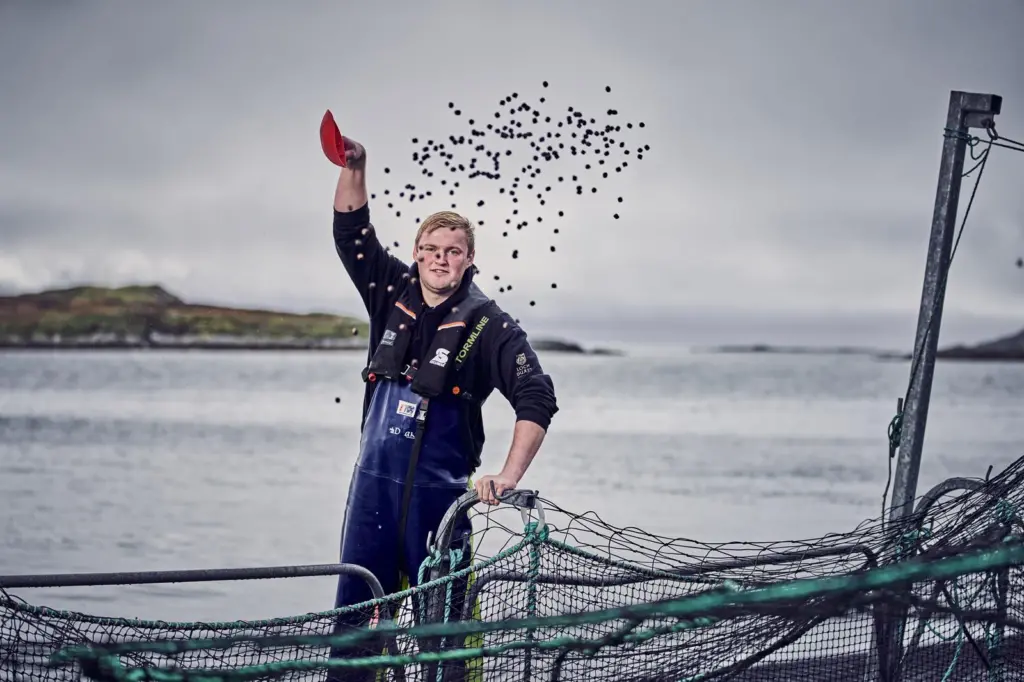
Blue Impact is BioMar’s global brand dedicated to sustainability and driving continuous change in aquaculture. It is centred around aquafeeds lowering carbon emissions, utilising more circular and restorative raw materials and minimising ingredients derived from wild fish stocks.
Loch Duart Managing Director Mark Warrington said BioMar’s holistic approach to sustainability, with Blue Impact addressing multiple sustainability challenges in the industry, was a key driver for the feed change.
“At Loch Duart, we are serious about reducing our impact on the planet because it’s the right thing to do. With this switch in feed, we will take another major step in the right direction while further improving the health and quality of our unrivalled Scottish salmon,” he said.
The producer’s sales director Chris Orr explained that Loch Duart firmly believes in feeding its fish what they naturally want to eat – a diet high in marine content, and also that this shouldn’t come at the expense of the environment.
“BioMar’s Blue Impact will not only reduce our carbon footprint but will help reduce the fish forage dependency ratio (FFDR) by increasing the use of circular ingredients and responsibly managing the world’s resources. This increases the sustainability of how we raise our salmon without compromising the taste, texture, or high omega-3 levels that our customers love, and Loch Duart is famous for,” Orr said.
Loch Duart has calculated that using the Blue Impact feed, its carbon footprint from feed production is now below 2kg CO2 eq/kg, compared to the standard farmed salmon average of 3.5kg CO2 eq/kg.
The feed that has been specially commissioned for Loch Duart, uses a minimum of 75% of marine ingredients from by-products from UK fish processing. Furthermore, the FFDR is now 0.7, which is around half of the current average levels for standard farmed salmon.
“Blue Impact is our flagship diet dedicated to sustainability,” BioMar UK Business Unit Director Robert Wilson said. “We have defined distinct sustainability parameters based on our BioSustain programme to measure the sustainability of this diet and we will continue to implement improvements year-on-year to ensure sustainable development to transform aquaculture.
“We are looking forward to starting this sustainability journey with Loch Duart and constantly challenging each other to find new and innovative ways to improve the sustainability of the entire value chain,” he said.
Loch Duart produces 6,000 tonnes of salmon each year from its farms in Sutherland and the Outer Hebrides. The independent company employs 160 people in the Western Isles, Sutherland and Ross and Cromarty.
BioMar operates 17 feed factories across the globe in Norway, Chile, Denmark, Scotland, Spain, France, Greece, Turkey, China, Vietnam, Costa Rica, Ecuador and Australia.
Related Articles
 AQUACULTURE
 AQUACULTURE
 FISHERIES