






E-Guardian Angel on your watch
Should you drop down dead while driving a train on the London Underground, the ‘dead man’s handle’ will be released and bring the train to a halt. Cambridge University scientists have now come up with a much more sophisticated ‘visual’ system which could be a boon to helmsmen and mates on those long, night bridge watches, reports Peter O’Neill.
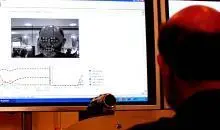
Peter Robinson, Professor of Computer Technology, speaking exclusively to World Fishing at the Royal Society Summer Science Exhibition, says they developed the system to ‘mind read’ what emotional and physical state people were in. Obvious applications are drivers nodding off at night on a motorway, for example.
Imagine you are alone on the bridge of a small trawler. You have your regular screens in front of you. In addition, there is a cheap, £15 webcam stuck on top of the map screen. The ‘picture’ of different movements of your eyes, nose, lips, grimaces etc., are fed into your regular PC [see Prof Robinson’s face in the photo]. When a sea monster, or ghost ship rises up in front of you, the camera/PC will see that you are surprised. You could have already chosen to set an alarm which only beeps for you on the bridge. Or it could trigger an alarm across the vessel so that others know immediately something is wrong. It would have to be loud enough not to be drowned out by the latest episode of Aliens from Grimsby being watched on satellite TV in the galley.
The ideal place for the cheap camera is straight in front of you. But, provided the face is almost all in the screen he says it could also work anywhere on deck.
So, you might be in control of winching , and spot a cable beginning to peel which, if it snapped, could catch someone. Your facial concern would be picked by the E-Guardian Angel and, depending on what setting you were on, trigger an alarm so all crew looked around, saw what might be going wrong, and sprang out of harm’s way.
For training crew in port manoeuvring or pair-trawl handling, the system could also indicate when the amount of information the trainee is having to process gets too much for them. The trainer could step in calmly and assist – without destroying the trainee’s confidence and indeed build it up for next time the pressure is on. So the range of situations can go from the helmsman dropping down dead on the job to learning which crew are best at keeping their cool under extreme circumstances.
Prof. Robinson is insistent that “it is just an extra. That’s the right way to think of it. The main use of this is when someone is interacting with the equipment on the bridge. If they are getting, say, a display from the satellite navigation or whatever, but they are confused, this would be able to tell that and be able to help.” That help could be a buzz alarm, or a voice talking. . “It gives you probabilities of different mental states… you could recheck the information etc.”
He says it would not need a lot of costly equipment to set up whatever you wanted. Developing such applications would be for someone else to research. “It depends on the various things that can go wrong on the bridge,” he said.
It can also confirm that things are going well – when the helmsman’s face shows he has reached and past a known wreck or seamount area, it would recognise contentment or relief. Similarly, if someone is thinking very hard about the information on the screen, that would show in their face and could indicate there is doubt building up about the validity of the information. Instead of waiting say five minutes, they might be stimulated to call a colleague to double check the data and maybe avoid losing a trawl.
To quantify the degree of reaction he says “We use a classification of emotions, that has something like 412 different, very finely divided elements, developed by a chap called Simon Baron-Cohen [Professor of Developmental Psychopathology at the University of Cambridge, not Ali G, but his cousin]. All we do when we are setting up a particular system, is choose a set of …these 412 which are useful for that particular application, say distraction or tiredness for car drivers.”
Portside, it could work for a crane operator or container controller who sees something going wrong way down below. The ‘adrenalin’ reaction on his face could trigger a quayside alarm, or voice announcement, almost instantaneously, by radio signal.
World Fishing had to ask whether it would be regarded as a ‘spy camera’ and suggested that the crew, not the owners, would have to say: ‘Yes, this is good’.
“It is a bit like when they were given satellite navigation systems which tracked where the boat was. Yes, indeed, there are ethical problems there,” he said.
The project is not tied to any commercial company but part of the UK Medical Research Council’s operations. The great advantage for the smaller vessel is that skipper and crew who are close friends may often push themselves to the limit to reduce work and stress on their colleagues. A quick beep from the E-Guardian Angel to say someone really must take a break would benefit ship safety as a whole. And you could always turn it on or off as you wish.
Related Articles
 FISHING TECHNOLOGY
 FISHING TECHNOLOGY
 COMMENT