





Discount supermarket chain scores well on seafood
Discount supermarkets are not always what they might seem. They have a justified reputation for selling food and other products at rock bottom prices, so it could be assumed that quality would suffer as a result.
However, recent blind taste tests have shown that this can be far from accurate. Lidl, a fast growing German owned discount chain in the UK, came out top when its seafood products were directly compared with those from a major manufacturer.
In its ‘biggest ever independent blind test’, Lidl asked more than 9,000 people in 14 locations throughout the UK to taste and give their opinion of two very comparable products.
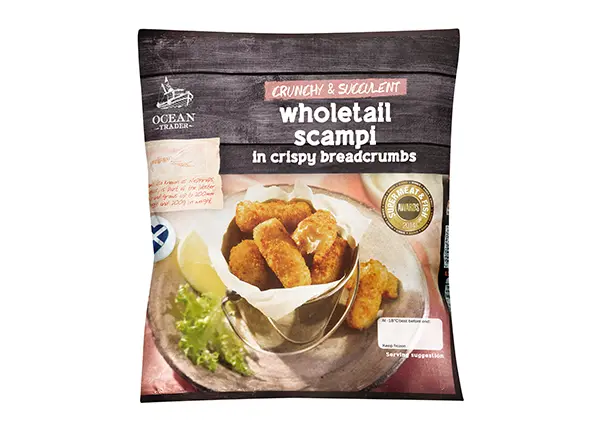
Lidl’s Ocean Trader wholetail scampi (Nephrops norvegicus tails) in crispy breadcrumbs was tasted alongside Young’s Wholetail Scampi for a television advertisement in Blackpool in May. Needless to say Lidl picked the most favourable comments to broadcast, but the overall reaction was that the product sold by Lidl was far better.
Not only was it judged to be superior in taste, it was also considerably cheaper than the one manufactured by Young’s. The Lidl 250g pack cost £1.95, equivalent to £7.80 per kg, while the 220g pack from Young’s was on sale at £2.77 which works out at £12.59 per kg.
According to Lidl each product pair was taste tested by at least 400 people.
The blind product comparison taste test results were published at the same time as the Grocer trade magazine Own Label Food & Drink Awards results. Two Lidl seafood products took top honours in these awards: Laschinger Hot Smoked Salmon Fillet and another Ocean Trader product, Lightly Dusted Seeded Haddock Fillet. Each product was tasted by a consumer testing panel followed by an ‘expert’ testing.
Market share
Discount supermarket chains such as Lidl and Aldi, have continued to increase their share of the British grocery market at the expense of the top UK supermarkets. According to research firm Kantar Worldpanel, Lidl grew by 11.3%, while Aldi grew by 16.6% during the 12 weeks ending 28 July, meaning both have moved to new market share highs of 5.6% and 4.0% respectively.
Lidl became established in the UK in 1994 and it now has more than 600 stores in the country with more planned. The company says it offers customers ‘a range of the very best quality fish, at low affordable prices’.
Like other UK supermarkets, Lidl emphasises its support of sustainable fishing and sells seafood products certified by the Marine Stewardship Council (MSC). Rupert Howes, MSC chief executive, says: “Lidl brought out its first MSC fish products in October 2006 and has continually expanded its range of MSC products since then.
“In co-operation with the MSC, Lidl targets its suppliers to make the environmental standards of the MSC better known and offers incentives for MSC-certified products.”
Mr Howes doesn’t say what these incentives are, but since Lidl sells its fish products at considerably lower prices than other UK supermarkets, price probably isn’t one of them.
Related Articles
 SEAFOOD
 SEAFOOD
 PROCESSING & REFRIGERATION