





Chinas white fish exports force European processors to develop new products
Since the mid-1980s China has become the world’s workshop with new factories being set up every year to manufacture toys, garments, textiles, consumer electronics and many other items for export. The vast army of low cost labour available to these factories has been a major factor supporting industrial growth in China including the development of the food processing industry.
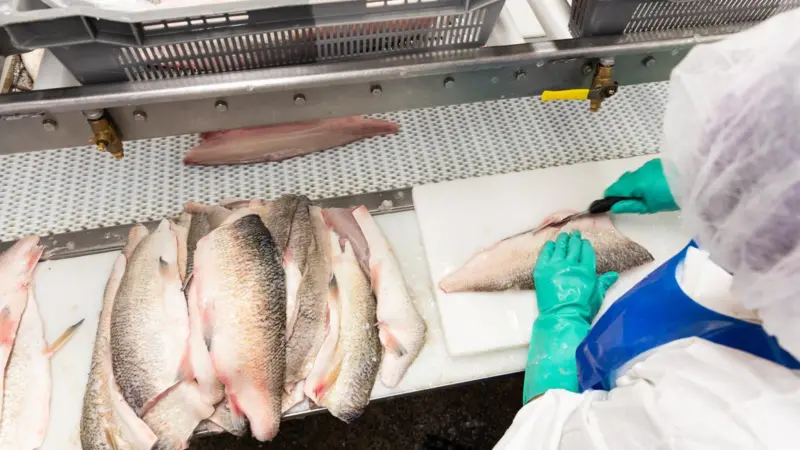
Cutting, filleting, skewering, wrapping and other manual food preparation tasks can be carried out at highly competitive rates in China for which mechanised production processors are the only cost effective solution in Europe, the United States and Japan. One consequence has been the development of China’s large seafood processing industry that is causing problems for fishery processing companies in Europe and other traditional production centers.
China is estimated to have more than 100 fishery processing plants that supply high quality filleted and processed white fish and other fishery products using fish and seafood items sourced from around the world. Although fishing communities exist all along the Chinese coastline, the fish processing industry has developed mostly in Shandong and Liaoning provinces in north and northeastern China which are the traditional center of China’s deep sea fishing industry.
Qingdao on the Shandong peninsular, Dalian on the Dalian peninsular in Liaoning Province and Xiamen in southern Fujian Province are China’s main fish processing centres. Although the three cities are traditional fishing ports, fishery processing for export is a comparatively new industry started in the 1990s.
Many fishery processing plants and filleting operations started up as joint ventures set up by foreign companies with Chinese partners. However, the fish processing industry now includes wholly Chinese-owned plants as well as 100 per cent foreign-owned companies operated by European, Japanese and American companies.
In addition to frozen white fish fillets, many processing companies offer a range of products including items catering to different geographical markets which allow changes to be made in product lines supplied according to which raw fish materials are available.
The growth of China’s export orientated fish processing industry has caused large problems for the European fish processing industry in the same way that China’s garment, toy, consumer electronics and electrical appliance manufacturing industries have undercut traditional producers in Europe and elsewhere. Norway, Iceland and other traditional European fish processing centers have been affected by the growth of China’s processed fish exports which have caused the loss of jobs as European processors have been forced to mechanise production and reduce labour costs.
Competitive advantages
“Fish filleting started about six years ago and competes with Norway’s industry. The problem is China’s cheap labour. The cost of filleting is cheaper here,” Jan Fossberg says. According to him the monthly wages in China are now about RMB 800 to RMB 1,000 (£1 = RMB 15.3) per person working 10 hours daily for six days a week, though these wages have increased from about RMB 500 to RMB 600 monthly three years ago. “One Norwegian worker earns the salary of 25 Chinese workers. Everything here is cut by hand and the processors are getting a better yield than cutting by machine; so there are two benefits — lower wage costs and better cutting yields,” he adds.
China’s fish processing plants are staffed largely by young women that are recruited from farming communities in rural areas. The young women work at the factories for two to three years where they live in dormitories and save their earnings. After their contracts are over, the women return to their home towns with their savings where they are considered highly eligible brides.
“The problem for Norwegian processors is imported frozen fish filleting. The Chinese processors defrost the fish, fillet and freeze them again,” Fossberg said. “Norwegians are doing the same thing, so they are competing on the same terms for the same products; but with China’s low costs they have lost their competitiveness. China has a very high production standard. From a hygiene and food safety view point they are doing high standard exports.”
New strategies
The Norwegian fish processing industry began to notice the impact of China’s growing fishery processing industry about five years ago. Realising that they were not able to compete with Chinese exporters on labour intensive processed fish products, Norwegian processors decided to adopt a different strategy and focus production on fresh fish products and value added frozen items such as fish fingers.
According to Fossberg, Norway is focusing on fresh fish concepts such as vacuum packing. “There is limited shelf life, but it is longer than on ice. For some companies this is going well. They do traditional filleting, but vacuum packing allows the filleting cost to be absorbed as China cannot compete with vacuum packed products because of transport costs,” he says.
The rapid expansion of China’s fish processing industry has created a production overcapacity due to a global shortage of fish and other fishery products. To utilise underused production facilities a number of leading Chinese processing companies recently have moved into the value added products and, once again, are expected to place European processors under fierce price competition.
Companies are moving towards value added products such as breaded products and fish fingers which are a huge volume business in Europe. “In May 2004 the companies were just considering doing this. By October they had already started doing it. They still have some way to go in quality, but it is just a matter of time. The fish pieces are not a perfect shape but they will learn quickly,” says Fossberg.
This time, however, he believes that renewed competition between Chinese and European fishery processors will lead to a new relationship between the two industries. Rather than the continuation of simple price competition over basic fish products in which Chinese exporters enjoy a large price advantage over most European processors, Fossberg expects the situation to develop to the point where European and Chinese fish processors begin to cooperate to supply the European market as a degree of accommodation evolves between the two sides.
“Chinese exporters’ target is Europe, the United States and Japan. They will go more towards value added products, but they do not have the market knowledge or market,” Fossberg said. “The Chinese industry will evolve more from a trading base to an interactive basis with European counterparts. There will be more partnering. The situation will move from fighting over price to more working partnerships — financial or other cooperation. That will be the natural development.”
“I think companies in Norway and Europe will develop this naturally. Europe will have to reorganise and find a fish processing production base where they do not fight China as they will have a hard battle. They need to be proactive in this competitive climate to have a viable business.”
Meanwhile, after focusing entirely on exporting initially, China’s fish processing industry is developing in a similar manner to many of the country’s other export industries including consumer electronics and electrical appliances. Initially established for export only, many manufacturers eventually begin to look for domestic market sales opportunities as local consumer spending grows in major cities.
“The seafood industry was purely an export industry but it is starting to go into the local market as there are large retailers here like Walmart, Carrefour, Lotus/Tesco and it will grow,” Fossberg forecasted. “Some say maybe it is too early but others say there are big retail requirements in the frozen goods section which is an urban phenomenon. The east coast is the driving force for the economy.”
Raw material
Meanwhile, the rapid expansion of China’s fish filleting industry has created a large increase in demand for raw fish materials. Some processing companies operate their own deep sea fishing fleets while others buy in their requirements from the global fish trading market. A large number of local trading companies of all sizes are involved in supplying fish to the processing industry.
Fisheries production in China’s own waters has faced serious problems during the past decade from overfishing and growing marine pollution from industrial and agricultural effluent, oil discharge and other pollutants. In 2004 the Ministry of Agriculture published regulations to curb overfishing and the illegal discharge of pollutants into 78,000 square kilometre Bohai Sea.
In 1986 about 19,800 fishing boats fished the Bohai Sea according to ministry figures. By 2003 the number of fishing vessels had reached 29,200.
Dwindling domestic fisheries production has forced many Chinese fish processing companies to seek raw fish supplies worldwide. Chinese distant water fishing companies have signed contracts to fish in African waters and elsewhere where local fishing is not so well developed.
Salmon
While China’s processed white fish exports are causing problems for the European processing industry, Norwegian salmon farmers are planning to increase their exports of fresh salmon to China. According to Fossberg exports of fresh airflown Norwegian salmon to China and Hong Kong now total about 200 tonnes a week and continue to increase. By comparison, exports of fresh salmon to Japan total 400 tonnes a week.
Fresh salmon first began to be used in five star hotels in China in the 1990s. “A lot of China’s fresh salmon imports are used for sushi and sashimi in hotels and Japanese restaurants,” Fossberg said.
China’s modern retail sector is of growing interest to the Norwegian salmon industry. Today there are estimated to be about 1,000 hypermarkets in China. Foreign-owned stores include Makro, Metro, Lotus of Thailand, Jusco of Japan and Antimart of Taiwan. Regional Chinese hypermarket groups also have sprung up such as Homeworld of Beijing. Local retailers that originally were official government grocery distributors and owned small shops are also building large retail outlets.
“Our job is to establish salmon in these stores,” Fossberg explained, noting that he also is the Norwegian Seafood Export Council’s director for China and South Korea. “We use a pull strategy. We convince the stores that salmon is profitable, but that it requires product management; so we work with them for training. The new Chinese middle class is buying salmon to cook Chinese style, European style and to use as sashimi.”
As part of the Council’s recent marketing initiatives, a banquet was organised for 300 people at the Sheraton Great Wall hotel in Beijing where 50 dishes using salmon were served in various national styles including Chinese, Japanese, Korean, Indian, European, Malaysian and Thai.
“This is our Global Delicacy project. We offer free training to stores including foreign owned stores,” Fossberg said. “We expect to sell 12,000 tons of fresh salmon to China in 2004 and 40,000 tons annually in five years time.”
Salmon is one fisheries product for which Norwegian fishermen currently do not have to fear competition from China. Fossberg noted that Chinese companies have tried to begin salmon farming in the Dalian area but that efforts have proved unsuccessful as salmon farming in addition to cold water requires a natural water current which is not present in northern Chinese waters.
Related Articles
 PROCESSING & REFRIGERATION
 PROCESSING & REFRIGERATION
 PROCESSING & REFRIGERATION