


Aquaculture meeting growing demand
Aquaculture is the worlds fastest-growing source of animal protein and currently provides nearly half of all fish consumed globally, according to a report published by FAO.
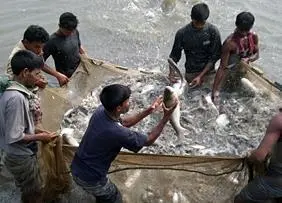
The report World Aquaculture 2010 found that global production of fish from aquaculture grew more than 60% between 2000 and 2008, from 32.4 million tonnes to 52.5 million tonnes.
It also forecasts that by 2012 more than 50% of the world’s food fish consumption will come from aquaculture.
With its growth in volume and value, aquaculture has helped reduce poverty and improve food security in many parts of the world. However, differences in production levels, species composition and farming systems exist within and between regions, and from one country to another.
The Asia-Pacific region dominates the sector – in 2008 it accounted for 89.1% of global production, with China alone contributing 62.3%. Of the 15 leading aquaculture-producing countries, 11 are in the Asia-Pacific region.
A few countries lead the production of some major species, such as China with carp; China, Thailand, Viet Nam, Indonesia and India with shrimps and prawns; and Norway and Chile with salmon.
In terms of farming systems, intensive systems are more prevalent in North America and in advanced aquaculture-producing countries in Europe and Latin America. In the Asia-Pacific region, despite major technical developments, small-scale commercial producers remain the backbone of the sector.
Small-scale producers and small and medium entrepreneurs are also important players in Africa. Commercial and industrial-scale producers dominate in Latin America, but there is strong potential for the development of small-scale production.
There is growing recognition of the need to address consumers’ concerns for quality and safe products and animal health and welfare, therefore, issues such as food safety, traceability, certification and ecolabelling are assuming growing importance and considered as high priorities by many governments, the report said.
Aside from environmental sustainability, other major challenges faced by aquaculture include climate change and the global economic downturn, the report noted. The sector should therefore prepare itself to face their potential impacts and make special efforts to further assist small-scale producers by organising them into associations and through promotion of better management practices.
“Achieving the global aquaculture sector’s long-term goal of economic, social and environmental sustainability depends primarily on continued commitments by governments to provide and support a good governance framework for the sector,” the report added.
Related Articles
 FISHERIES
 FISHERIES
 WORLD FISHING EVENTS