

Fishery research vessels for NOAA
Considered among the world’s most technologically advanced fisheries research vessels, these sister ships will join the ‘Oscar Dyson’, first of the class, which was commissioned in May of 2005.
According to Rear Admiral Samuel P. De Bow Jr., director of NOAA’s Office of Marine and Aviation Operations, “With this new class of vessel, NOAA is increasing the efficiency of its fisheries research with state-of-the art technology. These ships are so quiet, for example, that we expect scientists to be able to study fish and marine mammals with little impact on their behavior.”
State-of-the-art design
First of the four in service is the ‘Oscar Dyson’. It is a state-of-the-art research ship capable of conducting a wide variety of fisheries and oceanographic research. Foremost among these capabilities is acoustic quieting technology, which will enable NOAA scientists to monitor fish populations without altering their behavior.
‘Oscar Dyson’ will support NOAA’s mission to protect, restore, and manage the use of living marine, coastal, and ocean resources and will conduct projects for NOAA’s Alaska Fisheries Science Center and the Pacific Marine Environmental Laboratory. The primary objective will be to study and monitor Alaskan Pollock and other fisheries in the Bering Sea and Gulf of Alaska. The ship will also observe weather, conduct oceanographic research and habitat assessments, and survey marine mammal and bird populations.
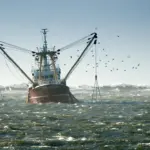
‘Oscar Dyson’ is designed as a stern trawler with a capability comparable to those of commercial trawlers. The ship can trawl to depths of 1,800m. Smaller sampling nets and towed fishing gear can be deployed from various winches over the stern or starboard sampling station A-frames. Longlining and trap fishing can also be accomplished from these two locations.
Centerboard sonar
Modern fisheries management relies heavily on sonar systems. The most critical system onboard the new vessels is the Scientific Sonar System, which can accurately measure the biomass of fish in the survey area. The System, and various oceanographic hydrophones, are located on a retractable centerboard (drop keel) so that critical transducers can be lowered away from the ship out of the region of hull-generated flow noise. This enables the ship to move the hydrophones away from the ship’s hull, which enhances the quality of the data collected.
Multidisciplinary oceanographic operations can be conducted in support of biological, chemical, and physical process studies. The ship can complete oceanographic research consisting of deployment/recovering of floating and bottom-moored sensors arrays. It has a traction-type oceanographic winch that can deploy up to 5,000m of 17mm wire rope or other cable in conjunction with the large stern A-frame.
Two hydrographic winches serve the side sampling station via the side A-frame. Each can deploy 3,500m of 9.5mm electro-mechanical wire so that two scientific packages can be rigged and ready for sequential operations. Water conductivity, temperature, and fluorescence can be measured as a function of depth using the hydrographic winches and CTD system.
In addition, capabilities are available for handling specialised gear such as MOCNESS frames, towed vehicles, dredges, and bottom corers. Surface currents are measured with an Acoustic Doppler Current Profiler, while a multi-beam sonar system provides information on the content of the water column and on the type and topography of the seafloor while underway.