




Christina S cuts a dash
The lines of new Christina S FR-224 are unmistakeably those of the Karstensen yard in Skagen, which has in recent years delivered a series of highly advanced pelagic vessels to fishing owners around the North-West Atlantic, characterised by high capacity, super-efficient cooling systems and the most economic possible use of energy.
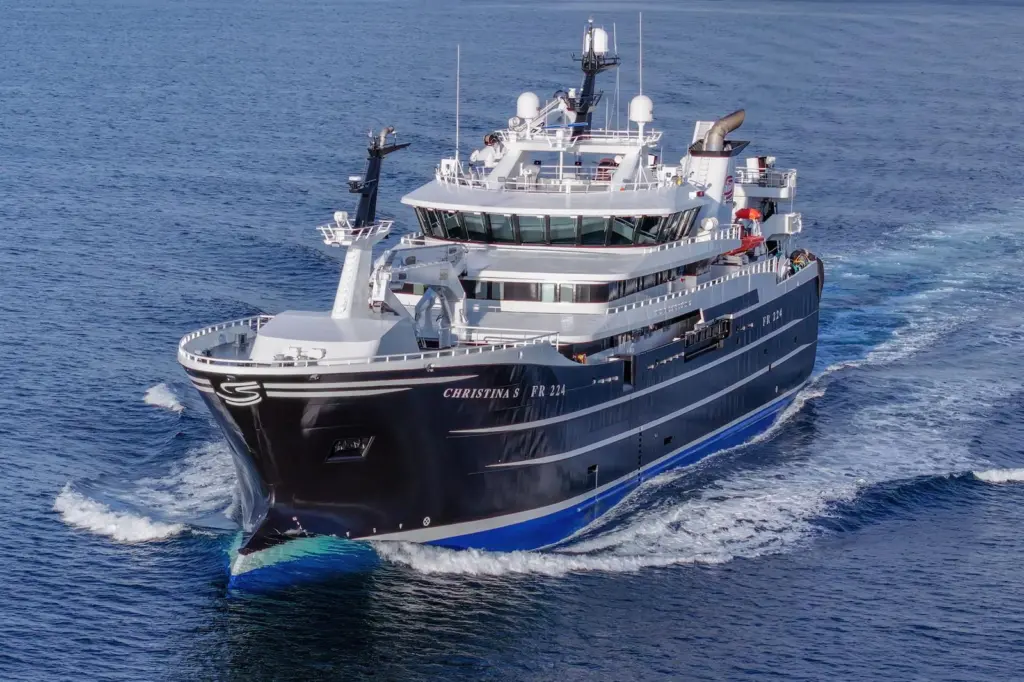
Alongside these ambitious targets in terms of efficiency and economy of operation, working and living conditions are fitted out to an exceptionally high standard. None of this comes cheap, and as with other Karstensen newbuilds, no expense has been spared in outfitting with the latest and most effective technology.
The 77-metre by 15.6-metre breadth Christina S is the yard’s own design, fine-tuned in collaboration with the customer, and is a dedicated pelagic trawler with a 2,350 cubic metre carrying capacity in its 11 RSW tanks, built to target herring, mackerel and blue whiting on much the same pattern as its predecessor. The previous Christina S was built in 2008 at the Fitjar Mek Verksted yard in Norway, and this 72-metre vessel is now fishing for its Icelandic owners as Margrét EA-710.
The Simpson family has a relationship with the Karstensen yard going back 30 years, with a number of their vessels have been regular callers in Skagen over the years for repairs and maintenance, but this is their first collaboration on a newbuild.
Ernie Simpson has headed the family business for the last five decades, taking command of his first new vessel in 1976 under tough circumstances. He has since taken a step back and the role of skipper and manager has been passed to his son Allan Simpson.
Proven power and propulsion
The hull of the new vessel was fabricated and partially outfitted at the in Gdynia at the Karstensen Shipyard Poland, with a steel hull topped with aluminium wheelhouse, boat deck, funnel and masts. From there it was towed to Skagen for the later stages of outfitting.
The propulsion and power setup onboard Christina S is along similar lines to previous installations for Karstensen newbuilds, with the 7320kW Wärtsilä main engine providing the primary power source for both propulsion and the hydraulics – working on the principle that when full power is needed for the deck layout, there’s less demand for propulsive power.
This is an all-Wärtsilä installation, with the 12V31 main engine powering a 4200mm 4G1190 propeller via an SCV 100/2-PDC68 reduction gearbox with a Cummins AvK, 2800kW/3500kVA shaft generator run on a PTO.
When the winch system is in use, the gearbox PTO is clutched in, and electrical power is supplied from the shaft alternator. During normal towing, the shaft alternator can be disengaged from switchboard, and the electrical power is supplied by either of the 940kWe Caterpillar C32 gensets. In addition, there’s a Scania DI09 harbour set.
The gensets are able to connect into main switchboard, controlled by the vessel’s DEIF Power-Management-System. A bus-bar breaker is fitted in the main switchboard, allowing the Brunvoll FU-63 aft thruster to be fed off shaft alternator and the AR-63 retractable forward thrusters and the vessel’s hotel load from powered from the diesel generator sets. The electrical power system is fitted for sliding frequency (60-50 Hz), by means of frequency converters for 400/440V and for 230V. This allows the main engine and propeller revolutions to be reduced with up to 17%.
Christina S has a two-step gearbox providing fixed revolutions of 138 and 116rpm. On sea trials, this arrangement delivered speeds of 18.2 and 16.5 knots.
Comprehensive outfitting
The deck equipment package comes from Killybegs company SeaQuest. The trawl winches are a pair of 91-tonne pull units, managed by a SeaQuest autotrawl unit, and there are two 110-tonne net drums in a waterfall configuration, aligned to the aft gate and hydraulically-operated guide pins, plus a 71-tonne topline winch, a 57-tonne tail-end winch and a netsounder winch mounted on the gallows top. The nine mooring winches and the anchor windlass are part of the SeaQuest package.
Christina S has a pair of 20-inch fish pumps, delivered with the associated hydraulic and fish hose reels. There’s a pair of fore deck cranes, as well as an aft net crane mounted to starboard over the trawl deck and a crane mounted on the aft gallows to deploy the fish pumps.
Catches are pumped onboard and pass through the separator before being routed to the selected RSW tanks. Johnson Controls supplied the twin 1506kW/1.295.000kCal/h RSW systems, and the vacuum system with two 4200-litre tanks is from C-Flow.
Accommodation has been completed by Maritime Montering and on main deck level this consists of three single and two twin cabins. There are four more single cabins and a sick bay in the superstructure, alongside the changing room and oilskin store, gym and steam room. Six more cabins are located at boat deck level and the crew’s day room/lounge, cinema, mess room, galley with provision room and separate fridge/freezer rooms are all located within Christina S’s deckhouse.
The 360° visibility wheelhouse onboard Christina S is outfitted by the yard’s own team, and places three Nor-Sap wheelhouse chairs facing the array of screens comprising the Furuno Blue Bridge display, and within consoles placing key system controls within easy reach, in addition there is a control position aft, overlooking the trawl deck.
There are nine 55-inch, 14 32-inch and four 27-inch Hatteland screens placed around the wheelhouse for the array of electronics supplied by Furuno UK and Woodsons.
The key fishfinders are the Furuno sonars, a low-frequency FSV-25, the medium-frequency FSV-85 and a high-frequency FSV-75, plus the trawl-mounted FS-70 sonar from Simrad. Sounders are a Simrad ES80, plus Furuno FCV-38, FSS3-BB and DFF-1 sets, the 3D set is an 80kHz WASSP unit and the current indicator is a Furuno CI68. A Scanmar installation with a package of sensors is used to monitor the trawl gear.
As well as the Furuno FMD-3200 ecdis, Christina S has a pair of MaxSea Time Zero plotters and an Olex 3D unit. The radars, GPS and AIS are all Furuno equipment. The gyro compasses are a pair of Simrad RGC-80 units and the autopilot is an AP-70. GPS compasses are a JRC JLR-21 and a Furuno SC-70.
Furuno supplied the A3 area GMDSS installation and the VHFs, as well as the VR-7000 VDR. There are two Sailor 900 V-sat systems, and Sailor also supplied the satellite TV.
Related Articles
 VESSELS & SHIPYARDS
 VESSELS & SHIPYARDS
 NEW VESSELS