



Collaborators develop mass production eel seedling tank
Japan Fisheries Research and Education Agency (FRA), Yanmar Holdings Co Ltd and Marino-Forum 21 have jointly developed a new tank for the mass production of Japanese eel (Anguilla japonica) seedlings. The initiative is part of a Fisheries Agency-commissioned project titled “Demonstration of Mass-Production System for Commercialization of Eel Seedlings.”
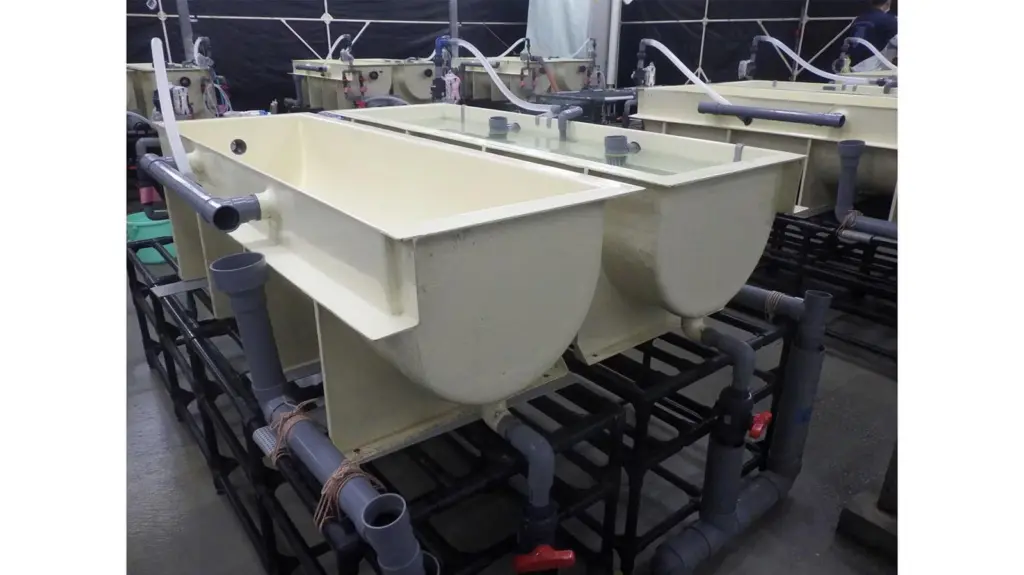
The newly-developed tank successfully produced approximately 1,000 glass eels per tank and achieved a significant reduction in rearing costs. It is made of fibre-reinforced plastic (FRP), making it more cost-effective and suitable for mass production compared to conventional acrylic or polyvinyl tanks.
Future enhancements, including improved tank design, more advanced rearing methods, and the development of an automatic feeding system, are expected to facilitate the broader implementation of artificially produced eel seedlings. The results of this research have been patented under the title “Tank and Device for Rearing Fish Larvae”.
Since the world’s first artificial hatching of Japanese eel larvae by Hokkaido University in 1973, numerous institutions have pursued eel larviculture. FRA’s predecessor developed a method in the early 1990s using shark egg-based feed and 5-litre acrylic bowl tanks. These innovations led to the world’s first successful artificial seedling production of eels in 2002, followed by full-cycle aquaculture – including breeding of parent eels produced from artificial seedlings – in 2010.
However, eel aquaculture still largely relies on wild glass eel collection, which has become increasingly scarce and expensive. To address this, FRA, Yanmar HD and Marino-Forum 21 launched a Fisheries Agency project in 2017 to develop a mass production system that could support the commercialisation of artificial eel seedlings.
Traditional rearing tanks (5–20 litres) yielded only 20–80 glass eels per tank. A larger, 1,000-litre semicylindrical tank was previously developed, but production per tank remained in the hundreds – less efficient per volume than small tanks. Moreover, tanks made from acrylic or PVC were costly and difficult to produce at scale. This highlighted the need for a more efficient and affordable tank for mass production.
Most existing eel larval tanks are horizontally oriented cylinders with an open top. Researchers tested six tank variations with differing diameters and lengths to analyse their impact on eel growth and survival. Results showed that increasing the diameter beyond 50cm reduced growth and survival rates, while extending the tank’s length had no adverse effects and allowed more larvae to be reared.
Using these findings and Yanmar HD’s fluid analysis, the team designed a new tank measuring 40cm in diameter and 150cm in length. Short-term rearing trials demonstrated that growth and survival rates matched or exceeded those in small tanks, with the ability to consistently rear thousands of larvae.
Recognising the need for scalable, low-cost production, the team adopted FRP for the tank material due to its durability and affordability. The structure was refined for simplified assembly and operational ease. Two long-term trials confirmed the new tank could produce around 1,000 glass eels per tank. The production efficiency per volume was comparable to smaller tanks.
With approximately four tanks manageable per operator and a drastically lower production cost per eel – estimated to be one-twentieth that of previous large tanks – the new design is expected to become a foundational technology for large-scale eel seedling production.
Plans are also underway with Yanmar Group to commercialise the tanks.
Meanwhile, to further reduce glass eel production costs and enable large-scale seedling supply, ongoing efforts will focus on larger tanks, advanced rearing technologies, automation, and energy-efficient systems. These efforts are part of the 2023 Fisheries Agency project “Practical Application of Mass Production Systems for the Commercialization of Eel Seedlings”, which aims to make affordable, high-volume artificial eel production a reality.
Related Articles
 AQUACULTURE
 AQUACULTURE
 AQUACULTURE