




WTO urged to protect small-scale fishers
A panel of experts has called for differential treatment of developing nations on the World Trade Organisation’s (WTO) Agreement on Fisheries Subsidies, emphasising the need to protect the livelihoods of millions of small-scale fishermen while India negotiates at the platform.
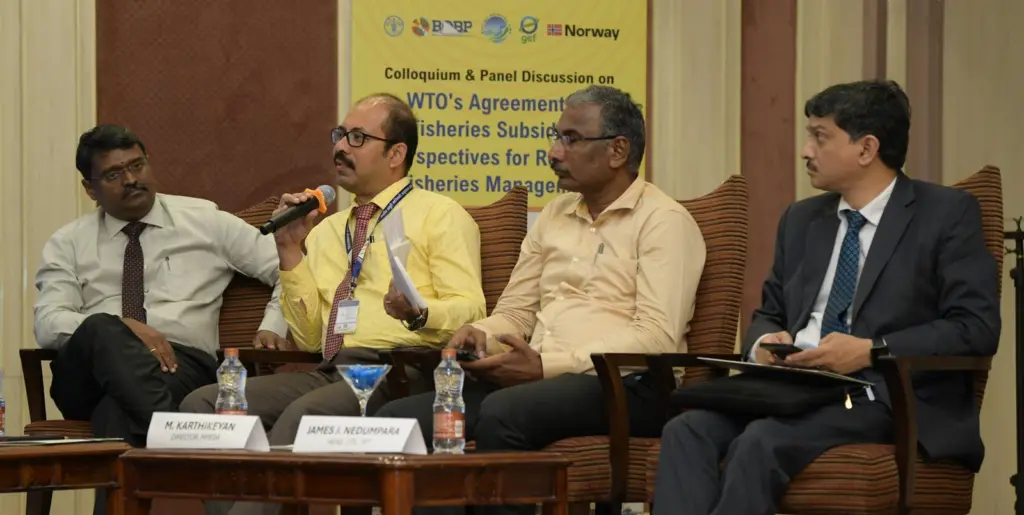
Fishery scientists, economists and experts on trade, investment and law attended a recent meeting organised by the Bay of Bengal Programme- Inter-Governmental Organisation (BOBP-IGO) in association with ICAR-Central Marine Fisheries Research Institute (CMFRI), Marine Product Export Development Authority (MPEDA) and other organisations.
Citing the disparity in the economic growth of the sector in developed and developing nations, CMFRI Director Dr Grinson George said: “Historically, these subsidies enabled developed countries to build large industrial fleets, causing significant environmental impacts and inequalities in resource distribution”.
Compared to this, India’s fish catch is predominantly small-scale based, making it a matter of food security and livelihood, advised George, insisting that the negotiations on this agreement should therefore focus on protecting the small-scale and artisanal fishers while encouraging sustainable growth in the fisheries sector.
A representative of the Food and Agriculture Organisation (FAO) of the United Nations expressed optimism about the WTO agreement, saying it could promote sustainability in the sector by curbing illegal, unreported, and unregulated (IUU) fishing and over-exploitation.
Pinar Karkaya, Economist at FAO Liaison Office in Geneva, also explained the legal and practical implications of the agreement.
Prof James J Nedumpara at the Centre for Trade and Investment Law of the Indian Institute for Foreign Trade (IIFT) flagged concerns over some aspects of the WTO agreement, saying that strong scientific backing is required to identify overfishing, overfished stocks and IUU fishing as mentioned in the agreement.
He also said regional fisheries management organisations (RFMOs) such as BOBP could play a crucial role in capacity building and sustainability assessment, fostering collaboration of countries at the regional level.
The experts also observed India’s subsidies are minimal compared to major fishing nations like China.
Related Articles
 SUSTAINABILITY
 FISHERIES
 FISHERIES