





Europêche: ICCAT makes progress despite Asian opposition
The 28th annual meeting of the International Commission for the Conservation of Atlantic Tunas (ICCAT), held in New Cairo, Egypt, ended on 20 November 2023 with the adoption of a total allowable catch (TAC) for North Atlantic albacore tuna of 47,251 tonnes – representing an increase of 25%.
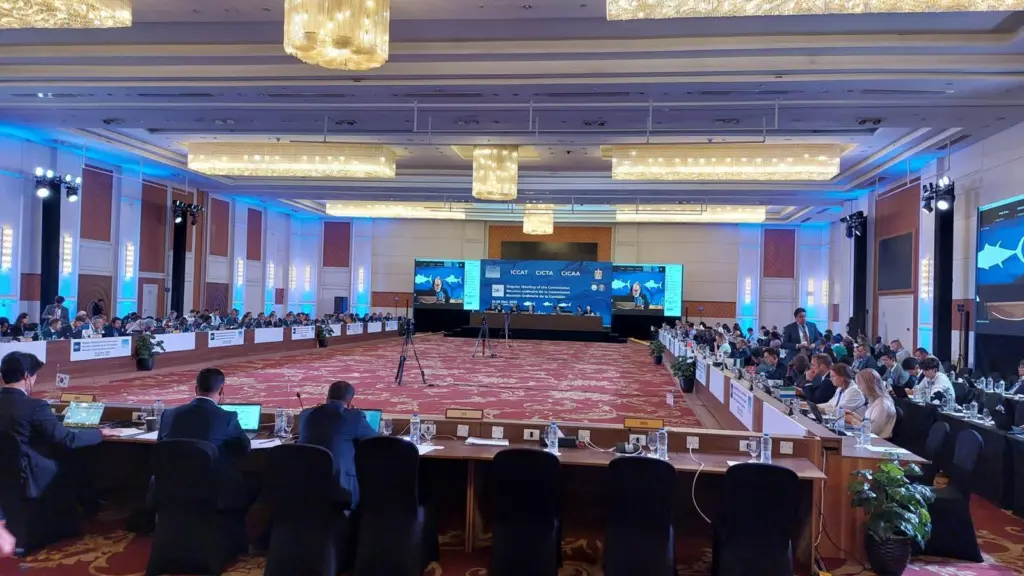
Representing the European fishing fleet at ICCAT, fishing industry body Europêche explained this was possible thanks to the scientific data evidencing the good health of the stock and the management and conservation measures implemented over several years.
“This is good news for the European fleet and the result of our fishers’ unwavering dedication in adhering to and implementing strict regulations,” Europêche Managing Director Daniel Voces said.
Also at the meeting, ICCAT adopted a TAC of 27,711 tonnes for the South Atlantic blue shark. But for the north stock, ICCAT decided to cut the TAC by 23% (from 39,000 to 30,000 tonnes). Europêche highlighted that this reduction was made despite the stock not being overfished and with overfishing deemed not to be occurring.
Europêche President Javier Garat expressed fears the decision “will add unjustified burden to the EU fishing industry”, which he said has made “significantly more efforts than other fleets” in reducing fishing effort while increasing reporting and monitoring at sea.
“As always, they will endure the consequences of strict management while other fleets will continue business as usual. We hope this changes now,” Garat said.
Europêche also highlighted that with regards to shark finning, Japan opposed and vetoed the European Union’s proposal for a recommendation concerning the conservation of sharks caught in association with fisheries managed by ICCAT. This included the obligation to provide more data to scientists and to land fins naturally attached to carcasses.
European fishing fleets have followed a ban on shark finning since 2003 and since 2013 the fins attached policy.
“While I note with satisfaction the growing number of co-sponsors on this conservation measure year on year, discussions have been on-going for 15 years now; it is time to approve the fins attached policy to guarantee the ban on shark finning,” Garat said.
For bigeye, while the stock evaluation allowed for an increase of the TAC up to 75,000 tonnes, corresponding to a 64% probability of remaining in the green quadrant of the Kobe matrix, ICCAT parties opted for a more cautious approach by adopting a rollover at 62,000 tonnes until a new allocation is determined.
Unfortunately, the ICCAT’s Commission has failed to adopt such a new scheme for the last two years, said Europêche.
“It is paramount to adopt a new allocation scheme ensuring both the possibility for developing countries to benefit from quota increases, and a certain stability for existing fleets, like the EU purse seine fleet which contributes to the local economies through fisheries agreements, use of port facilities and plants supply,” Europêche Tuna Group President Xavier Leduc said.
“While this would be perfectly possible with a potential increase of the TAC increased and the redistribution of unused fishing opportunities, Japan is reluctant to redistribute its long-term unused catch quotas to developing states. We hope that the working group on allocation will facilitate progress on this matter. We also hope that next year, ICCAT’s Commission will seize the opportunity to raise observer coverage on longliners, which are limited to 10% while purse seiners are 100% observed, and to ban at sea transhipments.”
Europêche Tuna Group Director Anne-France Mattlet added: “It is important for ICCAT to keep improving its compliance process and to avoid rewarding with additional fishing opportunities contracting parties (CPCs) involved in recurrent over-catch and poor compliance records unless they show a strong commitment to revert the situation and provide proof of improvement.”
The fishing body also pointed out that the high-sea boarding and inspection scheme also wasn’t adopted, as several contracting parties were not satisfied with the proposal, including China.
Related Articles
 SUSTAINABILITY
 FISHERIES
 FISHERIES