
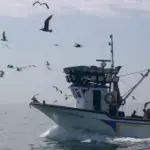


Listening to fisherman
Among the many problems that hound fisheries management is one that could be solved – as long as there is a personal and political will.
The problem is that too little attention is being paid to what fishermen have to say on the abundance, behaviour, and general state of the fish stocks they’re exploiting and on the factors affecting them, even though they are the ones making the observations and are the ones with direct experience. This is also the case with fisheries management, especially where the fishermen have managed their fisheries without the government’s help (even though governments assume that without it there would be no fish left in the ocean).
There’s no doubt in my mind that if the assessment and management scientists and officials spent more time with fishermen on board their vessels and in wharf-side pubs and bars, the state of the fisheries they were dealing with could be in a much better condition.
The book “Life on the Edge” written by Quentin Bates, a commercial fisherman turned journalist, (Hutton Press, 2001, 144p, also: www.abebooks.co.uk) is the product of listening to fishermen, and observing and documenting their work aboard five different fishing boats from four different British ports and one open sea beaching site. Although, it’s some seven years since the author wrote the book, the sea is the same sea, the fishermen are the same fishermen, their methods are the same methods, and most of the problems are the same problems. This book is still as relevant as ever.
The little volume, illustrated with well-targeted snapshots, is about how British fishermen do their gillnetting, trawling, cockle dredging and purse seining, and how they handle and land their catch. Interested readers will find some excellent plain language narratives. Here, I will only expand over what some of the fishermen told the author about fish and their own and official management.
“Anecdotal information”
The term “anecdotal information” can be heard, especially whenever official science and management wish to disregard information and opinions coming from fishermen, especially when such information would put a question mark on their model-based methodology. But an observant and experienced fisherman can in many cases put a finger on the real causality of phenomena for which the “best available science” has only one explanation: fishing.
When on board the gillnetter “Sandra” operated from the Stade beach at Hastings, Quentin listened to her skipper, Paul Joy, talking about availability of dover sole. “Fish like dover sole are governed by the sea temperature. If you don’t get cold winters, you don’t get the fish. The fish migrate to spawn as soon as the temperature comes up, but if you don’t get the cold spells, the migration back again doesn’t happen”. And: “We’ve had some warm winters for the last few year [prior to 1998], and the soles have not been showing up”.
On management
Hastings fishermen have their own society – HFPS – which manages the fishery to ensure that over-capacity is not an issue. HFPS allocates the beach-landing tracks and sites at the Stades where the boats lie, and no new ones are allocated until one is vacated.
Paul Joy sticks another nail in the coffin of the “Tragedy of the commons” theory, which claimed that fishermen must compete and keep increasing their fishing efforts until stocks are exhausted: “It keeps the status quo and ensures that there’s no extra pressure. It’s been so for the last 50 years and that way we don’t build up a fleet that’s too big for the stocks”. Hear, hear, ye quota groupies!
Les Snell, skipper of “Sophie Jayne”, a cockle dredger from Leigh-on-Sea, spoke about combined quota and days-at-sea management, and how it affects safety and catches: “We’re allowed to fish for two days a week out of Monday, Tuesday or Thursday, when we’d like to see it open for two days out of 4 or even 5. What happens is that if the weather is bad on a Monday and keeps the boats in, you know you’ve got to go on Tuesday and Thursday or lose out. It forces us to go when the weather isn’t really fit for fishing”. Skipper Snell also told him that the rules do not allow for effort increase when stocks recover. When it happens, the management can issue new licences rather than let established fishermen fish more.
There was more to learn about the quota management consequences on board “Courage”, a Fraseburgh purse seiner. It appears that black landings were common in those years and that a boat that practiced them was more attractive to crews, as they were boosting their earnings, but none of them would take a journalist on board.
Playing “catch up”
Fishermen are well aware of the time gap between what happens in real time and the management’s reaction. In skipper George West’s own words: “The fishing patterns move much faster than legislation can catch up. It’s constantly behind the times. You can see a change happening, and than it takes two years for a trend to be identified.” When the fishermen eventually can talk about the change with “their people” the latter must “take it to Europe”…
Basically, fishing can be flexible and “nomadic” as far as boats’ size and range permits. This flexibility is curbed by the quota system, but can be exercised on “non-pressure” stocks.
A skipper of a Whitby trawler was telling about “fair weather fishermen” who would crew a boat only when the fishing is good, “but when the fish are scarcer, so are crew”. It seems that a self-adjusting effort mechanism is inherent in more than one fishery. On board the trawler, Quentin was disturbed by the amount of the discarded small fish and amazed by the technique of trawling one trawl-board each side of and along undersea pipelines that evidently attract fish.
I recommend this book to both lay readers wishing to gain some knowledge on the fishing trade and techniques, and to fishery scientists and officers of all sorts, who might wish to improve their understanding of what makes fishermen tick.
benyami@actcom.net.il