



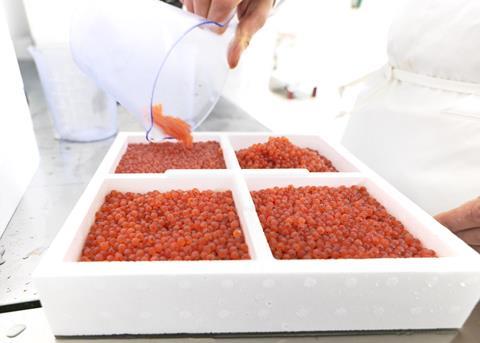
Benchmark Genetics Chile (BGCL) has successfully produced its first batch of locally produced ova known as SagaChile – a significant step in its improved genetic material.
Established in 2018, Benchmark Genetics Chile is part of the Genetics division of Benchmark Holdings plc (BMK) headquartered in Sheffield, UK. Under the division are seven companies that offer breeding and genetic products as well as technical services, with experience in 30 applied breeding programmes involving 20 species in 16 countries.
In late 2020, Benchmark Holdings hit the headlines with the announcement of a new strain of salmon ova called SagaChile. Over the years, Benchmark Genetics Chile has made numerous efforts to develop a new variety of ova that are generated locally and can respond to the requirements and particularities of Chile’s salmon aquaculture. The major focus of the new strain is balanced improved growth with late maturation, molecular markers of quantitative trait locus (QTL) for the Infectious Pancreatic Necrosis virus (IPN) and genomic selection for increased resistance against diseases such as Piscirickettsiosis (SRS), Caligus and Bacterial Kidney Disease (BKD).
“By supplying the best quality, high-performing genetics to the Chilean market and adapting and implementing our global capabilities, experience and knowledge to Chile’s salmon farming industry, we’re committed to contributing to salmon industry growth in the world’s second-largest salmon-producing country,” said Pablo Mazo, General Manager at Benchmark Genetics Chile.
“In order to realise our vision, we had to use locally produced ova with genetics that are adapted to the specific challenges met by Chilean salmon producers on a daily basis. Based on our latest field performance data, we’re sure that through this new strain, we will be able to help them improve their results, efficiency and sustainability.”
Production of the SagaChile strain was a long process with a very detailed production plan in relation to temperature, photo regime and the highest levels of biosecurity that were maintained with strict sanitary and quality protocols. Because the complete life cycle, from egg to egg, is fully controlled, maintaining focus through all life stages of salmon production was crucial. Two aspects of production were particularly important – the genotyping of the animals in a breeding nucleus, which enables accurate genomic selection for desired traits, and disease challenges against the main pathogens that are present in Chile.
“So far, the performance data have been in line with our expectations,” Pablo Mazo said.
“They show that SagaChile is performing at a high level and is robust to BKD and SRS with good growth and a high yield per smolt, reaching an average of 5kg/smolt at harvest. It appears to be a very competitive strain.”
In Europe, Benchmark Genetics’s European strains Salmobreed and Stofnfiskur are the result of continuous and systematic development that has been applied to the company’s long-established breeding programmes. This is recognised by the industry in Europe, where 51% of the salmon produced has Benchmark Genetics’s genetic imprint in them. All this knowledge and experience has now been transferred and specially adapted to SagaChile, placing local genetic selection at the forefront of the industry and at a high level. The main difference between Europe and Chile is that SagaChile’s production cycle takes place entirely on land, while in Europe, the fish are placed in seawater for on-growing.
“For the Chilean salmon industry, fast growth, overall robustness against sea lice, SRS, BKD and IPN and low maturation rates are crucial traits and SagaChile is performing competitively to these,” he said.
“Additionally, and following our strategy of breeding for today and the future, we are challenging our nucleus against piscine orthoreovirus (PRV) as it’s becoming an increasingly important disease in Chile. Advanced technologies such as QTL and genomic selection allow us to produced balanced genetic progress in these traits for SagaChile. This results in a cost-effective production with higher economic returns for the producer and maintains animal health and welfare.”
Having successfully concluded the first local egg production of the SagaChile strain, Benchmark Genetics began to market the new ova in Chile in January 2021. Almost six months on, Pablo Mazo says that there has been a remarkable interest and it’s becoming increasingly clear that the Chilean salmon aquaculture industry has a strong wish for another supplier to enter the ova market. While the Salmobreed and Stofnfiskur strains continue to be commercialised in the rest of the world, Benchmark Genetics is currently improving its production capacity and facilities standards in Chile, setting the same operational standards as those in Iceland and Norway and implementing cryopreservation, which offers enormous improvement potential.
“SagaChile has been well received and welcomed by the Chilean salmon industry,” he said.
“For now, however, it is important for Benchmark Genetics to further develop the strain specifically for the local industry before thinking about going further afield. We will continue this work by focusing on developing and improving the strain so it is specially adapted to the environment and market demands of the Chilean industry, and expect to make a significant impact in the years to come, achieving in Chile the same success that we have achieved in other parts of the world.”
There are firm hopes that for salmon farming as a whole, SagaChile will enable Chilean aquaculture to benefit and put more pressure on other suppliers when it comes to their product development. Going forward, Benchmark Genetics is aiming to offer close technical collaboration with its customers and a high performing product that sets new standards in biosecurity, egg quality and year-round supply.
“Our immediate plans are to scale up volumes, carry out more field trials, collect and analyse performance data and prove that SagaChile is an excellent local strain, with Benchmark Genetics as an excellent partner for the Chilean industry,” Pablo Mazo said.