



WWF: new approach to IUU fishing
WWF’s Smart Fishing Initiative has presented a new, simple, effective and inexpensive way to use satellite data to monitor global fisheries activities and curb illegal, unreported and unregulated (IUU) fishing.
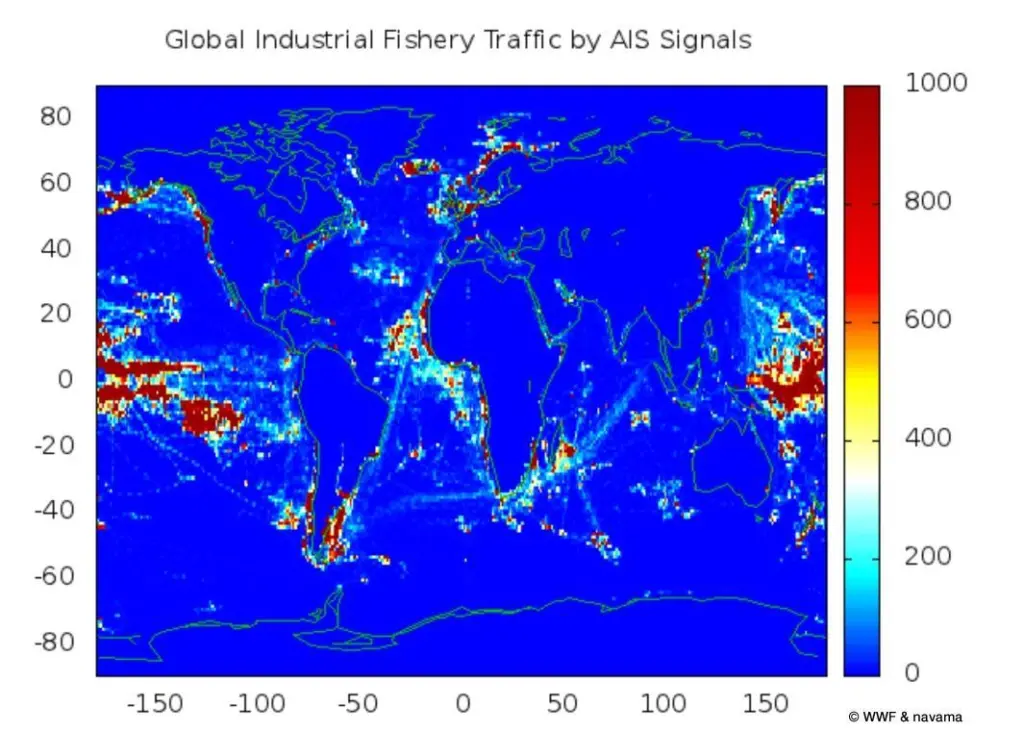
Using the ‘Automatic Identification System’ (AIS) introduced by the International Maritime Organization (IMO) in December 2000 for safety reasons, WWF shows how AIS data will enable governments and Regional Fisheries Management Organisations (RFMOs) to retrace the routes and fishing activities of vessels all over the world, improving sustainable fisheries management in national waters, and on the high seas, by revealing where IUU activity could potentially be taking place.
WWF evaluated AIS data of the last one and a half years from satellite operator ORBCOMM, using a specific methodology developed by the Smart Fishing Initiative, and found out it has become possible to retrace the routes and activities of fishing vessels, including vessels that are suspected of illegal fishing.
“We wanted to find out what is really happening out there when vessels are fishing and trans-shipping on the high seas”, says Alfred Schumm, leader of WWF´s Smart Fishing Initiative. “After all, illegal and uncontrolled fishing is a hard nut to crack – it causes ecological and economic damage worldwide that affects all of us; fishing communities, fishing companies, governments, buyers and consumers.”
“We found that the satellite AIS is a reliable supplier of data to improve transparency in all fishing practices taking place in national waters and on the high seas,” explains Mr Schumm. “Governments all over the world should make this system mandatory for every commercial fishing vessel. At the moment, the IMO only requires mandatory installation of the AIS system for ships over 300 metric tonnes, but not for fishing vessels”.
WWF is urging the European Union, national governments, RFMOs as well as States flagging fishing vessels operating on the high seas, to adopt as soon as possible mandatory installation of the AIS system on all fishing vessels under their flag, in addition to monitoring and control (M&C) measures currently being used, such as Vessel Monitoring Systems (VMS).
Related Articles
 FISHERIES
 FISHERIES
 WORLD FISHING EVENTS